
Australia and Oceania
______________________________________________
Diffuse Energy: maturing micro wind turbines, one turbine at a time
Ayoub Hameedi
Wind energy technology can really help us in achieving a sustainable future where we would produce 100% of our electricity from clean sources of power production. It has already been proven as an excellent match for solar PV technology. As per the Global Wind Energy Council (GWEC), roughly 78 GWs of new wind power generation capacity was connected to grid in 2022, thus bringing the cumulative global installed wind power capacity to 906 GWs. It is a commonly known fact that on-shore windpower projects require substantial amount of time and financial resources to be assembled in the first step and then getting connected to grid and producing electricity in the second step. Likewise, offshore wind power projects are even more complicated in nature and thus requires even higher of a financial resource and time due to an increased complexity of project. However, if we can somehow manage to reduce both the cost and the required finances to assemble wind power projects, this creative solution can really help us in an exponential growth of windpower as a sector in countries across the globe. This is exactly what this short report is all about.
Diffuse Energy is an Australian startup that is working on to mature micro wind turbines that can practically be installed anywhere without any problem, within no time, requires least financial investment and can produce clean electricity on immediate basis. This innovative solution is referred to as Hyland 920 wind turbine system and it has an installed capacity of 220 watts per micro wind turbine. One of the biggest benefit of Hyland 920 wind turbine system is that it can easily be installed on telecommunication towers, roof tops and along with already installed solar PV projects. The video given below is an intellectual property of Australian Renewable Energy Agency and is shared here for educational purpose only:
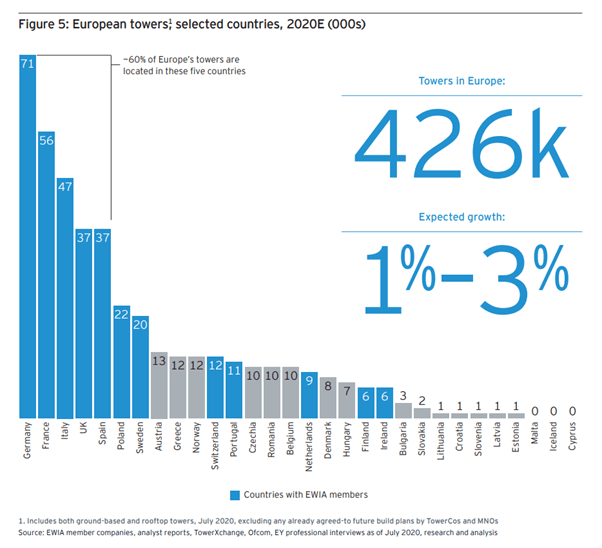
As per an Ernst & Young report (2020), there were 426,000 telecommunication towers in Europe and a lion’s share of which almost 60% were installed only in Germany, France, Italy, UK and Spain. Poland had another 22,000 telecommunication towers installed followed by Sweden with another 20,000 installed telecommunication towers respectively. The graph given below is an intellectual property of Ernst & Young:
Hyland 920 wind turbine system can really initiate a green revolution when it comes putting a dent in greenhouse gases emission curve from already installed telecommunication towers across Europe. In order to bend the emissions curve in Europe, we must consider each and every sector in the continent, no matter how big or small it is. As per International Energy Agency (IEA), data centres and transmission networks causes 1% of energy related greenhouse gas emissions. Every piece in the puzzle makes a significant difference and thus should get equal attention from policy makers in Europe. Likewise, As per European Commission, there were 9.1 million farms in European Union in 2020 that altogether represented almost 38% of the total land area of the European Union. Just imagine, that each of the available farm in European Union will have these micro wind turbines installed to satisfy their energy demand and to produce 100% of their needed electricity through clean sources. Similarly, just imagine, if each of the installed solar PV project in European Union will also blend in these micro wind turbines along with the row and rows of solar PV panels. These hybrid clean energy projects based on both solar PV and micro wind turbines will certainly boost our ability to produce even more clean electricity and to guide European Union into a 100% clean energy future. How can we forget rooftops in European Union. It would be great, if all of the rooftops in European Union (where possible) will have a combination of both solar PV panels and these micro wind turbines. By doing so, we can certainly turn our rooftops into micro-engines of clean electricity production. Yes, its possible provided we invest enough policy attention and financial resource in this direction.
Micro wind turbines can really help Australia, European Union and rest of the world to create a sustainable future for all. These are small in size, does not require much financial resource, can be installed quickly and immediately starts generating electricity. There is a high probability that when blended in with the solar PV panels, these micro turbines can amplify an overall clean energy production and can support solar PV panels during cloudy days with extreme winds. It would be a win-win situation for every stakeholder in the process. I personally believe that policy makers in European Union must implement each clean energy solution that can help the Union in putting a dent in its greenhouse gases emission curve. Yes European Union can beat the emissions curve and it can create a sustainable future for all of its almost 448.4 million inhabitants.
© Copyright 2024 Ayoub Hameedi. All rights reserved.
Australia can produce 100% clean electricity from renewable resources by 2030
Ayoub Hameedi
Government of Australia relies heavily on fossil fuels namely black coal, brown coal, natural gas and oil when it comes to electricity generation in the country. As per the Department of Climate Change, Energy, the Environment and Water, Australia produced roughly 40% of its total electricity from black coal in 2021. The country produced another 11% of its electricity from brown coal, followed by 18% from natural gas and roughly 2% from oil. Altogether, Australia produced a lion’s share of its electricity 71% from fossil fuels in 2021. On the contrary, the country produced the remaining 29% of electricity from renewable resources. This highlights the dire need for Australia to minimize its unsustainable reliance on fossil fuels and to exponentially increase its dependence on clean sources of power production like solar PV, wind power and marine energy technologies. A future scenario where Australia would produce all its electricity from renewable resources is realistic and possible provided enough policy attention and financial resources are invested in this direction. Australia has the much needed solar and wind power generation potential in place. In addition, solar PV and wind energy technologies are already mature in the country. Both already discussed factors paves the way for Australia into a future with no reliance on fossil fuels. This is what this short report is all about.
As per the Geoscience Australia, the continent receives the highest amount of solar radiation per square meter than any other continent. This makes Australia a country with one of the best available solar radiation potential in place. In-fact, the solar radiation potential of Australia is roughly 10,000 times more than its total energy consumption. So, we have the much-needed solar radiation potential in place. It is equally important to mention here that roof top solar PV system technology is already well established in Australia as 30% of the homes have solar PV systems on their rooftop. Altogether as per Australian PV institute, the country had a cumulative installed solar PV capacity of roughly 30 GWs at the end of December 2022. Keeping the installed solar PV capacity in mind, we can confidently say that solar PV technology is already mature in Australia. However, Australia can do better and it must do even better to bend its greenhouse gas emissions curve and to fight climate change. When compared with Australia, China had a cumulative installed solar PV capacity of 393 GWs close to the end of 2022. Likewise, as per International Renewable Energy Agency (IRENA), United States of America had a cumulative installed solar PV capacity of 113 GWs, followed by Japan with roughly 79 GWs, Germany with 66.5 GWs and India with 63 GWs of installed solar PV capacity at the end of 2022. Of course, Australia can choose to exponentially grow its installed solar PV capacity during this decade, so by the end of 2030, Australia would also have 150 – 200 GWs of installed solar PV capacity in place. If China and USA can make it happen, so can Australia as well.
Australia has an equally excellent potential for wind power generation as well. According to the Government of Australia’s website, the country has a long coastline of 60,000 kilometres that can be easily used to deploy both fixed and floating offshore wind farms. As per the Global Wind Energy Council (GWEC), Australia has an estimated offshore wind technical potential of 4963 GWs. A lion’s share of this potential roughly 3391 GWs exists in floating offshore wind farms whereas another 1572 GWs can be installed in the form of fixed offshore wind farms. Even if Australia successfully harness 10% of this offshore wind technical potential, it can easily install 500 GWs of offshore wind parks in its coastal areas. As per the Spanish Wind Energy Association, China had a cumulative installed wind power capacity of 329 GWs in 2021. Likewise, United States of America had a cumulative installed wind power capacity of 132.7 GWs in 2021. If China and USA can install hundreds of GWs of wind power capacity, so can Australia as well.
The choice is ours and will always be. Now imagine a scenario where Australia would have an installed renewable energy capacity of 700 GWs by the end of 2030. A lion’s share of this installed capacity around 500 GWs is from onshore and offshore wind parks whereas another 200 GWs is in the form of installed solar PV capacity. From a long-term strategic perspective, the Government of Australia should focus on building huge battery parks to store surplus clean electricity and to use it when needed. It would be equally great, if the Government of Australia would place a huge emphasis on maturing wave energy technology in the coming decade or two. A Danish company named WEPTOS is already maturing a wave energy technology solution and can thus help Government of Australia in this regard.
Summing up all, Australia can produce 100% clean electricity by 2030. It has the much-needed solar PV and wind power generation potential in place. Most importantly, both solar PV and wind power technologies are already matured in Australia as the former has an installed capacity of 30 GWs whereas, the latter has 9.1 GWs of installed onshore capacity. Now is the time for Australia to exponentially grow its installed solar PV capacity from 30 GWs to 200 GWs and to invest aggressively to ensure a combined offshore and onshore installed wind power capacity of 500 GWs in this decade. Yes, it is possible that Australia can have an installed 200 GWs of solar PV and 500 GWs of offshore and onshore wind power capacity by 2030. This would ensure a 100% clean electricity supply to households and businesses in Australia. It would also facilitate the country in exporting clean electricity to neighbouring countries and to earn a handsome revenue. The choice is ours and will always be.
© Copyright 2023 Ayoub Hameedi. All rights reserved.
SunDrive: An Australian start-up that might turned out to be an Achilles in our fight against climate change
The concentration of carbon dioxide gas in atmosphere (right now) is the highest we’ve ever seen. According to NASA, it was 418 parts per million on February 15, 2022. Just 17 years ago (on January 16, 2005), the concentration of CO2 was slightly above 378 parts per million. As a result of our unsustainable reliance on fossil fuels, we’ve managed to raise the concentration of CO2 gas by another 40 PPM. We all know that an increase in the concentration of CO2 gas in our atmosphere is raising the average temperature across the globe. This rapid increase in global average temperature is causing the climate to change. We all know that the glaciers on both sides of globe are melting at a pace never observed before. As per NASA, Antarctica and Greenland are melting six times faster right now than they did in 1990’s. This rapid increase is global average temperature is also giving species less time to adapt to changes occurring in climate. Consequently, species are getting extinct at a pace never seen before. We only have this decade to limit an increase in global average temperature and to minimize the negative impacts of climate change across the globe. In order to win our fight against climate change, we must reduce our greenhouse gases emission quickly through an increased reliance on solar and wind sources of power production. An excellent step in this regard would be to make efficient solar pv panels and wind turbines that would require less energy and natural resources during formation phase in factories and also are able to produce more electricity than the conventional solar pv panels and wind turbines. One such successful attempt has been made by SunDrive in Australia that has made an extremely efficient solar pv panels fulfilling all of the already discussed criteria’s.
SunDrive Solar was formed by Vincent Allen and David Hu in 2015 with the main aim to reduce the cost of solar pv panels and simultaneously increase the efficiency so that solar pv panels would produce more electricity with less installed infrastructure. As per Vincent Allen, a traditional solar cell is made of silver that is an expensive material and does not occur in abundance in nature. On the contrary, copper is relatively inexpensive and occurs much more abundantly in nature than silver. Thus, if silver would be replaced with copper in solar pv panels, their prices would certainly decrease even further. If we would combine a decrease in solar pv panels price with an increase in their efficiency, we would certainly make solar pv panels as the most suitable choice when it comes to installing new power plants in countries across the globe. This is exactly what Vincent Allen and David Hu have accomplished in reality. Their company SunDrive has started producing solar pv panels that are made of copper instead of silver and has also one of the highest efficiency levels, solar pv panels have ever achieved on a commercial scale. This is an excellent news for renewable energy sector in general and solar pv in specific.
As per International Energy Agency, countries across the globe installed a cumulative 133 GWs of solar pv capacity in 2020. A lion’s share of this installed capacity came online from China that installed slightly over 48 GWs of solar pv capacity. Next on the list was United States of America with 19.3 GWs followed by EU (including UK) with 19 GWs respectively. It must be appreciated but this should just be considered as a beginning of an energy transition that would help us in bending emissions curve, limiting temperature increase to 1.5 degrees and reducing the negative impacts of climate change.
Start-ups like SunDrive are a big ray of hope for us all in our fight against climate change. We can and we must achieve all of our goals outlined in Paris climate agreement. We have fixed environmental problems in our history. Ozone hole and The Montreal Protocol is an excellent example in this regard. We all came together, took much needed steps in the right direction and solved the already spoken environmental problem amicably. We can also do the same for limiting temperature increase to 1.5 degrees, bending the emissions curve and reducing the negative consequences of climate change. We know what needs to be done to solve the environmental issue of climate change and we have the needed technology in place too. All we need is a strong political will and businesses with an equally strong sense of corporate social responsibility to bend the emissions curve during this decade.
© Copyright 2022 Ayoub Hameedi. All rights reserved.
Bushfires in Australia is a strong reminder that we need to put a full stop to our unsustainable reliance on fossil fuels
Ayoub Hameedi
The on-going Bushfires in Australia highlights everything that is wrong with the climate change and why we need to take bold and serious actions to mitigate it. The bushfires that Australia is experiencing right now is one of the most severe in intensity in the history of the country. According to an article published in the Guardian newspaper on December 24 (2019), the bushfires are already on its way to create a new unfortunate history of devastation by over-shadowing the previously most damaging bushfires recorded in 1974. According to Time, the current bushfires have already burnt an area more than 12 million acres in Australia. This highlights the dire need for Prime Minister Scott Morrison to acknowledge that climate change is real and he needs to take serious actions to reduce greenhouse gases emission from Australia. The extreme negative impacts of climate change has already made its way in Australia where the unprecedented intensity and sheer magnitude of bushfires has killed nearly half a billion animals in the country.
One of the most heart-breaking thing about surfing internet these days is you find photographs containing horrible scenes that for the first glance makes you realize that you are watching content from HELL. Only to realize later that the photographs represents the sheer intensity of fires in Australia. I can recall a photograph from Matthew Abbott where the flames of the fires were following the trees from trunks, eventually making its way all across the branches to the top of the trees. In the first look (quite unfortunately), I (for a moment) thought that this would best portray how a forest in hell would look like. In my personal opinion, What Scott Morrison needs to understand is that there exist a direct relationship between the increased intensity of bushfires and climate change in Australia. According to Climate Council Australia, the estimated days for high to catastrophic fire risk for Melbourne has increased from roughly 32 days in 1870 to roughly 35 days in 2008. However, the experienced change is quite sharp after that as the number of days with high to catastrophic risk of fire increased to 50 days in 2010, jumping to estimated 60 days in 2060 and finally 80 days by the end of this century. It is extremely important to mention here that the concentration of carbon dioxide in atmosphere has also sharply increased from 378 parts-per-million in 2005 to 412 parts-per-million in November 2019. So, there exist a clear relationship between a rapidly increasing concentration of carbon dioxide in atmosphere and sharply increasing days of high to catastrophic risk of fires in Melbourne. Unfortunately, it is quite true for the rest of Australia too as 9 out of 10 hottest years in Australian history have occurred since 2005. An increased average temperature means less rainfall, that then leads to more drier conditions and thus makes areas more prone to bushfires.
Now the question comes to the most important point of what Scott Morrison can do as an elected Prime Minister of Australia. The country stands 16th on the scale of biggest GHGs emitter in the world. Unfortunately, it is also one of the largest exporter of coal and natural gas in the world too. According to the Reserve Bank of Australia, the country exported coal worth of USD 67 billion in 2018. Quite interestingly, India earned USD 137 billion through the exports from IT industry in 2019. India almost earned twice as much revenue through the exports from IT sector than Australia made through the export of coal. This portray a perfect example for Scott Morrison what Australia can also look like in future too, if Scott Morrison would take the Aussie economy away from coal and in the direction of IT and renewables. A 100% transition to solar pv, windpower and waste-to-energy in Australia would certainly reduce GHGs emission from the country. According to Geoscience Australia, the country receives 10,000 times more solar radiation than its total annual energy consumption. It would also be a big step in reducing the role of fossil fuels in the exports from Australia and diversifying export portfolio for the country. We have the required solutions, only thing we are missing in this case is political will. Scott Morrison, your political will to move Australia away from fossil fuels and towards clean energy can create a sustainable Australia for everyone to live in decades from now.
© Copyright 2020 Ayoub Hameedi. All rights reserved.
Australia can produce 100% clean electricity through solar pv, wind power and waste-to-energy sources by 2035
Ayoub Hameedi
This report is aimed to help the national government of Australia to upscale the installed renewable energy capacity in the country. It would present alternatives to replace conventional power production system with greener and more sustainable options. It is important to highlight here that solar pv, windpower and waste-to-energy sources are mature enough to satisfy 100% electricity requirement of Australia. In 2015 – 16, Australia generated around 83% of its electricity from fossil fuels where a lions share of around 63% was produced from coal. Another 20% of the electricity in Australia was generated through natural gas. Renewable resources produced over 16% of electricity where hydropower contributed 7%, windpower generated another 5% and solar pv produced the remaining 3%. This represents a wide gulf that exists between conventional and clean sources in the sector of power production in Australia. The Prime Minister really needs to focus on closing this gap initially and then eliminating the role of coal and natural gas completely from the equation.
Solar pv technology, windpower and waste-to-energy sources are mature enough to satisfy 100% of Australia’s electricity requirement in an environment-friendly way by 2035. Australia needs to up-scale the installed capacity of solar pv, windpower and waste-to-energy to a point where each of the aforementioned source would produce at-least 35% of the total electricity required by the country. It is important to mention here that Australia is amongst the mecca of solar energy as it receives the highest solar radiation per square meter in comparison to other continents across the globe. Thus, with right policies in place, solar pv can even produce over half of the total electricity demand and can prove to be the backbone of renewables in the country. A map reflecting solar pv potential of Australia is as follows:

In 2016, countries across the globe installed around 75 GWs of solar pv capacity where a lions share was installed in China, Germany, Japan, United States and Italy. It must be appreciated that the commutative installed solar pv capacity grew exponentially from 6 GWs in 2006 to 303 GWs in 2016. Thus, it can be concluded that solar pv as a mean to generate clean power is a mature technology and prioritizing solar pv on coal and natural gas would help Australian government to reduce its carbon footprint and to meet the goals outlined in Paris Climate Agreement. It is important to point out here that China has an installed cumulative solar pv capacity of 130 GWs. Likewise, Germany has installed over 45 GWs of solar pv, over 52 GWs of on-shore wind power and another 5.86 GWs as offshore wind power to generate clean electricity.
The story is the same for windpower. In 1973, producing electricity from off-shore and on-shore wind farms were a dream for Denmark. The country is now expected to produce 70% of its total electricity through windpower and other clean sources by 2022. So, in a span of 50 years, Denmark has developed windpower from an idea into a reality that acts as a backbone when it comes to clean power generation in the country. Apart from the production of clean electricity, the country also earns billions in revenue from the export of green energy technology that roughly makes around 6.7% of the total exports from Denmark. Australia can seek help from Denmark to upscale its installed windpower capacity to a point where it would generate at-least 35% of the total electricity consumed in the country.
Year 2016 was an equally good year for windpower where China added over 23 GWs, USA added over 8 GWs, Germany installed 5 GWs, India added 3.6 GWs and France added 1.6 GWs. The global cumulative installed windpower capacity observed an exponential growth from 74 GWs in 2006 to 487 GWs in 2016. Australia has one of the best conditions to produce windpower and it can certainly use its vast coastal areas to install offshore farms with larger turbines (e.g. a turbine with 8 MWs output capacity) to increase the share of clean energy in the overall energy mix of Australia. Denmark today has 20% less wind turbines than it had in 2001 however, during the same time period its installed capacity has increased two-fold. It has only been possible by upgrading the already installed turbines and installing bigger turbines in off-shore areas. Australia can choose to follow the same path to reap the same positive rewards.
Municipal solid waste is an extremely precious resource to produce clean electricity. Australia can consider Sweden as an example as it produces 3 MWs of energy (both heat and electricity) from each tonne of waste. In 2015, Sweden produced 17 terrawatt hours of energy from waste. A lions share of 14.7 twh was used for heating while the remaining 2.3 twh was consumed for electricity production. Sweden imports waste from Great Britain, Norway and Ireland. In 2000, it imposed landfill tax of SEK 250 per tonne, if the waste is sent to a landfill and in 2015, the aforementioned tax was doubled to SEK 500 per tonne. Australia can use its municipal solid waste to produce energy and can choose to import waste from New Zealand too for the sake of energy production.
All in all, expanding the installed solar pv capacity, onshore & offshore wind farms and waste-to-energy power plants can help Australia to meet all of its electricity demand through clean sources of power production. Simultaneously, Australia needs to invest money to promote energy efficiency, so that more could be achieved through less resources. The government also needs to give subsidies to promote research and development within wave-power, so that 30 years from now Australia could export this technology to earn revenue. Wind power and Denmark is an excellent example when it comes to maturing a technology through subsidies and using it to increase export to earn revenue. Australia can produce 100% clean electricity by 2035, provided given proper policy attention, priority and financial resources are channelized in this direction. By doing so, Australia would certainly create an excellent example for OECD and rest of the world to follow.
© Copyright 2018 Ayoub Hameedi. All rights reserved.
Solar photovoltaic technology is the future for Australia
Ayoub Hameedi
In 21st century, a swift transition from conventional sources of power production to renewable resources is a reality. It is a goal that is absolutely realistic and achievable provided proper time, finances and policy attention are diverted in this direction. There are several countries across the globe that are taking right policy measures to promote clean sources of power production to reduce their greenhouse gases emission and reliance on fossil fuels. Argentina is one such example that saves around USD 300 million in terms of expenditure on liquid fuel by replacing a GW of conventional power with a clean source. In addition, the transition also allows Argentina to reduce 2 million tons of carbon dioxide emissions on annual basis. Likewise, for Denmark, off-shore wind farms were a dream before 1973, now Denmark earns around USD 8 – 9 billion as revenue through the export of clean and other energy technologies. On annual basis, Denmark generates around 43.4% of its total electricity through wind power. Likewise the oil crisis of 1973 and 1979 triggered an extensive use of geothermal for heating in Iceland. Continuous development and research has now enabled Iceland to produce around 25% of its total electricity from the geothermal resources. The same oil crisis of 1973 forced USA to establish Solar Energy Research Institute (SERI) to develop the potential of clean sources of power production and to reduce its reliance on conventional sources. SERI was later upgraded to National Renewable Energy Laboratories (NREL), a key institute to promote clean sources of power production in USA. The outcome is pretty clear as USA installed around 10.6 GWs of solar pv capacity in 2017. According to International Energy Agency (IEA), around 98 GWs of solar pv capacity was installed globally in 2017. In addition to USA, a lions share of around 53 GWs of solar pv was installed in China, followed by India with 9.6 GWs, Japan with 7 GWs and finally European Union with an installed capacity of slightly less than 6 GWs in 2017. So the formation of SERI in 1977, paved the way for United States of America to install 10.6 GWs of solar pv capacity in 2017.
Last year was also a remarkable year for roof-top solar pv in Australia as the country installed around 3.5 million solar pv panels to reduce its reliance on conventional sources. Collectively, an installed capacity of 1 GW in 2017 reflects the fact, that Australians are indeed making a right choice at right time, that would not only empower them with the ability to control their electricity bills, would be an excellent source to earn revenue in case of excessive power production and would certainly reduce line losses during transmission as the source of power production and point of consumption would be the same. Australia did a fantastic job but it can do even better and it must do even better to ensure a sustainable future for everyone. It would not be wrong to categorize Australia as mecca of solar energy as it amongst the places with highest solar radiation on annual basis across the globe. A map reflecting the solar energy potential of Australia through solar pv panels is as follows:
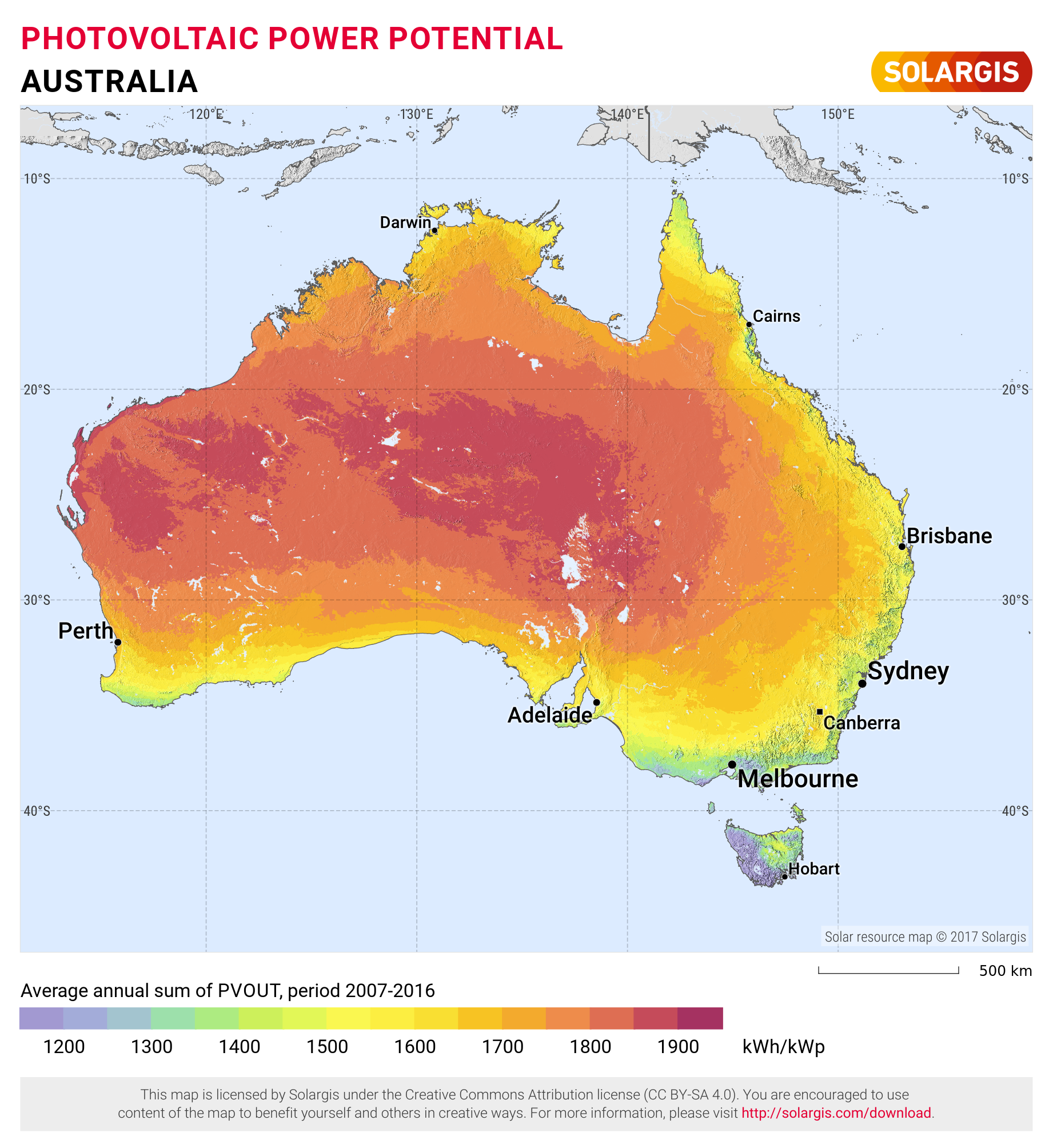
Solar resource map © 2018 Solargis.
When it comes to the next ten year plan, Australia can choose 3 different types of futures for itself. First one is the ideal one, where it would choose to 3x its 2017 pace and would add 3 GWs of solar pv on annual basis for coming ten years (between 2019 – 2028). By doing so, an installed capacity of 30 GWs of solar pv would reduce carbon dioxide emissions by 60 million tons (i.e. 1 GW reduces 2 million tons of CO2). The second scenario is a bit modest, where it would increase its pace by 2x and would install 2 GWs on annual basis and thus install a collective capacity of 20 GWs of solar pv panels by 2028. This would enable the country to reduce its carbon dioxide emissions by 40 million tons. A third scenario is one where Australia would choose to maintain the status-quo and would thus install 1 GW of solar pv each year and would thus add 10 GWs by 2028. The status-quo would help Australia to reduce its CO2 emissions by 20 million tons.
According to Australian Energy Council, the average unit size for solar pv grew from slightly less than 3 kW in January 2012 to slightly over 6.5 kW in November 2017. Thus, size of the installed solar pv units grew 2x during last six years. Moreover, the country has seen an impressive growth in the installed capacity of solar photovoltaics as it added 1.04 GWs in 2012, 0.79 GWs in 2013, 0.8 GWs in 2014, 0.71 GWs in 2015, 0.75 GWs in 2016 and finally 0.94 GWs (not the final figure though) of solar pv capacity in 2017. Altogether, the size of the installed units and the collective added capacity between 2012 – 2017 clearly reflects that the solar pv technology has matured in Australia. Now is the time for the Government to be bold and take major steps to enable a sustainable transition to clean sources of power production for every sector of economy in the country.
Summing up all, Australia‘s reliance on black coal, brown coal and natural gas would not help the government to reduce the greenhouse gases emission. Up-scaling the deployment of renewable resources will certainly bend the emissions curve and would help the Australian government in achieving the goals of Paris Climate Agreement.
© Copyright 2018 Ayoub Hameedi. All rights reserved.
New Zealand can reduce its greenhouse gases emission by enhancing its forest cover
Ayoub Hameedi
New Zealand is an island country that meets the pacific ocean on its east coast and Tasman sea on its west coast. According to the Department of Conservation, Government of New Zealand 80% of the country was densely forested before people arrived however, today only 24% of land is covered with native forests. This reflects the dominant ideology of 19th & 20th centuries that development and a healthy state of environment cannot co-exist. However, towards the end of the 20th century an increased awareness on environmental issues strongly promoted the fact that economic development and a healthy state of environment can co-exist. A number of countries like Sweden, Finland and Costa Rica proved this to be true through the initiative of forest regeneration that sustained economic growth, promoted biodiversity and is now a tool to mitigate climate change.
Sweden is one of the most densely forested countries in Europe as 70% of its land mass is covered with trees. It earns a revenue of around USD 15 billion on annual basis through the export of paper, pulp and swam timber. In order to sustain a healthy forest cover, Sweden plants around 400 million seedlings on annual basis. Likewise, Finland is also one of the most densely forested places in Europe and around 78% of its land mass is covered with trees. Forest industry helps Finland to earn € 20 billion in terms of revenue on annual basis. Costa Rica had a forest cover of 26% in 1983 but with right policies in place to promote sustainability and an effective follow-up, it increased its forest cover to 52.4% in 2013. As a result of conservation efforts, the sector of tourism & travel contributed around USD 7 billion, representing a share of 5.1% of country’s GDP in 2016. It is important to mention here that New York state has a population of 19.8 million (i.e. 4 times to the population of New Zealand) and still it has managed to sustain a forest cover of 63%. On yearly basis, forest cover helps New York State to generate USD 1.9 billion in terms of tourism and forest related industry generates another USD 4.6 billion in terms of revenue on annual basis. The forest sector has provided employment to over 60,000 masses in the State of New York.
If Sweden, Finland, Costa Rica and the State of New York (in USA) can commence economic development that is in align with sustaining a healthy forest cover so can be the case for New Zealand too provided proper time, physical energy, technical expertise and financial resources are diverted in this direction. Climate change is the most complex environmental issue we are facing today and it is already costing us around USD 1.2 trillion on yearly basis. There is a dire need that every country regardless developed, rapidly developing or under-developed play its role to mitigate climate change. Trees are the nature’s carbon capture and storage devices therefore, the most cost effective strategy to mitigate climate change is to sustain a healthy forest cover.
New Zealand can choose to plant native species of trees to increase its forest cover to two-fold by 2040. It will certainly transform New Zealand into a thriving ecological system to preserve and promote biodiversity. An enhanced forest cover will also help New Zealand to reduce its greenhouse gases emission that has experienced an increase of 54% since 1990. The already spoken factors are two important pillars of planetary boundaries that gives us a clear idea of boundaries that we need to abide by if we want to create a sustainable present and future for us and our coming generations. Unfortunately, we have already crossed the safe limit for genetic diversity categorized under biosphere integrity and are already in the zone of uncertainty when it comes to climate change.
Summing up all, Sweden, Finland, Costa Rica and the State of New York serves as an example when it comes to commencing economic development and sustaining an ample forest cover, simultaneously. New Zealand can follow the same path and can choose to enhance its existing 24% forest cover to 50% by 2040. A two-fold increase in forest cover will certainly help New Zealand to reduce its emissions by using forests as carbon sinks. It is an opportunity that New Zealand should avail. Finally, the given suggestion is both realistic and achievable provided proper time, physical energy, financial resource and an effective follow-up are directed towards achieving this goal.
© Copyright 2018 Ayoub Hameedi. All rights reserved.
 Project GE