
Biomass
How Russian Waste can help Finland to reduce its reliance on Nuclear Power
Ayoub Hameedi
Finland is quite well known for its technological innovation, lush green forests and deep blue lakes. It was categorized as the happiest country in World happiness report (2018) and has recently celebrated its 100th year of independence. However, an area where the administrative body can take actions to improve the implementation of sustainability is the sector of power production. As per Finnish Agency, the country generated over 33% of its electricity through nuclear power and when one combines that with clean sources of power production, it helps Finnish economy to remain carbon neutral up to 79% on yearly basis. However, from a critical perspective, nuclear power has more or less the same impact as fossil fuels as later releases greenhouse gases into atmosphere whereas, former produces nuclear waste that needs to be safely buried in deep tunnels and normally requires a price tag in billions of dollars. From the perspective of Sustainable Development, electricity production through nuclear power plants is unsustainable too as the power plants consume around 400 gallons of water to produce a megawatt of electricity. Moreover, safety hazards in case of a natural catastrophe makes things even worse. From a policy perspective, a question that might arise is how can we resolve this issue in a sustainable manner? The answer is both realistic and financially inexpensive for Finland and Russia. It’s about seeing waste as a precious resource to generate power and to optimize its role further when it comes to the landscape of power production. It must be appreciated that Finland generates slightly over 16% of its electricity from biomass. Another question that might arise is where to get hold of waste to increase its share in the total energy mix? and the answer lies in importing waste from Russia.
Russia produces around 48 million metric tonnes of municipal solid waste on annual basis that means each citizen generates around 330 kg of municipal solid waste. According to World Bank, if the status quo is maintained, Russia will be required to increase its waste management capacity up to two-fold by 2025, as it will produce around 60 million metric tonnes of MSW on annual basis. The apparent situation is a serious social and environmental issue for Russia however, from a policy point of view it presents a clear window of opportunity for both Russia and Finland. Both countries can choose to sign a bilateral agreement where Russia would export a certain percentage of municipal solid waste to Finland. On initial basis, Finland would then use this imported waste for clean power production. Once things start to settle down, Finland can then increase the percentage of imported waste from Russia to gradually neutralize it’s reliance on nuclear power. As already spoken, Finland has the required technical skills and physical infrastructure in place to generate power from waste all it needs to do is to import waste from Russia. With an effective bi-lateral agreement, Russia would certainly export its municipal solid waste either for free or at a meager price to Finland. From a financial perspective, the price would still be financially viable for Finland to pay than what it takes to produce power from nuclear power plants. It is important to highlight here that Sweden has sharply decreased the amount of waste ending up in landfills during last 20 years as a result of power generation from municipal solid waste. Finland can also facilitate Russia to manage its waste in a more sustainable manner and it will certainly create a scenario that would be win-win for both stakeholders. An end result of this strategy would be that Russia will tackle its waste problem in a more effective manner in both present and future. Finland will increase it’s capacity to generate power from waste and thus would neutralize its reliance on nuclear power. Finally, price tag to generate power from waste would be fairly inexpensive than what it takes to produce power from nuclear power plants. Finland can then reinvest the financial savings in business sectors across Russia to improve trade between two countries.
Wrapping up facts, Russia needs to manage its waste in a safe and environment friendly manner and Finland needs to reduce its reliance on nuclear power if it wants to increase sustainability in the sector of power production. Finland already has required technical expertise and physical infrastructure in place, everything needed now is to have a bilateral agreement in place to import waste from Russia for coming 20 – 25 years for power production in Finland. Thus a strategic solution, if acted upon will certainly create a win-win situation for both Finland and Russia and would certainly create more room for business and trade between the two countries.
© Copyright 2018 Ayoub Hameedi. All rights reserved.
Biogas: A Sustainable Fuel to power vehicles In Sweden
Ayoub Hameedi
Biogas is an important fuel for public transport in Sweden. Almost 30 cities utilizes biogas as fuel to power municipal buses. The production of biogas can be defined as a natural process in which organic material is broken down by the micro-organisms in an oxygen-deficient environment. It takes place in five different steps. The first step is to recycle organic waste and residues. The components utilized in this process are waste, residual products, energy crops and forestry materials. The waste is then converted into biogas during the second phase. In the third step, biogas is converted into two different fuels namely compressed bio-gas (CBS) and liquefied bio-gas (LGS). In the second last step, an extra energy in converted into heat and electricity for domestic consumption. Last step involves the utilization of compressed bio-gas (CBS) and liquefied bio-gas (LBS), resulting in the closer of procedure. The authorities in Sweden plans to generate 15 TWh of biogas on annual basis by 2030. A map reflecting the utilization of various types of bio-fuels in Sweden is as follows:
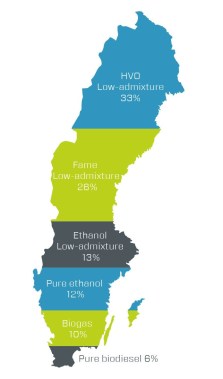
It can be concluded that biogas formulates 10% of the total bio-fuels consumption in Sweden. On the other hand, pure biodiesel formulates 6%, pure ethanol makes 12%, ethanol low-admixture formulates 13%, fame low-admixture represents 26% and lastly, HVO low-admixture makes 33% of the total bio-fuels consumption in Sweden. A total of 1.7 TWh of bio-gas is produced on annual basis in Sweden and half of it is utilized in Vehicles. At present, over 260 bio-gas plants are in operation in Sweden. A graph reflecting the use of bio-gas as vehicle fuel during the time frame of 1995 – 2011 is as follows:

An exponential growth in the use of bio-gas as vehicle fuel can be observed from 2000 on-wards. The utilization of biogas reached its maximum point in year 2011. Another pie-chart reflects that 49% of biogas is utilized for the production of heat, another 36% is used as vehicle fuel, 4.5% is utilized for the sake of power generation, another 10% is used for flaring and remaining 0.5% represents missing data.
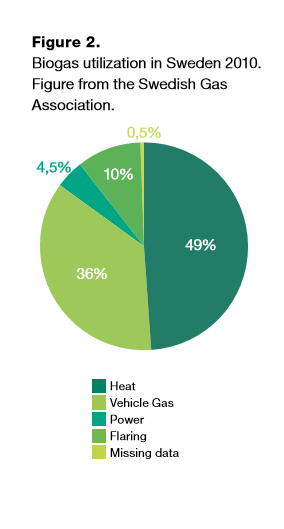
Finally, it can be concluded that biogas is an important renewable energy source when it comes to generating heat, powering vehicles and production of electricity in Sweden.
© Copyright 2017 Ayoub Hameedi. All rights reserved.
Waste As A Sustainable Source of Electricity Production In Sweden
Ayoub Hameedi
Waste is an essential component of every society and it can either be used to generate energy or it can be ended up in landfills. Fortunately, in Sweden Municipal Solid Waste (MSW) is perceived as an important source to generate heat and electricity through Combined Heat and Power Plants (CHP-plants). The process of conversion of MSW into heat and electricity is so efficient that only 1% of MSW ends up in landfills on annual basis. CHP-Plants have played a significant role over the period of time to reduce the reliance on fossil fuels, when it comes to the production of electricity. In 1970, Sweden was the most oil dependent economy in the developed world however, factors like air pollution, toxic water, landfills and dead forest forced policy makers to take some strict measures. As a result, things started to change in a positive manner. CHP-plants together with other innovative solutions have decreased reliance on fossil fuels up to 90% for the sake of heat and electricity generation in Sweden.
There are 33 waste fired plants in operation in Sweden out of which 27 generates electricity. In 2014, a total of 2 Terrawatt hours (Twh) of electricity and 14.6 Twh of heat was produced through CHP-plants in Sweden. European Union (EU) sends 140 million tonnes of waste to landfills on annual basis. This huge amount of waste which ends up in landfills within EU provides a window of opportunity to Swedish policymakers to boost the output of CHP-plants in Sweden through the import of waste. In 2015, over 2.284 million tonnes of household waste generated 14.7 Twh of heat and 2.3 Twh of electricity in Sweden. The output of CHP-plants in Sweden was slightly better in 2015 than in comparison to year before. The difference was positive and found to be 0.3 Twh in case of electricity production and 0.1 Twh in case of heat generation. Sweden generates 3 MWs of electricity from each tonne of waste and thus outperforms all other countries in EU in this field. The generated heat is then sold to district heating network and electricity to power companies to reduce reliance on fossil fuels. The first district heating network in Sweden started its operation in year 1948.
According to the Avfall Sverige statistics, Sweden imported over 1.328 million tonnes of waste from other EU member states namely Norway, Great Britain and Ireland in 2015 for the sake of heat and electricity production. As an outcome of a pro waste-to-energy strategy, the amount of waste ending up in landfills has decreased sharply during 1994 – 2015. A graph representing the same is as follows (Source: Avfall Sverige, 2016)
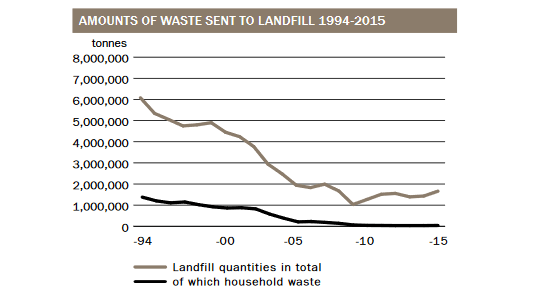
It is clear that the number of landfills in Sweden has decreased rapidly during last 20 years. Similarly, the amount of household waste has also decreased significantly during the same time period. Another graph representing the amount of energy produced from waste during the time period of 1985 – 2015 is as follows (Source: Avfall Sverige, 2016):

It clearly reflects that Sweden has utilized waste to generate over 15 million megawatts (MWs) of energy during 1985 – 2015.
It can be concluded that waste-to-energy power plants has reduced the amount of waste sent to landfills and has simultaneously increased the production of energy too. An increased efficiency in terms of energy production has caused Sweden to produce more electricity from each tonne of waste than any other country within EU. Sweden is certainly a case study in this field and countries planning to install waste-to-energy power plants can enrich their experience from Swedish model.
© Copyright 2017 Ayoub Hameedi. All rights reserved.
 Project GE