
Countries in Africa
____________________________________________________
Renewable Energy can help Senegal to fight climate change and beat poverty
Ayoub Hameedi
How we generate electricity and what source we rely on, matter’s a lot. If we import fossil fuels to produce electricity, we add unnecessary burden to our economy by losing tax revenue to import bill. However, if we generate electricity from renewable sources, we save energy dollars that could then be put to better use and simultaneously bend our greenhouse gases emission curve. According to a report “Renewable Senegal” by New Climate Institute and GermanWatch, Senegal had an installed electricity generation capacity of roughly 1.5 GW that produced 5.61 terawatt hours of electricity in 2021. Unfortunately, Senegal produced a lion’s share of its electricity roughly 80% from coal, gas and oil. The percentage of electricity produced from renewable sources (hydropower, wind, solar and bioenergy) was 20.14% in 2021. An increased reliance on renewable energy to phase out fossil fuels will facilitate Senegal in decarbonization, promoting green economic growth, bending the emissions curve, fighting climate change and creating green jobs to end poverty.
Senegal has good conditions to generate clean electricity from solar PV and windpower technologies. In-fact, IRENA has identified a solar PV potential of over 37 GWs for Senegal. Again as per Renewable Senegal report, 90% of the country receives more solar radiation per square meter than northern Germany. In addition to solar PV potential, Senegal also has an estimated potential of 4.5 GWs of onshore windpower capacity followed by another 13 GWs of fixed offshore windpower potential. Altogether, Senegal has over 50 GWs of solar PV and windpower potential which can certainly help in decarbonization and promoting green economic growth. A mix of both solar PV and windpower technologies will ensure power production and its supply when it is needed the most. During the daytime, solar PV can play a crucial role while in the evening and during the night, windpower technology can fill in the gap left by solar PV technology. As per African Energy Portal (AEP), almost 5.82 million people in Senegal had no access to electricity in 2022. A lion’s share of masses roughly 5.22 million people without access to electricity lived in rural areas while the remaining 0.6 million people belonged to urban areas. There is a dire need for Government of Senegal to come up with sustainable projects to expand an installed solar PV and windpower capacity in rural areas of the country. Simultaneously, it is pertinent that Senegalese Government would prepare masses to work in clean energy technology and invest financial resource and public policy attention accordingly. This would create sustainable source of employment and certainly uplift masses out of poverty in Senegal.
Clean energy technology can be an economic engine to foster green transition and to phase out fossil fuels in Senegal. It is possible for Senegalese Government to install 3 GWs of Solar PV and 3 GWs of windpower each in the coming 2 years. As per International Energy Agency (IEA), in 2024, China installed 162.4 GWs of solar PV followed by 47.5 GWs in European Union, 31 GWs in United States of America, 21 GWs in India and lastly, 7.9 GWs in Brazil. Thus, it is equally possible for Senegal to install a cumulative 6 GWs of solar PV and windpower technology in next 2 years. By doing so, Senegal can put a dent in its emissions curve, decarbonize its economy and promote sustainable economic growth to end poverty.
© Copyright 2025 Ayoub Hameedi. All rights reserved.
Can vertical hydroponic farming prove to be an answer for existing food crisis in Western and Central Africa
Ayoub Hameedi
According to World Food Programme (WFP), over 40 million people in West and Central Africa lack enough food to eat and are thus suffering from hunger and poverty. Adding insult to injury, the already spoken figure is expected to exponentially increase to nearly 53 million people by June 2025. Regional conflicts, forceful displacements, financial instability and climate change are the root cause of instability in West and Central African countries. Again, as per WFP, over 10 million people have been forced to relocate from their homes in Burkina Faso, Chad, Cameroon, Mauritania, Niger and Nigeria. IPCC say that even if we would limit temperature increase to 1.5 degree Celsius, the number of dangerous heat days will skyrocket from 60 days each year in 1985 – 2005 to 110 days each year by 2060 in West Africa. The story of Central Africa is not any different. If we fail to achieve goals outlined in Paris climate agreement, Central Africa will experience a 2 – 4 degree Celsius increase in its mean annual temperature by the end of 21st century. Consequently, each year Central African countries would experience 150 days where average annual temperature would be over 35 degrees Celsius. Unfortunately, the consequences of climate change will exacerbate an existing poverty ratio in West and Central Africa. As per Oxfam, 87% of Chad’s rural population lives on less than a dollar each day. Unfortunately, the rest of West and Central Africa represents almost the same figure. International Fund for Agricultural Development say that 1 in 3 people in West and Central Africa experiences extreme poverty. I believe that vertical hydroponic farming can certainly prove to be a sustainable solution to eliminate poverty in West and Central Africa. It can simultaneously provide a sustainable source of food for people experiencing extreme hunger and poverty.
Vertical farming is an indoor method of food production where plants are grown and stacked on one another. For this reason, this method of food production is referred to as vertical farming. In my opinion, if we rely on renewable resources, vertical farming can indeed prove to a blessing for West and Central Africa. However, it has its own challenges as well. First and foremost, vertical farming consumes a lot of electricity on year-round basis. The price of electricity in each country across West and Central Africa can really either make or break vertical farming as a sustainable method of food production. Thus, there is a dire need that all electricity used in vertical farms should be 100% renewable. It is indeed a blessing that West and Central Africa has an excellent solar PV potential to produce 100% clean electricity. The map given below is an intellectual property of Solar GIS and show the electricity generation potential of West and Central Africa.
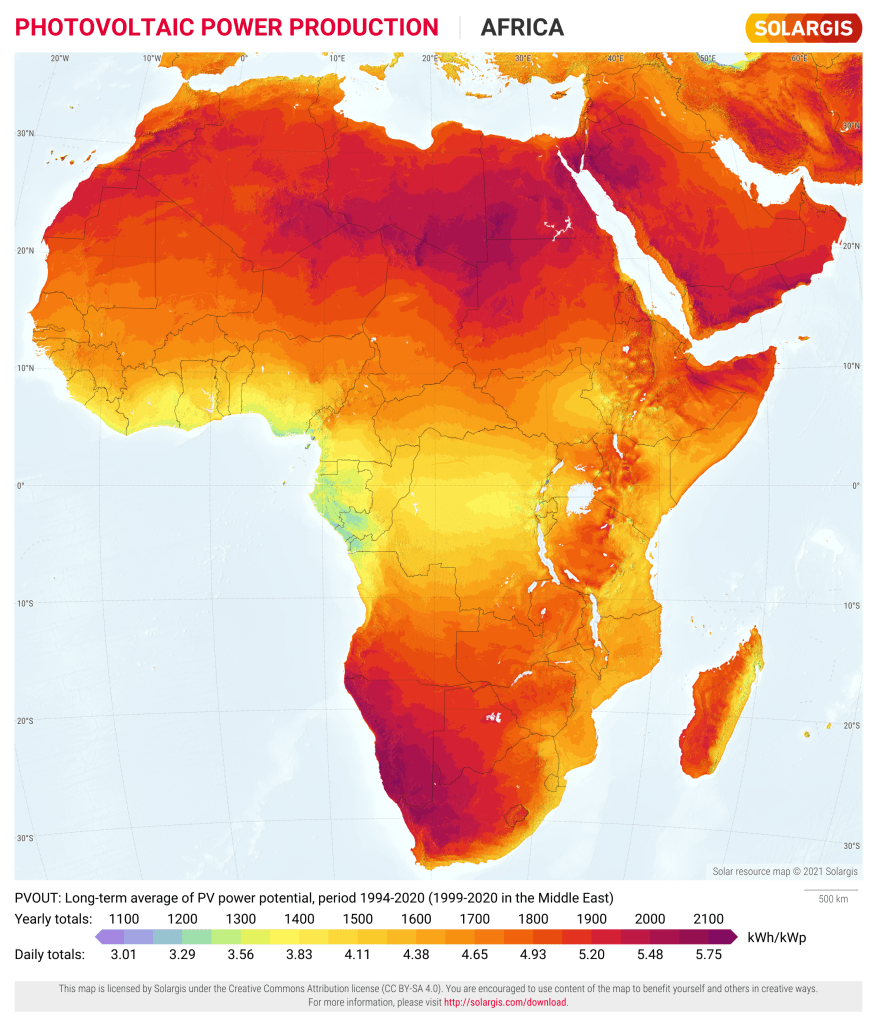
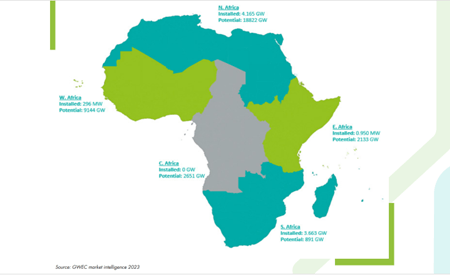
We can conclude from the above map that West and Central Africa has an excellent potential to produce electricity through solar PV. Likewise, as per Global Wind Energy Council’s report Status of Wind in Africa, West and Central Africa has a cumulative windpower potential of 11,795 GWs. On the contrary, the countries in the West and Central Africa barely had 296 MWs of installed wind power capacity (i.e. in West Africa in 2023). Thus, if solar PV and windpower technologies would be matured both clean sources can produce enough electricity to grow food in the region. So availability of 100% clean electricity on round the clock basis is not an issue.
According to United Nations Development Program (UNDP), indoor vertical farms require least space and have rapid growth cycles. This efficiency in the production method helps the farmer to save energy, water and other resources. As per IVL Swedish Environmental Research Institute, food grown in vertical farms through hydroponic technology require limited use of fertilizers and pesticides. In addition, the conditions in which food is produced in vertical farms remains static on year-round basis. As a result, we can grow food in vertical farms any time of the year. In conventional farming method, food production is dependent on a lot of factors including weather condition, quality of soil and usage of fertilizers. However, indoor vertical farming method is completely independent of all three spoken factors affecting the quality of the produced food. The number of vertical farms in Japan has exponentially increased from 35 in 2009 to over 150 in 2017. As a result of this mass production, the cost of leafy greens in Japan has sharply reduced.
As per IVL Swedish Environmental Research Institute, vertical farms produced more food per land area than greenhouses and conventional open field cultivation methods. Vertical farms also enable us to grow food in locations that we normally think are not suitable for food production. Hydroponic farming method uses much less water than used in greenhouses and conventional open field farming methods. Since hydroponic method is a closed system, thus, there is no water loss due to either surface water run-off or evaporation. However, vertical hydroponic farms require a lot of initial capital and technological know-how of how to operate a vertical farm. With right policy actions taken, at the right place and in the right direction, vertical hydroponic method can certainly help us to fight poverty and make sure that people would have enough food on their tables.
Now imagine, if we have solar PV parks and windpower farms in West and Central Africa in 100s of GWs of installed capacity that are inter-connected to promote an efficient use of electricity across the entire region. The clean electricity produced by these interconnected farms would then be utilized to grow leafy greens, herbs and micro-greens in vertical hydroponic farms that would then eliminate hunger by providing food at a stable and relatively low price in West and Central Africa. The crops produced could be used to feed people and simultaneously vertical hydroponic farms can employee masses particularly women who could then be trained to work in these facilities. If Japan can mass produce leafy greens and sharply reduce their price, so can countries in Central and West Africa too.
© Copyright 2024 Ayoub Hameedi. All rights reserved.
Makoko Floating School: A ray of hope for all the children living in slums in coastal areas across the globe
Ayoub Hameedi
Climate change is the most serious environmental issue of our time. It is primarily caused by our unsustainable reliance on fossil fuels since 1850 that has increased the concentration of greenhouse gases in our atmosphere. As a result of increased GHGs concentration, more heat is trapped that then increases the global average temperature. This increase in global average temperature then disturbs the delicate balance nature has developed over the span of last thousands of years. It is important to mention here that during the height of last ice age about 20,000 years ago, the sea level were 400 feet lower than it is today. Likewise, at the end of last ice age, the sea level rose to around 13 feet in a single century (Source: The water will come). This reflects the fact that how quickly a coastal landscape can change in a world prone to rising sea level due to climate change. According to NASA, Greenland lost 286 billion tons of ice on annul basis between 1993 to 2016. Similarly, Antarctica lost 127 billion tons of ice on annual basis during the same time frame as stated earlier. The rapidly melting ice at North and South poles requires us to think creatively and to come up with solutions that are out of the box. Solutions, that would cope with the rising sea level, cost less, easily build, re-build and thus increase the resilience of masses in financially challenged situation in slums in coastal areas across the globe.
A practical example of one such infrastructure is Makoko floating school that is built in a slum based in lagoon outside the city of Lagos, Nigeria. It serves as a ray of hope for the children living in slum that one day they would be able to uplift themselves and their families out of poverty with the help of education they receive in Makoko floating school. The floating school is basically constructed with the help of two materials. First and the foremost is the barrels, that forms a solid floating base for the rest of the infrastructure. The second part of the floating platform is made of wood. The first floor of the floating school is comprised of green and open space where the kids can enjoy quality time during their recess. Above ground floor lies the classroom that allows the kids to receive education. On the top of the floating school infrastructure lies the roof and the terrace completely equipped with the solar photovoltaic panels. Makoko floating school (as shown below) was designed and constructed by architectural firm NLE.

(Source: NLE)
The Makoko floating school model can very well be replicated in slums in coastal areas of Bangladesh, India, Pakistan and in numerous other under-developed countries across the globe. This would give the children in coastal slums a fair and square chance to get education and to improve their financial situation by making conscious choices in life. The floating school idea is no doubt unique in nature and inexpensive to build. The materials required to create the floating platform can easily be found in all of the developing and under-developed countries across the globe. The need of hour is that finances would be channelized in this direction and an effective follow-up would be executed once a floating school project is implemented in any of the aforementioned geographical location in the world. The replication of the Makoko floating school is realistic and achievable and can ensure education to the ones most in need of education in coastal slums in countries across the globe.
© Copyright 2020 Ayoub Hameedi. All rights reserved.
Zero Mass Water system can help Djibouti in mitigating water scarcity
Ayoub Hameedi
Djibouti is one of the many countries in Sub-Saharan Africa. Water scarcity is amongst the biggest challenges faced by Djibouti as it has no lakes or rivers that would serve as a source of clean water supply. As a consequence, public administration in the country has to rely on deep underground aquifers to have access to clean drinking water. It is important to remember that an unsustainable water management practice and lack of re-storage facilities where water would be stored after usage would certainly reduce the underground water table in the existing aquifers. As a negative impact, the water level would continuously be reduced and Djibouti has to face tough condition in case of droughts and low rainfall. Fortunately, there exist a solution that can help Djibouti in mitigating its existing water scarcity. The already spoken solution has been designed by an Arizona based start-up and is referred to as zero-mass water system.
Zero-mass water system has two functions where its first job is to produce electricity, store it in a lithium-ion battery and then to use the same electricity to extract clean drinking water from the surrounding environment. An arrangement of two standard hydro-panels can produce up-to 4 – 10 liters of clean drinking water in a day. The stated amount is sufficient enough to satisfy the clean drinking water requirement of a person in a modest manner. A short video clip reflecting how the developed solution works is as follows:
(The shared video is an intellectual property of zero-mass water).
A question that might arise in the mind of a reader is how do the hydro panels work. The answer is simple to understand. The designed solution takes air and sunlight and first produces electricity. The generated power is then used to extract and process water from the air that is then stored to be used later by the owners of the hydro-panels. The designed solution has a huge potential provided proper policy attention and financial resources are invested in this direction to up-scale its implementation in areas suffering from acute shortage of water. Countries other than Djibouti in Sub-Saharan Africa can also seek benefit from hydro-panels too. What can possibly be done in this regard is to design a ten-year plan, where the aim would be to provide hydro-panels to 100,000 masses in Djibouti in a single year. Replicating the same strategy and improving the implementation process through trail and error for a decade would help the Central Government in Djibouti to provide clean drinking water to a million people. Once a million people has been provided with hydro-panels, the policy makers can then choose reach 2 million people in the second decade that can served as a second phase of the implementation process. An excellent feature about the zero mass system is that it can be installed in almost every type of geographical location and can function effectively to provide clean drinking water to mitigate acute water shortage.
All in all, the provision of zero mass system to a million people in Djibouti in a decade might appears to be enthusiastic however, is completely achievable in nature. Likewise, the provision of zero mass system to another 2 million people in the second decade is equally feasible provided proper time, policy attention and financial resources are invested in this direction. The implementation of the presented idea would certainly help Djibouti in achieving Sustainable Development Goals (SDGs), and would improve the supply of clean drinking water to masses in the country.
© Copyright 2019 Ayoub Hameedi. All rights reserved.
National Forestry Fund – An effective tool to protect tropical rainforest in Democratic Republic of Congo
Ayoub Hameedi
Democratic Republic of Congo (DRC) is located in Central Africa. It covers a total area of 2.344 million square kilometers and is blessed with rich tropical rainforest. According to US Central Intelligence Agency (CIA), DRC is the second largest country in Africa and around 68% of it is covered with tropical rainforest. Algeria is the largest country in Africa. Unfortunately, only 9% of people in DRC have access to electricity, thus leaving over 61 million people without any access to electricity and limited opportunities to uplift them out of poverty. The presence of dense tropical rainforests represents a massive untapped potential in the form of eco-tourism which if tapped properly can facilitate Democratic Republic of Congo to eradicate poverty. According to World Wide Fund for Nature (WWF), Congo Basin is spread across six countries in Africa and spans around 500 million acres. More than half of the Africa’s rainforest is located in Democratic Republic of Congo and is home to mountain gorillas, Chimpanzee and forest elephants.
Costa Rica can serve as an excellent example for DRC as the former has increased its forest cover two-fold since 1983 and used eco-tourism to earn an annual revenue of USD 7 billion. Apart from the revenue, eco-tourism created 110,000 jobs in Costa Rica. Democratic Republic of Conga can preserve its rainforest from deforestation and thus can earn a solid revenue through eco-tourism, create jobs and uplift masses out of poverty. The given suggestion is both realistic and feasible and can be implemented by 2030 provided proper political will and financial resources are diverted in this direction. In 1996, the then Government in Costa Rica created a National Forestry Fund with a basic aim to pay USD 120 to conserve a hectare of forest in Costa Rica. National Forestry fund created altogether 48,000 jobs through the reimbursement of funds to protect biodiversity and forest cover in Costa Rica. As a result, land use sector that was a major source of carbon dioxide emission in 1990 turned into a net carbon sink by 2005. In 1990, the land use in Costa Rica produced 2.4 million tonnes of carbon dioxide gas. Due to the implementation of National Forestry Fund to preserve and restore forests, the same sector started absorbing 3.5 million tonnes of carbon dioxide gas on annual basis by the end of 2005. The same can be the case for Democratic Republic of Congo where the funds channelized by Germany, Norway, Sweden, Denmark, Finland and Iceland would protect tropical rainforest & biodiversity, create jobs in thousands and uplift masses out of poverty. Most importantly, an availability of financial resource on monthly basis will create a dent in poverty and thus urge national government and masses in Democratic Republic of Congo to protect tropical rainforest. The Nordic countries and Germany can collectively choose to spare USD 1 billion on yearly basis for National Forestry Fund to motivate national government of DRC to preserve tropical rainforest.
Summing up all, National Forestry Fund will preserve tropical rainforest in Democratic Republic of Congo, flourish biodiversity, regulate temperature, rainfall and reduce greenhouse gases from atmosphere. As per IPCC, we need to reduce greenhouse gases emission by 45% till 2030 and preserving rainforest is a much needed step in the right direction. The given suggestion is realistic and would certainly create dent in existing poverty ratio in Democratic Republic of Congo. Unfortunately, according to World Bank, we have lost 1% of the global forest cover between 1990 – 2015. In order to mitigate climate change, we certainly need to reverse this trend. Creating a National Forestry Fund to protect tropical rainforests in Democratic Republic of Congo would be one such step to ensure a sustainable future for everyone.
© Copyright 2018 Ayoub Hameedi. All rights reserved.
African Elephants and why we need to know them
Ayoub Hameedi
Elephants are the largest land mammals on planet earth and they do play an important role when it comes to seeds dispersal and germination. Elephants also have a lot in common with human beings, for example, a baby elephant also loses its first teeth and tusks. Elephants live in groups, maintain strong social bonds with each other, have an ability to identify their own-selves and do strongly recognize the absence of another member. However, African elephants need our help when it comes to sustaining their population and it is what this report is all about. In our recorded human history, future generations would certainly categorize 20th century as a time period, where we practically pushed nature and other species to a point, where it becomes difficult for species to exist and for nature to maintain its stable state, it had for around 12,000 years. Since 1950, we have un-sustainably relied on fossil fuels and have thus raised the concentration of carbon dioxide in our atmosphere from 320 parts-per-million in 1950 to 400 parts-per-million in 2013. Besides increasing the concentration of carbon dioxide in atmosphere, we again unfortunately pushed the specie of African elephant to a point where it was categorized as an endangered specie by IUCN in year 1996.
Following the conservation efforts, the status of African elephants was then reversed to vulnerable that is one step better than endangered status however, African elephants have had the same vulnerability status since 2004. This means that we need to take concrete actions to help African elephants. The reason behind this categorization is fairly simple that we have managed to wipe out almost 90% of the African elephants population in 20th century. It is quite painful to mention here that around 20,000 African elephants lost their lives on annual basis due to our greed for their tusks and their habitat shrinked to 33% due to our ever increasing hunger for wood. It makes around a killing of 55 African elephants a day or over two elephants each hour. Now, an important point for us to understand is that a female elephant takes about 22 months to give birth to an elephant. This pregnancy period of slightly less than two years makes it difficult for the elephants to recover.
In my personal opinion, there are three key ways to bring the poaching of elephants down sharply and to eliminate it completely. The most effective is to introduce a ban on markets where there is high demand of ivory. World Wide Fund for Nature (WWF) has taken this challenge and worked with the China to eliminate the use of ivory. The efforts bear the fruits and as a result, China has introduced a ban on 1st of January 2018 on the trade of ivory and products made out of it. Another key action in this regard, is to carry out a concrete plan to eliminate the masses access to assault riffle (AK-47). It is quite unfortunate to mention here that poachers have used the already spoken weapon to kill the gentle creature. Mozambique is an example, where poachers have killed 11,000 elephants in 7 years through AK-47. The third effective strategy is to create more and more forests that could provide habitat to these gentle creatures so that elephants do not have to visit human settlements for food. It is quite heart breaking to mention here our exponential growth in population has shrinked the African elephant habitat from 3 million square miles to slightly over 1 million square miles. In short, African elephants habitat has shrinked about 66% since 1979. By increasing their habitat through reforestation, African elephants would have less conflicts with humans and thus their population would prosper.
All in all, African elephants are just one example that has vulnerable status when it comes to adequate number to sustain their population. It is our responsibility to understand this basic fact that nature is basically like a network, where each specie has an important role to play and each specie in one way or another is connected to every other specie. In order to let nature work in a sustainable manner, we must allow each specie to live and thrive on this planet that we share with millions of other plants and animals. We cannot choose to be selfish.
© Copyright 2018 Ayoub Hameedi. All rights reserved.
The Great Green Wall of Africa: An effective strategy to mitigate climate change
Ayoub Hameedi
Climate change is a known reality of 21st century and it is an end result of our unsustainable reliance on fossil fuels. The burning of conventional sources of power production releases greenhouse gases in our atmosphere that in turn disturbs their natural concentration and thus leads to an increase in global average temperature. The concentration of carbon dioxide now stands at 400 parts-per-million. Consequently, the global average temperature is now 0.9 degrees higher than the normal. According to NASA, since 1978 the global average temperature has experienced an increase from 0.06 degrees to a more alarming figure of 0.9 degrees. It is extremely important for us to take every possible measure to limit this temperature increase to 1.5 degrees as the difference between an increase of 1.5 degrees and 2 degrees would be enormous. Again as per NASA at 1.5 degrees tropical coral reefs would have a chance to sustain the change whereas at 2 degrees the tropical coral reefs would lose their resilience completely. Likewise, with an increase of 1.5 degrees the fresh water availability in Mediterranean area will be reduced by 9% whereas at 2 degrees, it will be reduced by 18%. So the difference is quite clear and now it is up to us to make sustainable choices to limit temperature increase.
As spoken earlier, climate change and a resulting increase in global average temperature is a known fact and the sooner we would recognize it and take mitigating actions, the less of an uncertainty we would face in this regard. One such action has been initiated by a number of countries in Africa that are currently planting a great green wall with an aim to reverse desertification with the help of nature. It is important to mention here that among all of the available technologies to mitigate climate change, plantation of trees are the most inexpensive one and provide positive benefits relatively quickly too. Trees absorb greenhouse gases from atmosphere and thus plays a pertinent role in maintaining the concentration of greenhouse gases up to a sustainable level. An absence of trees would just do the opposite. The given service is just one example of ecosystem services offered by the trees.
(*The shared video is an intellectual property of BBC News)
The project of planting Great Green Wall of Trees was first designed in 2004 as a joint initiative of 11 African countries namely Ethiopia, Burkina Faso, Chad, Djibouti, Eritrea, Mali, Mauritania, Niger, Nigeria, Senegal and Sudan. The aim was to create vegetation and trees belt from Dakar to Djibouti to fight desertification. The planned green wall once completed would be 7,000 kilometers long and 15 kilometers wide. It would be comprised of native trees that would also produce a positive impact on the biodiversity too. One such example is the plantation of desert date tree, which if planted on a large scale would provide dates as a sustainable source of food and to earn revenue through its exports. Another important tree is Acacia tree that has the ability to store water in its roots and thus to keep soil moist and water available in the nearby wells. As per the BBC News, the project was started in 2007 and would cost an estimated amount of USD 8 billion. So far, Ethiopia has managed to restore 15 million hectares of degraded land followed by Nigeria that has restored 5 million hectares of degraded land and Sudan where 2,000 hectares of degraded land has been restored. Senegal has planted 11.4 million trees and has restored 25000 hectares of degraded land as well. It is extremely important that Burkina Faso, Mali and Niger would also play a bigger role than their present part.
Finally, we need to understand this basic fact that nature took around 4.5 billion years to create earth as we see it today. We share planet with millions of plant and animal species that also have an equal right to survive and thrive. In-fact, our resilience is based on how sustainably we manage and utilize natural resources that we have been blessed with. The governments across the globe should finance such projects and motivate masses to initiate similar projects at micro and macro level as it is only then we would be able to create a future that would be socially equitable, financially viable and ecologically sustainable for us and our coming generations.
© Copyright 2018 Ayoub Hameedi. All rights reserved.
Plastic Homes : A low-cost solution for masses in a financially challenging situation
Ayoub Hameedi
The aim of this report is to promote the reuse of plastic bottles to minimize their negative impact on the environment. The thrown away plastic bottles eventually ends up in oceans making their way through streams and rivers. This creates pollution and disturbance in marine environment. The same plastic waste in oceans then eventually reaches our dinner table through sea food. Our unsustainable reliance on plastic is causing a problem that is likely to stick around for the next 4 centuries. We started relying on plastic in mass form around 1960. We made a choice at that point that created plastic waste problem in the first spot. Again as always, we can choose to recycle, reuse and reduce our reliance on plastic so that we and our coming generations would live in harmony with nature. We need to understand that we share planet earth with 8.7 million other species out of which 2.2 million are in seas, oceans and rivers. It is our mutual responsibility to show respect and consideration and one of the best way to do so is to reduce reliance on plastic. An important point to remember is that once we have used the plastic and have thrown it away, it would be out of our sight but would still remain present in the ecological system for the coming 400 years. Thus we need to make sure that our used plastic in whatever form it is, ends-up in recycle bin. There are many stakeholders that are sorting out ways to reuse plastic in a sustainable manner. One such solution is to build houses with plastic bottles and to cover them with mud. The houses built this way are relatively inexpensive and thus provide a decent place to live in to those in a financially challenging situation.
Nigeria is a country where a major portion of population is homeless. According to Bureau of Public Service reform around 108 million Nigerians are technically homeless. The acute shortage of homes highlight the dire need that houses should be built and provided on easy installments to Nigerians so that they could live in a decent manner. It would also enable these homeless Nigerians to contribute positively in the growth of Nigeria. An organization with title Developmental Association for Renewable Energies has come up with an inexpensive solution, where thrown away plastic bottles and mud are used as a building material to construct houses in Nigeria. During the construction, the plastic bottles are filled with mud, that are then placed adjacent to each other and are then covered with mud. A video clip giving a brief overview is as follows:
(*The shared video is an intellectual property of AlJazeera English)
From a financial point of view, the solution provides an inexpensive accommodation to masses but if we would analyze mud houses critically, we would realize that there is a dire need to replace mud with another sustainable alternative. It is important to mention here that mud is formed by mixing different types of soil with water. According to Food and Agriculture Organization (FAO), soil is not a renewable resource as nature takes around 1,000 years to form 1 cm of soil. Replacing soil with bamboo can prove to be a more sustainable alternative. Likewise, finding a more suitable alternative than bamboo can also be another excellent point to improve the existing design of the solution. All in all, plastic homes are an inexpensive source of accommodation for masses in a financially tight situation and simultaneously are an excellent source to reduce plastic waste too.
© Copyright 2018 Ayoub Hameedi. All rights reserved.
Revolutionizing the Electricity Generation System in Nigeria
Ayoub Hameedi
Federal Republic of Nigeria lies in the region of Sub-Saharan Africa and belongs to the category of a lower middle income group country. According to the World Bank statistics (FY 2015), the population of Nigeria was over 182 million with a life expectancy of slightly over 53 years at the time of birth. A geographical map of Nigeria with different regions is as follows:
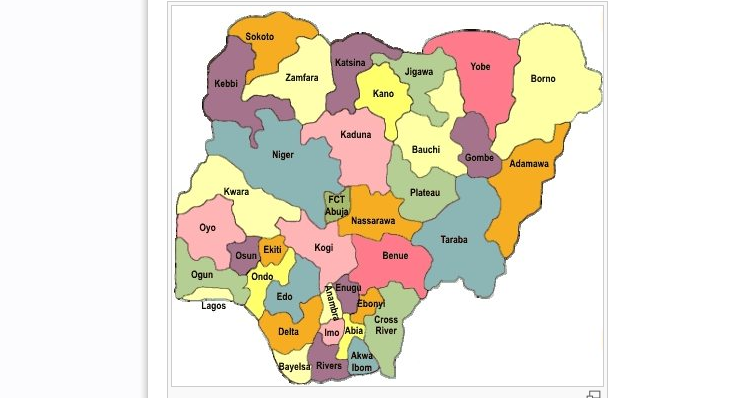
This short report is about the electricity generation system in Nigeria and how it can be improved in terms of sustainability. A significant percentage of electricity is generated through diesel and gas generators at individual level, which makes it quite difficult to predict the total installed capacity in Nigeria. As per a rough estimation, the total installed capacity was almost 10 gigawatts in 2014. It is important to mention here that Nigeria is the 10th largest producer of oil in the world and certainly the largest producer of oil in the continent of Africa. The Government of Nigeria earns almost 70% of its revenue through the export of oil. The revenue amount was USD 50 billion in year 2011 however, still 43% of masses in Nigeria have no access to electricity. All these statistical figures point only in one direction that Nigeria is suffering from “resource curse” . From a policy perspective, the problem of resource curse and bureaucratic inefficiency is complex to deal with but it’s not an impossible scenario. It would take some serious dedication and honest diversion of financial resources to resolve the problem. It might also take a decade or two before the results would be visible to the world. The question which arises at this point is what could be done to put Nigeria back on the track of Sustainable Development. A possible answer is available as under:
The first and foremost policy recommendation is to include the power generation system in the financial loop. The best strategy to do so is to choose renewable sources like solar photovoltaic (PV) and wind power over fossil fuels. Let’s begin with the creation of a “National Renewable Energy Fund (NREF)” for the promotion of renewable energy resources in Nigeria. Another question which arises at this point is since Nigeria belongs to a lower middle income group so how can the funds be generated. The answer lies in the oil revenues. Assuming the oil revenues to be USD 50 billion on annual basis, even if 20% of the revenue is channelized for the creation of a NREF on annual basis, an amount of USD 10 billion would be generated each year. A continuous repetition of this policy for 5 years will generate USD 50 billion which would be sufficient enough to satisfy the electricity needs of whole Nigeria through renewable resources. It is completely understandable that Government of Nigeria might have to make a lot of financial compromises and there might be a lot of criticism but with proper socio-political awareness, this goal can be achieved. It is like sacrificing 5 years for coming 35 – 40 years. The investment of a single year would harvest the benefit of seven years. From a policy point of view, it represents a complete win-win situation. A 100% renewable energy system would spare fossil fuel for the sake of export. Thus, the overall oil revenues would increase too as an outcome of this policy. In case of Nigeria, the potential for Concentrated Solar Power (CSP) and Solar photovoltaics (PV) is enormous. The estimated potential of CSP in terms of installed capacity is 428 GWs. Likewise, the estimated potential of Solar PV in terms of installed capacity is 1,046 GWs respectively. A solar radiation map for CSP potential in Nigeria is as follows:
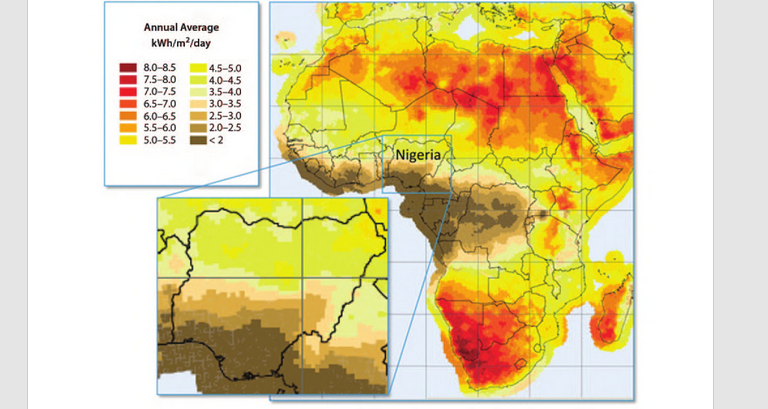
The estimated potential of wind power in Nigeria is 19 GWs. The installed hydropower capacity is approximately 2.2 GWs at present but has the potential to be optimized up to 7.2 GWs. Thus, it can be concluded that the overall renewable energy potential for Nigeria in terms of installed capacity is 1498 GWs, respectively. A sum of all the estimated potential is as follows:
428 GWs (for CSP) + 1,046 GWs (SPV) + 19 GWs (for wind power) + 5 GWs (for hydropower) = 1498 GWs
It is a rough estimation and even if authorities in Nigeria would be able to install one-third (i.e. 499.3 GWs) of it, the country would be self-sufficient in terms of electricity generation. Moreover, authorities would have surplus electricity to export to other countries in region and to earn a handsome amount in revenue. Let’s assume even if 100 GWs of installed capacity is used to satisfy domestic consumption and another 150 GWs of installed capacity is lost due to line losses and transmission failure, still 249 GWs of installed capacity would be there to generate electricity which could then be exported to neighboring countries. Another policy recommendation is to install waste-to-energy power plants. It would reduce the amount of waste ending up in landfills and put waste into a more sustainable use.
The establishment of wind farms, solar photovoltaic parks, hydropower and waste-to-energy power plants would generate numerous jobs which would definitely be taken up by the people of Nigeria. This economic growth would then allow the flow of money from top to bottom and as a result the quality of life of Nigerians would be improved further. An important point to mention here is that energy policy makers in Nigeria needs to seriously focus on establishing an efficient electricity transmission system within the geographical boundary of Nigeria for domestic demand and beyond for the sake of export. It would decrease the line losses and thus increase the revenue earnings.
All in all, the renewable energy potential for Nigeria is enormous and if proper time, energy and financial funds are invested, it can act as another source of revenue earning for Nigeria. Besides financial benefit, Nigeria would become carbon neutral and thus could be on track to become a truly sustainable country. Lastly, an honest approach, financial transparency and accountability are the key factors to success elsewise, no policy approach would be able to turn things around in a positive manner.
© Copyright 2017 Ayoub Hameedi. All rights reserved.
 Project GE