
Countries in Asia
____________________________________________________
Aralkum desert: Why its a must for everyone to know about it
Ayoub Hameedi
As per United States Agency for International Development (USAID), Aral sea was once the fourth biggest lake in the world. However, the then USSR ruthlessly exploited Amy Darya and Syr Darya, major sources of water input for Aral Sea for irrigation in Uzbekistan and Kazakhstan. USSR constructed over 20,000 miles of canals, followed by 45 dams and over 80 reservoirs to ensure an adequate supply of water for cotton and wheat. Consequently, less water went into Aral Sea and more water was diverted to agricultural plots. This thoughtless action disturbed the delicate ecological balance of Aral Sea and lead it to a point where water loss each year due to evaporation was 8 times more than the water getting into it. Initially this led to the shrinking of Aral Sea however, without proper attention and mitigating actions this delicate ecological system passed beyond the point of no return. Thus, once Aral Sea quite quickly started transforming itself into a new ecosystem referred to as Aralkum desert. It can most certainly be referred to as world’s youngest desert.
The photograph given below (taken by NASA on March 24, 2020) is an image of a day where wind carries salt and dust from dried lake bed and spread it over an area even beyond the boundaries of once Aral sea. According to European Space Agency, sandstorms spread 150,000 tonnes of salt and sand each year from the dried lakebed to areas that are 100s of kilometers away from Aral Sea. The poisonous salt from dried lake bed is even exacerbating the melting of glaciers in Pamir mountains on Afghanistan’s boarder and can even be found as far as on the coast of Antarctica, on the glaciers of Greenland and in the forests of Norway. It is important to point out here that the snow and glaciers in Pamir mountains are the main source of water supply to Amu Darya. As a result of rapid glacier melting due to poisonous salt and dust, Amu Darya might experience a lot of river flow for the next decade or two, however, once the glaciers would retreat, Amu Darya would then certainly experience a lot less water in terms of river flow. We can say with confidence that this man-made environmental catastrophe is significantly affecting other parts of the world. Sadly, it is an excellent example to understand that different ecosystems across the globe are inter-connected. A catastrophe in one ecosystem (no matter how remote) will certainly have a negative affect on other ecosystems too. Due to a rapid decrease in the size of Aral Sea, climate in the region is also changing as both winters and summers are more intense now than before.
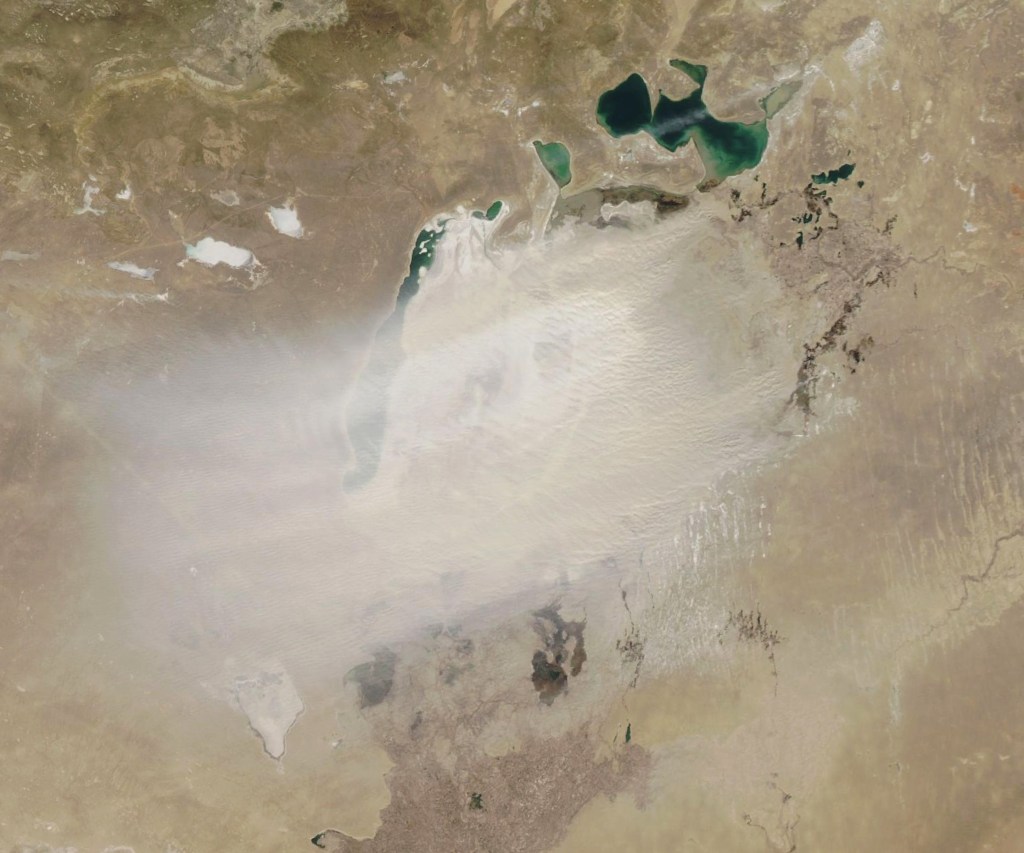
World Bank say that Aralkum desert is now one of the key sources of airborne pollutants in the region. It also comes in with a hefty price for Uzbekistan. Again, as per World Bank, an annual financial loss to Karakalpakstan economy is over 44 million USD (i.e. 2.1% of region’s GDP). World Bank fears if the environmental catastrophe remains un-addressed, a cumulative financial loss to region’s GDP would be over 844 million USD in the next 2 decades. Besides financial loss, as per United Nations, an absence of Aral Sea and resulting desertification is now creating a number of other problems including degradation of arable land, food shortage, malnutrition, respiratory issue among local people and poverty at a staggering rate of 44% respectively. If we pay close attention, we would realize that all the already spoken issues are inter-connected and an increase in the intensity of an issue would certainly exacerbate other issues as well. Adding insult to injuries, UNICEF say 1 in 6 children in Eastern Europe and Central Asia reside in areas experiencing severe water scarcity.
Summing up all, the damage done to Aral Sea can most certainly be referred to as one of the biggest man-made environmental catastrophes in the world. It is a very sad incident and offer us all a valuable lesson (at a very big price) of what can happen, if we would take our ecosystems and their services for granted. We must learn to respect nature and must abide by the rules it has in place. We only have one planet and we must do all we can to protect it. Together, we can indeed create a sustainable world for all.
© Copyright 2024 Ayoub Hameedi. All rights reserved.
The death of Aral Sea and lesson it offers to us all
Ayoub Hameedi
According to Encyclopedia Britannica, Aral sea was once used to be the fourth largest lake in the world covering an area of 68,000 square kilometers in Central Asia. Unfortunately, this was profoundly correct up until 1960 however, due to unsustainable water withdrawal practices done initially by USSR (Union of Soviet Socialist Republics) and after its collapse in 1992 then carried on by Uzbekistan, the water volume in the Aral sea started to drop sharply. As a consequence of wrong policies in place, Aral sea that was once the fourth largest lake in the world (in 1960s) appeared more to be like a pond (in 2014), when compared to its former size. The map given below is an intellectual property of Encyclopedia Britannica and is shared here only to highlight the consequences of wrong policies in place.
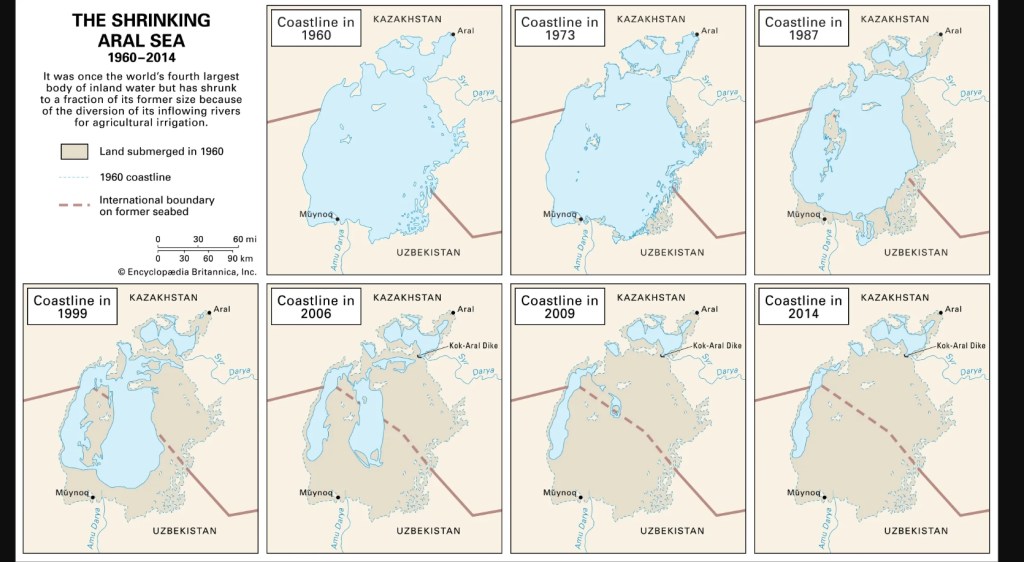
We can clearly see from the map above how quickly Aral Sea decreased in size from 1960 to 2014. I strongly believe that the damage done to Aral Sea could have been reversed or minimized in affects, if the mitigating actions were taken place and executed before the start of 21st century. From the beginning of 21st century, we can clearly see that the damage done to the Aral sea reached to a point of no return. The size of Aral Sea in 2006 is not even one-third of the size Aral Sea enjoyed in 1960. Most importantly, Aral sea lost significant amount of size during the next 3 years. The size of Aral Sea in 2009 is almost half to what Aral sea was in 2006 (just 3 years ago). This single fact significantly points that the damage done to Aral Sea as a water body and an ecosystem reached to a point of no return. A question that might arise here is what were the factors that lead to the depletion of Aral sea and certainly caused one of the biggest man-made environmental catastrophe during last century. This is what this report is about.
Amu Darya is amongst the largest rivers in Central Asia and flows through Afghanistan, Tajikistan, Turkmenistan and Uzbekistan. Previously, it used to end up in Aral Sea but now an excessive water diversion from Amu Darya for agriculture purpose made it impossible for Amu Darya to reach Aral sea. This is amongst the primary cause of a rapid decrease in the size of Aral Sea. Likewise, Syr Darya is another river in Central Asia that flows through Kazakhstan, Tajikistan and Uzbekistan and finally ending up in Aral Sea. Both Amu Darya and Syr Darya were the key source of water input for Aral Sea. To achieve self-sufficiency in cotton production, Russia during the USSR period ruthlessly exploited a lions share of agricultural plots in Uzbekistan for cotton production. As per World Bank, Uzbekistan used 1.2 million hectares of agricultural land for crop production in 1913. By 1950, Uzbekistan was already using 2.3 million hectares of land for agriculture purpose. Adding insult to injury, by the end of 1990, Uzbekistan was already using 4.2 million hectares of land for agriculture purpose. Thus, in 77 years, Uzbekistan went from 1.2 million hectares of agriculture land to 4.2 million hectares of land used for crop production almost 61% of which was used for cotton production. Cotton was referred to as white gold for Uzbekistan. Unfortunately, this unsustainable growth pattern in agriculture sector in Uzbekistan created a lesson for rest of world regarding what could happen, if we would take our ecosystems and its services for granted.
As per World Bank, USSR used 64 billion cubic meters of water from Amu Darya and Syr Darya for irrigation purpose during 1913 – 1960. The remaining 56 billion cubic meters of surface water was allowed to discharge into Aral sea. Unfortunately, by 1985 only 2 – 5 billion cubic meters out of a total available 120 billion cubic meters of water from Amu and Syr Darya’s were reaching Aral Sea. Consequently, the water input to Aral sea was way less than the water loss due to evaporation. An annual water loss due to evaporation in Aral sea is approximately 40 billion cubic meters. Sadly, water loss due to evaporation was roughly 8 times more than the water getting into Aral Sea on annual basis by 1985. This man-made disturbance primarily caused the once fourth largest lake to shrink rapidly and then caused the death of Aral Sea.
To conclude, we must not take our ecosystems and their services for granted. We must learn to live within the boundaries of our ecosystems. We must learn to do more with less resources. Most importantly, when it comes to economic activities, we must measure the proposed economic activity’s impact on our environment. In Aral Sea’s case, protecting the Aral Sea was much more important than the cotton production. However, wrong policies in place and their execution created one of the biggest environmental issues and certainly a lesson for us all. Hopefully, we would remember the lesson and won’t repeat such mistakes in future. We could have saved Aral Sea but our arrogance foster by our belief that we can manage nature caused an environmental disaster of an unprecedented level. We must do all to protect our ecosystems and their services as our survival is based on healthy ecosystems and their services. We must not forget the fact that nature can manage without us. We on the contrary, cannot manage our lives properly without nature.
© Copyright 2024 Ayoub Hameedi. All rights reserved.
Plastic tar roads in India
Ayoub Hameedi
As per the United Nations Development Programme (UNDP), India generates 15 million tonnes of plastic waste each year. Unfortunately, about 25% of this produced plastic waste gets recycled and the remaining 75% of the waste plastic ends up in landfills. It is important to mention here that landfills both in India and in other countries across the globe are one of the major source of methane gas emission. When compared with carbon dioxide gas in atmosphere, methane gas has 25 times more ability to trap heat and thus it is way more dangerous than carbon dioxide gas when it comes to global warming and a consequent change in our climate. There is a dire need for us to think out of the box and to develop solutions that would help us in reducing the amount of plastic waste ending up in landfills. One such solution has been developed by India where waste plastic is now seen as useful material in the construction of roads. Applying the circular approach on plastic waste is helpful in many ways. First and foremost is the amount of plastic waste ending up in landfills will be reduced sharply. We all know that plastic takes a few hundred years to break down. A chart from WWF Australia shows the breaking down time span of different plastic products:

The above chart is an intellectual property of WWF
Whenever it comes to the execution of an infrastructural project, two factors namely price competitiveness and durability plays a very crucial role. Using shredded plastic as a construction material enhances durability of completed road and also reduces the price significantly. This creates a win-win situation for everyone where a construction company can produce better quality roads at less price. The local government has to deal with less plastic waste in landfills and thus less expenditures when it comes to managing plastic waste. Moreover, an improved quality road that requires less maintenance also reduces the repair related expenditure as well. Finally, a road well built in a far flung rural area would enable swift mobility from one place to another. Imagine, a pregnant lady being carried in an ambulance to a hospital on a well built road. Now imagine the same situation on a damaged road with lots of potholes in it. There is a very big difference between the former and latter. Thus we can say that a well built road with the help of shredded plastic would be financially viable, socially equitable and might also be sustainable for the whole society. An important question that might arise in a reader’s mind is how do we actually use shredded plastic as a material in the construction of roads and this is what this short report is all about.
The process of plastic tar roads begins with shredding waste plastic into small pieces. The construction procedure of plastic tar roads is similar to the construction of ordinary roads in India. The first step is to heat up the stone aggregate up to 170 degree celcius. The shredded plastic waste is than sprayed on the heated stone aggregate. Due to the presence of heat, the applied plastic softens down and form a sort of coating over the heated stone aggregate. In the final step, hot bitumen is applied over the heated stone aggregate with plastic coating on it. This process is helpful in many ways. The use of plastic in roads construction causes less plastic waste to end up in landfills or in incineration centers. In fact the use of plastic decreases the use of bitumen in road construction by roughly 10%. Moreover, plastic tar roads have enhanced strength and performance when compared with traditional roads. In addition to less plastic waste and enhanced performance, plastic tar roads costs less per constructed km than traditional roads. It is important to point out here that the plastic tar solution was applied in Jumbulingam road Chennai, Veerbadhra Street Erode, Vandiyur Main road, Vilachery main road and Canteen road during 2002 – 06 in India. The aforementioned roads were examined in 2008 and none of these plastic tar roads had any potholes, cracking, deformation or any edge flaw in them. If India can make it happen so can rest of the world as well. Plastic tar roads are an innovative solution to mitigate plastic waste in India. It will prove to be an equally innovative solution for countries in other parts of the world too.
Summing up all, we can easily say the plastic tar roads are socially equitable, financially viable and might be sustainable for the whole society. The discussed solution provides us an opportunity to use plastic waste in an effective way that would otherwise end up as trash in landfills and incineration centers, where it would either remain in our ecosystem for few hundred years or would be burnt and thus cause air pollution.
© Copyright 2022 Ayoub Hameedi. All rights reserved.
DGrade: A sustainable solution to plastic waste problem
Ayoub Hameedi
Plastic waste is a key environmental issue we are facing today and it is affecting every country equally in a negative manner. According to the United Nations Environmental Programme, we buy 1 million plastic water bottles each minute. However, this is just the tip of the plastic pollution problem we are creating right now. Other than the plastic water bottles, we also purchase a whopping 5 TRILLION one time use plastic bags each year across the globe. The figures mentioned in previous lines reflect that how deeply we are hooked-up with plastic. Our addiction to plastic causes us to produce 300 million tonnes of plastic waste annually. This is not only chocking our water bodies but are also causing numerous species (both on land and in water) to die as well due to plastic ingestion. If the status quo would be maintained with the usage of plastic we will have more plastic in our oceans than the fish by 2050. Yes, unfortunately you’ve read it correctly that we will have more plastic in our oceans than the fish, if we would choose to do nothing about plastic usage and subsequent waste that we produce. Out of sight and out of mind strategy will only turn an already bad problem into an even worse scenario.
DGrade is an eco-friendly company geographically located in Dubai, United Arab Emirates that turns plastic waste into products like t-shirts, face masks, caps, bags and reusable coffee cups. DGrade primarily relies on Greenspun Technology to transform plastic waste into usable products. The first and foremost step when it comes to Greenspun technology is to collect plastic bottles that are normally thrown away as waste. Once collected, the plastic bottles are then washed and subsequently teared down into further smaller pieces. This step is normally referred to as wash and flake. The plastic flakes are then heated and changed into fiber during the third step of the process. The newly formed fiber from plastic is then further processed into polyester yarn. During the final step, the recycled polyester yarn is then used to form already spoken products. As per the DGrade company, the Greenspun technology basically turns waste plastic into polyester yarn. Thus, we can say that using polyester yarn (based on recycled plastic) is good for the environment, economy and the people. It basically promotes the concept of circular economy by turning waste into a useful product and thus avoiding/reducing the usage of resources that would have been used otherwise. When compared with virgin polyester yarn, plastic based polyester yarn uses 50% less energy, emits 55% less carbon dioxide gas, requires no oil for production and consumes 20% less water. Apart from these already stated benefits, it contributes to less plastic waste in our ecosystem that will then protect the life in different forms both on land and in water. We should not forget this basic fact that we share this planet with millions of other species that also have an equal right to live in prosperity just like us.
Summing up all, DGrade is a green company that’ve the audacity to see plastic waste as a valuable resource and developed the needed technique to turn it into recycled polyester yarn. The company took the much needed step in the right direction to create a dent in the amount of plastic waste we produce on annual basis. In general, it is really good that companies have started addressing the issue of plastic waste however, an equal responsibility lies on us as consumers too. The best strategy is not to use plastic bottles and bags however, if we have too, we can always make sure to leave bottles and bags in the designated recycling facilities. For us, it might be a small step in our daily lives however, it will be a giant leap when it comes to protecting other species and the environment we all rely on.
© Copyright 2021 Ayoub Hameedi. All rights reserved.
Solar photovoltaic technology is the answer for India
Ayoub Hameedi
India has a population of over 1.3 billion people and is also one of the largest economies in world too. Due to its rapid economic progress followed by an exponential growth in population, India also faces challenges that are large in magnitude and complex in nature as well. One such issue is to provide electricity at an affordable price to consumers to constantly fuel the economic growth and to eradicate poverty. According to Indian Ministry of Power, India had a cumulative installed thermal power generation ability of over 231 GWs that represented roughly 62% of the total installed capacity in August 2020. A lion’s share of the installed thermal power generation ability was coal with 199.5 GWs, followed by lignite with 6.3 GWs of installed capacity, natural gas with another 25 GWs and diesel with 0.5 GWs respectively. Apart from the fossil fuels, India had another 7 GWs of installed nuclear power generation ability. On the renewables side, the country had an installed hydropower capacity of 45.6 GWs, followed by another 88.7 GWs of renewables in terms of installed capacity.
Solar photovoltaic technology is already a part of energy equation in India, however, the solar pv sector is capable to perform even better. In-fact, it can prove to be a solution that might eliminate the use of coal in India. Unfortunately, India today relies heavily on coal to produce cheap electricity however, the status quo cannot really be maintained for long. The primary reason of-course is the climate change. Each degree of warming will exacerbate drought in India and would thus reduce overall food availability for masses in India. In order to mitigate climate change, India needs to phase-out coal as quickly as possible. According to the Ministry of the New and Renewable Energy, India has an estimated solar pv potential of 749 GWs respectively. It must be appreciated, that India had an installed solar pv capacity of 33.7 GWs by the end of last year however, India can do much better and it should do much more to reduce its carbon dioxide emission and reliance on coal. One example is the state of Karnataka that had an installed solar pv capacity of 7.2 GWs however, it has an estimated solar pv potential of over 24 GWs. Thus, there is still 17 GWs of available solar pv potential in Karnataka that can be used to reduce Indian reliance on coal. Likewise, Madhya Pradesh had an installed solar pv capacity of 2.2 GWs. In actual, Madhya Pradesh has an estimated solar pv potential of 61.6 GWs respectively. The story is quite similar for Maharashtra as well where 64 GWs of estimated solar pv potential is available that can be harnessed for electricity production. In reality, Maharashtra had only 1.7 GWs of cumulative installed solar pv capacity by the end of 2019.
Prime Minister Narendra Modi needs to put India on a path where solar pv technology would play a major role when it comes to electricity production in India and coal would be a technology of the past. National Solar Mission is an excellent step in this regard however, PM Narendra Modi needs to put a full stop to the further development of coal based power plants in India. In-fact, like Germany, India should also come up with a strong deadline when it would phase-out coal for electricity production. If Germany can make it happen, India can make it happen too. Spain has recently closed half of its coal power plants and the reason is that it becomes more and more expansive to produce electricity from coal in European Union. Thus, we can say that with right policies in place, we can phase-out coal from the landscape of electricity production. It is an excellent take away for Prime Minister Narendra Modi as well that with the help of right policies in place, India can also phase out coal in the coming decade.
© Copyright 2020 Ayoub Hameedi. All rights reserved.
My shopping My bag – An excellent initiative to reduce plastic waste in Coimbatore city in Tamil Nadu, India
Ayoub Hameedi
Plastic waste is a big environmental issue for most of the rapidly developing economies in the world, today. Each year millions of tonnes of plastic waste ends up in oceans through rivers. It is then taken up by marine life and the same plastic then eventually ends up on our dinning tables through sea food. It causes a lot of health issues and it also declines the quality of marine life in ocean too. An excellent strategy to decrease plastic waste in marine areas is to reduce the use of plastic bags. Another is to design such plastic bags that would dissolve easily in water. As a positive impact, as soon as a plastic bag would enter into a water stream, it would dissolve easily and there would be no waste in rivers, streams and oceans. One such solution has been designed by the city administration of Coimbatore that has developed eco-friendly bags that gets dissolved in water bodies in a years time. The designed eco-friendly bags are promoted through an initiative called My shopping My bag where the goal is to motivate the restaurants, marriage halls, boutiques and general public to use eco-friendly bags so that plastic waste would be reduced to a maximum extend.
Coimbatore city in India has taken an excellent initiative through the implementation of My shopping My bag initiative. If other cities in Tamil Nadu State would replicate the same plan, it would create a big difference in decreasing the overall plastic waste from the Tamil Nadu state. My shopping My bag is basically a plan to replace the existing plastic bags in Coimbatore city that takes centuries to dissolve with bags that gets dissolve in water in 11 months to a years time. The administration in the Coimbatore city is pursuing restaurants, boutiques, marriage halls and general public to use eco-friendly bags. The need of hour is that the political administration in Tamil Nadu state would encourage rest of the cities in Tamil Nadu to replicate My shopping My bag initiative too. It would certainly help the state in the implementation of sustainable development goals (SDGs). Once the implementation is successfully achieved in Tamil Nadu, the Government of India can make it a law that would facilitate all of the remaining states in India to implement My shopping My bag initiative so that the overall plastic waste from India would be reduced. If the program becomes successful, it would be an unprecedented example for the rest of the countries to follow.
A successful implementation of My shopping My bag initiative in India will also encourage Pakistan to implement a similar program. It is quite unfortunate to mention here that River Indus that flows through India and Pakistan is amongst the largest rivers in the world however, it is also the second largest source of plastic pollution in the world too. Thus, if Pakistan would replicate a similar program to replace existing plastic bags with eco-friendly bags that gets dissolve in water body in 11 months to a year, the amount of plastic waste that ends-up in oceans would sharply reduced. To make this dream come true every city and state in India and every city and province in Pakistan needs to take serious action to replace the use of typical plastic bags with a more eco-friendly option. The given suggestion is realistic and feasible provided proper policy attention, time, financial resource and follow-up are diverted in this direction to eliminate plastic waste from business-as-usual in both India and Pakistan.
© Copyright 2019 Ayoub Hameedi. All rights reserved.
River Indus is the second largest source of plastic pollution in the world
Ayoub Hameedi
Water is important for human life. In-fact, if we would study the development of human settlement since the beginning, we would realize the fact that we have always formed communities around rivers. The basic reason is that rivers provide us with clean drinking water that would then help us to live a decent life. Other than drinking purpose, water from rivers is also channelized for agricultural activities and to carry out numerous other domestic chores. Unfortunately, quite often we flush the waste water in the same water body that we have used to extract water from in the beginning of the process. If waste water is flushed in a clean water body over a sustained period of time, the later would become polluted and thus consequently it would wreck havoc for the nearby settlements. River Indus is one of the largest rivers in the world and is a source of clean water supply for millions in India and Pakistan. However, unfortunately it is simultaneously the second largest source of plastic pollution in the world. Plastic pollution is extremely poisonous for oceans as a large mass of plastic waste create dead zones where marine life cannot survive due to absence of sunlight. There is a dire need that dedicated efforts and concrete actions must first be taken to reduce plastic waste and then to eliminate it completely. The stated target might seems to be quite ambitious in nature however, with focused efforts, implementation & follow-up of right policies, the Government of Pakistan can achieve plastic-free river Indus by 2030.
An important question that a reader might ask at this point is what could be done to eliminate plastic waste on permanent basis from Indus. From a policy perspective, cities along with the Indus river can install big plastic nets at the end of pipes that transport waste water from cities to Indus. The installed net will stop the plastic and other form of waste while the water would easily flow through the net. Once passed through the net, the waste water can then go through a treatment process in the waste water treatment plants. The key purpose for this activity is to remove the chemicals and other hazardous impurities from waste water so that the environmental impact of waste water would be neutralized. All the cities along with the river Indus can form a joint commission to share their experiences from the execution of the proposed idea. The lessons learnt would certainly help the joint commission and cities in further improving the implementation of this idea. Once the plan is executed successfully, the physical state of river Indus would gradually be restored that would then lead to an improvement in terms of number and variety of fishes available in river. An enhanced number of fish stocks in Indus would certainly increase tourism and revenue generated through sustainable harvestation of fish in river Indus. The respective provincial governments can work with the city administrations to finance the implementation of already spoken plan. City administrations can first raise funds on their own and the respective provincial governments can provide matching grants for the successful implementation of the project.
The proposed project is completely sustainable in nature and is realistic in terms of implementation too. It will eliminate plastic waste, would improve the overall quality of water and fish stocks in terms of number and species in river Indus. This would then increase the revenue earned through tourism and fishing from the river Indus. The implementation of the proposed project is a right step in the right direction and if executed at the right time, its positive impact would be felt equally all across Pakistan. Finally, river Thames was once amongst the most polluted rivers in the world. However, its situation is quite the opposite now. So can be the case for river Indus too, provided proper policy attention, financial resources and technical expertise are diverted in this direction.
© Copyright 2019 Ayoub Hameedi. All rights reserved.
Recycling plastic bottles and aluminium cans for a free metro ride in Istanbul
Ayoub Hameedi
Turkey is one of the most rapidly developing economies in the world. According to World Bank, the country experienced serious poverty in 2002 as 30% of its population were poor however, rapid economic progress created a serious dent in poverty and as a result, the already spoken figure dropped to 1.6% in 2015. The gross domestic product (GDP) of Turkey grew from approximately USD 238 billion in 2002 to USD 851 billion in 2017. As a result of an improved quality of life, the per capita carbon footprint of Turkish citizens also exponentially grew from 0.6 metric tonnes (1960) to 4.5 metric tonnes (2014). This massive increase in per capita carbon footprint highlighted the dire need to execute appropriate measures to reduce the greenhouse gases emission. Upon the realization of this fact, the city administration of Istanbul introduced a unique program to boost its plastic and aluminium recycling and to encourage more citizens to take public transport.
The introduced program can be referred to as recycling canes and plastic bottles for a metro ride. It was introduced as a pilot project to understand the masses response to this innovative solution. It works through a vending machine that has the ability to accept aluminium cans and plastic bottles from masses and to reward them in exchange with cash points that could then be used through their public transport card for a free ride. The tariff varies 3 cents for a 0.5 liter plastic bottle to 6 cents for a 1.5 liter plastic bottle. On the contrary, the recycling of a 0.5 liter aluminium can would reward masses with 9 cents. From a critical point of view, extraction of aluminium and its further processing to form cans is an extremely energy intensive process. On the contrary, recycling of aluminium cans reduces the energy consumption and thus also shrink the negative impact on environment. A video of the pilot project is as follows:
(The shared video is an intellectual property of The Hindu newspaper )
There is a dire need to expand the pilot project to the whole of Istanbul and to rest of the country too. Given proper time and follow-up, the introduced project on pilot basis would reduce the number of private vehicles on roads and minimize traffic congestion too. It is important to mention here, that an average time spent by drivers in traffic congestion in Istanbul during peak time is around 60 hours. Munich in Germany has a similar figure for traffic congestion and it causes a financial loss of USD 3.1 billion to the city administration on annual basis. Keeping the figures as constant, Istanbul also faces a financial loss of USD 3.1 billion due to traffic congestion on roads on yearly basis. In the span of a decade, it means a collective financial loss of USD 31 billion. It is an amount that Istanbul certainly cannot afford to lose.
All in all, recycling cans and plastic bottles for a free ride in public transport is certainly an innovative way to increase recycling and reduce traffic congestion in Istanbul. It is indeed a much needed step in the right direction to reduce greenhouse gases emission and to implement Paris Climate Agreement. As spoken earlier, an implementation on a broader level in the whole of Istanbul and rest of the Turkey will certainly help the national government to save finances and to protect the environment. Lastly, it will create an example for other countries to follow and to reap the same benefits.
© Copyright 2019 Ayoub Hameedi. All rights reserved.
Three biggest environmental challenges for Pakistan
Ayoub Hameedi
Pakistan has encountered numerous challenges since 2005 when a massive earthquake jolted the country, followed by extreme flooding in 2010 that literally drowned 1/5th of the whole country and left millions without food and shelter. However, these mentioned incidents are just the tip of an iceberg and one of the most pressing environmental challenge ahead for Pakistan is the depletion of underground water aquifers. Due to the lack of infrastructure to store surface water, Pakistan has to rely extensively on underground water aquifers to sustain socio-economic growth and to carry-out business-as-usual. An exponential growth in population together with rapid urbanization and an unsustainable use of underground water in agriculture and in other activities makes the existing situation even worse. As a result, our per person water availability is expected to decrease to 700 cubic meters by 2025, a state which is referred to as physical water scarcity. This over-drafting from aquifers is directly related to land subsidence, that makes physical infrastructure unsafe in the long run. According to an article “Land subsidence and declining water resources in Quetta valley, Pakistan” Quetta city is already suffering from land subsidence of 10 cm per year, which is consequently damaging physical infrastructure in different parts of Quetta valley.
Similarly, an equally serious problem is desertification and land degradation that has negatively impacted around 68 million hectares of land in Pakistan. The main factors behind desertification and land degradation are poor agricultural practices, followed by deforestation and over-grazing by livestock. Thus, on one side the available land is degrading due to already spoken factors and on the other, the population is growing exponentially that means more houses and more jobs are needed to offer a decent quality of life. Thus, shortage of land, depleting aquifers and a rise in population will create an extremely undesirable future for the country and there is a dire need to resolve these issues in due time and with the resources available in hand.
An inadequate forest cover is an equally important sustainability issue for Pakistan. As per Global forest Watch, 0.6% of Pakistan was covered with forests. This represents a dire need to plant forests on a massive level to promote biodiversity, reduce greenhouse gases emission, to prevent soil erosion and to restore degreaded land. The absence of forest cover will prove to be an ecological disaster for Pakistan. A sad example in this regard is that river Indus deposits 40 million tones of soil into its basin each year. A key reason might be the lack of forests that could hold the soil intact and prevent it from erosion. The soil deposited in Indus basin not only damages dams and reservoirs by shortening their life span but also destroy land that could otherwise be used to grow food. An adequate forest cover is a must to mitigate climate change and to ensure a sustainable future for everyone.
The solutions needed to solve the already spoken problems are simple and possible. A century ago, Norway was on the brink of losing all of its forests. Today, its forest cover has seen 3x growth. It is a result of harvesting only half of the total annual growth in forests in Norway. Likewise, the administration in China has invested USD 100 billion in last ten years to restore forests in the country. One Billion Tree Tsunami is a right step in the right direction however, Pakistan requires more of such initiatives in whole of the country. In order to protect planted saplings, deforestation should either be completely banned or must be ensured that only a quarter of the total growth in forests would be harvested on annual basis. Similarly, it is important to ban the grazing of pastures where the saplings have been planted. To protect the aquifers, the state of Tamil Nadu has made it compulsory for metropolitan areas and municipalities to harvest rain water and artificially recharge ponds and other facilities designed to store rainwater. Pakistan can replicate the same strategy to reduce its reliance on groundwater aquifers. Moreover, a sustainable shift for flood irrigation to drip irrigation practice can seriously help Pakistan in reducing its water consumption in agriculture and to protect and restore aquifers. Finally, the already discussed solutions will certainly put Pakistan on the path to protect its available natural resources and to create environmental conditions that would allow the economy to thrive in harmony with nature.
© Copyright 2018 Ayoub Hameedi. All rights reserved.
Sustainable forest management is a key for India to eradicate poverty even further
Ayoub Hameedi
India has sustained a gross domestic product (GDP) growth ratio of over 5% since 2009. It has experienced 10.26% in year 2010, followed by 5.4% in 2012 and finally recovering again to 6.6% in 2017. As a result of this rapid economic progress, almost half of the Indians are now classified as middle class. All of these masses have the ability to spend between USD 2 – 10 each day . However, this rapid economic growth followed by an improved quality of life has also caused an increase in the greenhouse gases emission too. India is amongst the top 5 producers of greenhouse gases in the world. It signed the Paris Climate Agreement on 22 April 2016 and implemented it on 4 November 2016. To reduce greenhouse gases emission, India plans to increase its forest cover from 21% to 33% in coming years and also plans to spend USD 6.2 billion on re-plantation. An ample forest cover is an effective strategy to remove greenhouse gases from atmosphere and thus to mitigate climate change. It is an equally excellent opportunity for India to earn revenue through eco-tourism and the country can consider Sweden, Costa Rica and New York state are three examples in this regard.
Sweden is the third largest exporter of paper, pulp and swan timber in the world. In 2016, it earned revenue of 125 billion Swedish Kronor (i.e. USD 14.8 billion) through the export of wood related products. Despite such intensive harvestation, 70% of land area in Sweden is forested and the forest cover has seen a two-fold increase in last 90 years. A question to ask is what can India learn from this? Forest management can also prove to be an efficient source of revenue for India provided the trees are harvested in a sustainable manner. An investment of USD 6.2 billion for re-plantation will be an ideal beginning for the same. It is a norm to plant around 400 million seeds each year in Sweden. It is basically the plantation of seeds at such a vast magnitude together with strict regulations to avoid illegal deforestation that has enabled Sweden to earn revenue in billions on annual basis without harming its existing forest cover. By replicating the same strategy, India can use its forests as carbon sinks, to protect its wildlife and to earn revenue through ecotourism and export of paper, pulp and swan timber. It is important to point out that Sweden harvests around 1% of its standing forest cover however, simultaneously, plants around 400 million seedlings to balance the negative impact. The finances that are invested on re-plantations are generated from the revenue and Swedish forest industry also employees 70,000 masses in a direct form too.
Costa Rica is another example for India as it increased its forest cover from 26% in 1983 to over 50% in more recent years. As a result, it has seen a significant increase in tourism from 155,000 in 1970 to 1.1 million tourists in 2000. Similarly, the revenue from eco-tourism also soared from USD 21 million in 1970 to USD 1.15 billion in 2000. The State of New York is another excellent example for India as its forest cover is 63% and it earns around USD 2 billion on annual basis with the help of forest related tourism. Summing things up, the given idea is both realistic and achievable provided proper policy attention and financial resources are directed in this direction. It is equally important to follow-up the implementation to gain knowledge to improve the given idea even further. It is quite unfortunate to mention here that 1 in 5 Indians (i.e. 270 million people) still lives in poverty. This undermines the economic growth of India and the human potential it can otherwise tap. The given proposal can easily help the government to reduce poverty even further.
© Copyright 2018 Ayoub Hameedi. All rights reserved.
Innovative ideas to promote energy efficiency in Lahore city, Pakistan
Ayoub Hameedi
Lahore city is no doubt a socio-economic engine for Pakistan. The city itself now hosts over 10 million people however the available resources are limited and thus are adequate enough to sustain only a certain number of people. The biggest challenge for city planners is this regard is to plan city in a way that would promote resource efficiency to provide a decent quality of life to everyone. A key way to do this is to promote energy efficiency by introducing a radical shift in our current approach. It might seem odd in the beginning but gradually it would become the new normal for Lahore and its residents. There are two innovative solutions that can help Lahore city to reduce its energy consumption when it comes to street lighting and for air-conditioning. It is important to mention here that both of the solutions are in implementation phase in USA and Norway and thus are completely feasible provided proper time, finances and planning are invested in this direction.
The first innovative solution that can help Lahore city to reduce its energy consumption is referred to as CoolSeal. It is basically asphalt in white colour rather than a traditional black one. Due to its white colour, it basically reflects light back and thus lowers the temperature of the surrounding area and the subsequent cooling need during summer time. It is important to remember that black colour has the ability to retain heat on the contrary white colour does the exact opposite. Therefore, it’s quite obvious that roads made of black asphalt absorbs heat and thus increases the temperature and cooling need of the surrounding area. The innovative solution of CoolSeal has been developed by a cleantech company GuardTop and has been applied on pilot basis in the city of Los Angeles in United States of America. The place where the white asphalt was applied had 12 degrees Fahrenheit less of a temperature than places with black asphalt.
The second innovative solution that can promote energy efficiency in Lahore city requires a shift from existing street lighting system to high pressure sodium lamps with electronic dimming gear and power line communication feature. The aforementioned functions allow the street lights to dim automatically in the absence of any motion. As soon as any individual street lamp detects motion, it starts to lightning up to its full ability. The already spoken innovative solution is in implementation phase in E18 highway that connects Oslo city to Asker in Norway. Hafslund ASA, the company responsible for operating streetlights in Oslo city has reported energy savings of up to 70% through sustainable shift to higher pressure sodium lamps with electronic dimming gear and power line communication features (E-Street Project, 2007). According to Scientific American, LED light bulbs have arsenic, lead and a number of other dangerous substances that none of us would like to have it in our underground water table or on surface water bodies.
It is completely understandable that it would be pretty unusual to see white roads and street lights that would lighten up completely only when they would detect motion. Some would find this to be interesting others on the contrary, would find it to be seriously irritating. However, we need to keep in mind that the construction of roads and highways were heavily criticized, initially. When the cars were invented, the owners of horse wagons used to lose their temperament completely upon finding a car. The idea of flying in air was once considered a madman’s idea too. Likewise, back in our history, discovery of oil from a plot of land would made the land lose its worth, as it could not be used to grow food. So, was the case for generating clean electricity from wind turbines but all of these ideas were accepted by the masses and today all of the aforementioned cases are an important part of our daily life. So, can be the case for white roads and self-dimming street lights. If the Lahore Development Authority (LDA) would reduce its energy consumption and operating cost to 50% as a result of the implementation of already spoken ideas, it would absolutely be worth it.
© Copyright 2018 Ayoub Hameedi. All rights reserved.
Dr. Yunus and his pursuit to install solar home systems in Bangladesh
Ayoub Hameedi
It is a known fact that individuals with their persistence, patience and strong will can alter the destiny of a nation. So, is the case with Nobel laureate Dr. Younus who through his continuity, strategic thinking and motivation installed a million solar home systems in Bangladesh that now provides clean electricity to around 8 million people in the country. The project was designed and implemented by Grameen Shakti under the umbrella of rural electrification program in Bangladesh and was launched through the financial support of World Bank (WB), Asian Development Bank (ADB) and a host of other stakeholders. The former two institutes took keen interest in the project due to its profound impact on masses in Bangladesh. The initial aim was to install 500,000 solar home systems in five years (i.e. 100,000 / year). However, Grameen Shakti the brain child of Dr. Younus installed 60,000 solar home systems each month and thus achieved twice the target within the same time period. Besides providing clean electricity, the project might ensure a sustainable forest cover in Bangladesh that would facilitate the country in emission reduction and in its fight against climate change. The presence of clean electricity will certainly facilitate the masses to use hours after sunset in a more productive manner to secure a better future through education and financial opportunities.
Dr. Younus founded Grameen Shakti in 1996 that now provides clean electricity to millions in Bangladesh. A core factor that might have contributed in the success of solar home system could be that the monthly cost to maintain a solar home system (SHS) was the same that a family would otherwise spend on kerosene. Another core factor could be an effective awareness creation campaign on the social, financial and environmental benefits of SHS in comparison to its conventional alternative. According to World Bank, the percentage of masses with access to electricity in Bangladesh has improved from 8.5% of total population in 1990 to around 75% in 2016. However, still a quarter of population is without access to electricity that means millions of people since the total population of Bangladesh was over 162 million in 2016.
Beyond Bangladesh, solar home system is a ray of hope for countries like Niger where only 16.2% of the population have access to electricity. In 2016, 40% of Nigerians were still without an access to electricity. The story is not much different for people in Papua New Guinea where 77% of population is still without electricity. Senegal with 35% of population without access to electricity is another case. As per International Energy Agency (IEA), over a billion people across the globe still lives without electricity. In a world where the price of solar photovoltaic modules is sharply decreasing, it is fair to say that solar home systems is a ray of hope for people without electricity. As far as the finances are concerned, the Scandinavian Governments of Sweden, Norway, Denmark, Finland, Iceland and Greenland can create a “Sustainable Energy fund” to provide clean electricity to electricity poor masses across the globe. The proposed climate positive project will certainly be a big step to mitigate climate change and to improve the quality of life for masses across the planet. Norway contributed a billion USD to Amazon Fund between 2008 – 2015 to protect Amazon forest and to fight climate change. Creating a fund to provide clean electricity through solar home systems will be the same as it will also reduce the rate of deforestation across the globe. Even if all of the 6 Governments will kick start the fund with a collective sum of USD 2 billion, it can play a vital role in up-scaling the use of solar home systems across the globe. Unfortunately, we have lost 1% of existing forest cover between 1990 – 2015 but there is still a hope in the form of solar home systems as a key mitigating strategy to reduce deforestation.
Summing up all, the required solutions are available and we do have a successful project as an example to follow too. All we need is to have an adequate financial resource and an effective follow-up to transform the aforementioned goal into reality. By doing so, the Scandinavian Governments will certainly foster the strategies to achieve Sustainable Development Goals across the globe.
© Copyright 2018 Ayoub Hameedi. All rights reserved.
The Great Green Wall of China
Ayoub Hameedi
In my personal opinion, the biggest lesson 20th century has taught us is to live peacefully with each other. We have experienced horrific consequences of WWI, failure of league of nations, WWII and then experienced the emergence of United Nations in order to prevent the occurrence of such incidences again. We have certainly experienced an improved quality of life once the world wars were over. However, we have relied extensively on fossil fuels in our pursuit to improve the living standard and thus disturbed the concentration of greenhouse gases in atmosphere. As a result, we now live in a world where average global temperature is 0.9 degrees higher than the normal. This increase in temperature is disturbing climate across the globe. There is a dire need that we should pump in financial resources to upscale solutions capable to reduce the concentration of greenhouse gases in atmosphere. One such solution is to plant trees as they have the ability to absorb greenhouse gases from atmosphere. It is really important for us to understand that as a forest matures, it reduces the concentration of greenhouse gases in the surrounding area. Thus, forests are reservoirs to store greenhouse gases and provide habitat to animals and birds that consider forest as their home. On the contrary, deforestation releases the stored greenhouse gases into atmosphere and thus exacerbates an increase in temperature.
This report is about one such project aimed to fight climate change and desertification in China. In 1978, the then administration decided to initiate Three-North Shelterbelt Development Program with an aim to increase forest cover to fight desertification. Under the umbrella of this project, a total of 69 million hectares of land has been planted that has added around 2.483 billion cubic meters to the existing standing volume of forest in China. A total of 50 billion trees have been planted and upon completion in 2050, the plantation project would be a 4500 kilometers long wall of trees with an aim to reduce the negative impacts of sand storms from Gobi desert. Likewise, China has another project Grain for Green program in place with an aim to promote forestation and to protect soil from erosion on the steep hills in the country. The political administration in China has imposed a ban on logging in primary forests to preserve them. It is important to mention here that forests with old-grown trees have already stored large volume of greenhouse gases (GHGs) over decades and centuries and therefore, it is both economically feasible and environmentally sustainable to preserve them. Once an old tree falls, it has already cleared the way for the next tree to keep providing the ecosystem products and services. As a result of right steps taken by the administration in the right direction, the total forest area is China reached 208 million hectares with a total standing volume of 15.137 billion cubic meters. Collectively, China has invested USD 100 billion in last decade to promote afforestation to fight the changing climate and to reduce its greenhouse gases emission too.
All in all, it should be appreciated that China is taking much needed steps to increase its forest cover to reduce emissions, improve air quality and to fight climate change. However, it is also a nation that is the largest importer of timber and thus there is dire need for China to ensure that the imported wood must be sustainably sourced and it must be reused and recycled at the end of the use. Lastly, China can reap higher socio-economic and ecological benefits by enriching plantation through diverse species of trees.
© Copyright 2018 Ayoub Hameedi. All rights reserved.
China: A Global Leader in Solar Energy Technology
Ayoub Hameedi
The second decade of 21st century posed China as a global leader in the field of renewable energy technologies. The total installed capacity for electricity production was 1646 GWs which comprised of both conventional and non-conventional sources. The total installed capacity of solar photovoltaics (SPV) was 77.42 GWs, out of which 34.54 GWs were installed during year 2016. It is important to point out here that the global installed capacity for SPV is 305 GWs. So, China basically represents a quarter of the total installed solar pv capacity across the globe.
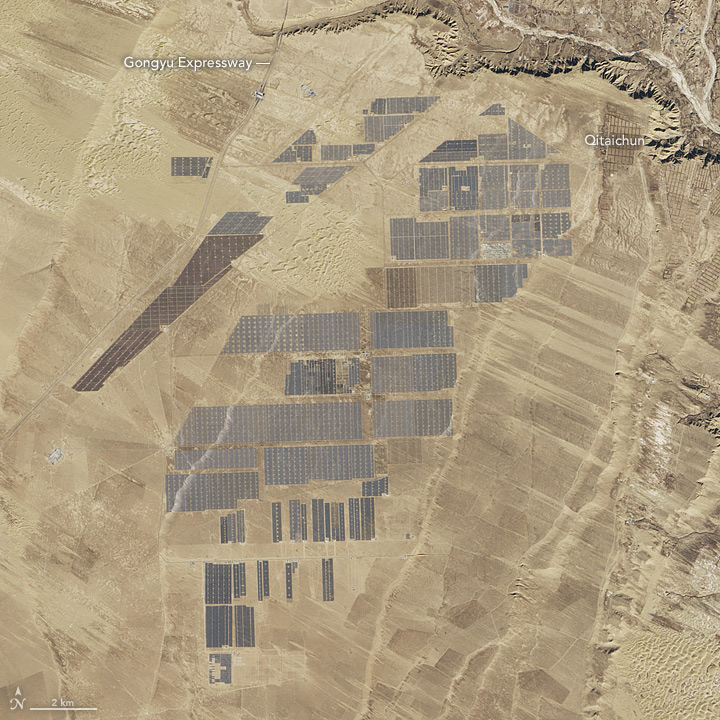
It has recently completed world’s largest solar pv farm “Longyangxia Dam Solar Park” which has an installed capacity of 850 MWs, enough to supply power to 200,000 households in the country. It plans further to enhance the installed solar pv capacity to a figure of 110 GWs by 2020. A satellite image of Longyanxia Dam Solar park project installed over an area of 30 square kilometers is as follows (Source: South China Morning Post, 2017):
When it comes to promotion of renewable energy technologies (RET), the State Council (i.e. governing body in China) is pumping money beyond its own geographical border and in far-flung countries like Egypt, Pakistan, Brazil, Indonesia, Vietnam and Ethiopia.
A graph representing the installed solar pv capacity in China from year 2010 on-wards is as follows:

An exponential growth in the installation of solar PV took place from year 2011, when a total of 2 GWs of SPV was installed in China. The same pattern repeated itself during the next five years. A whopping 34.24 GWs were installed in year 2016, which took the total installed capacity to over 77 GWs. A comparative analysis of clean energy investment made by China and European Union during 2005 – 2015 is as follows:
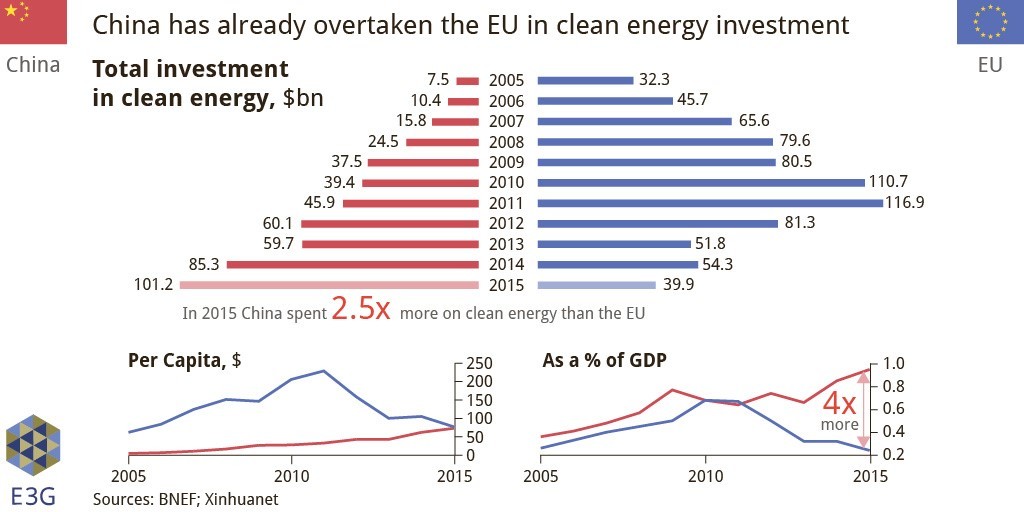
Again, it can be observed that the investments made by China in clean energy sector grew exponentially from year 2005 to 2015. It started from USD 7.5 billion in 2005 and reached to a highest figure of USD 101.2 billion in 2015. On the other hand, EU invested USD 32.3 billion in 2005 and reached a tipping point of USD 116.9 billion in 2011, finally sinking back to USD 39.9 billion in 2015. Thus, it can be concluded that the investment in clean energy sector has grown exponentially for China whereas, European Union has reflected quite an opposite trend. Finally, solar energy technology (SET) will expand further in China as it plans to enhance its SPV capacity to a whopping 110 GWs by 2020.
© Copyright 2017 Ayoub Hameedi. All rights reserved.
Gujarat: A Power House of Solar Energy in India
Ayoub Hameedi
The state of Gujarat secures a top position when it comes to total installed solar photovoltaic capacity in India. Other prominent states in the same field are Rajasthan, Maharashtra, Madhya Pradesh and Andhra Pradesh. Gujarat has a total installed solar pv capacity of 852 MWs, followed by Rajasthan with 553 MWs, Maharashtra with 100 MWs, Madhya Pradesh with 37 MWs, Andhra Pradesh with 23 MWs and all other states with a total installed capacity of 115 MWs, respectively. The current installed solar photovoltaic capacity represents 21.3% of the total installed renewable energy in Gujarat. On the other hand, installed wind capacity grabs a lion’s share with a total percentage of 77.8% respectively. Altogether, installed renewable energy capacity represents only 17.8% of the total energy mix in Gujarat. When it comes to power production, the existing gulf between the installed renewable energy and fossil fuels & nuclear power is astronomical. Thermal resource generates 76% of total electricity followed by nuclear power which is responsible for another 2.5%. On the contrary, hydro power generates 1.7% accompanied by 17.8% of power generation from solar, wind, biomass and small hydro.
The credit to promote solar energy in Gujarat belongs to Narendra Modi who is the current Prime Minister of India, too. He served Gujarat as Chief Minister for 13 years in a row. When he took the charge, Gujarat was facing an energy shortage and when he left the office to be the Prime Minister of India it was producing surplus energy . The state now produces 3 GWs more electricity than it’s requirement. This presents a financial opportunity where the surplus electricity could be exported to neighboring states to earn a strong revenue. Gujarat Solar park (GSP) is located in Charanka, Patan distict in Gujarat and has an installed capacity of 600 MWs respectively. The row after row of solar photovoltaic panels sits silently on top of brown soil and serves as a backbone when it comes to total installed solar PV capacity in India. GSP is also amongst the largest installed solar parks in the world. Another solar PV project is installed on top of Vadodara branch canal and is comprised of 35,000 solar panels. It has an installed capacity of 10 MWs and was completed with a final cost of USD 18.3 million.
It is appreciated that Narendra Modi took bold steps to promote solar energy in Gujarat however, still there lies challenges ahead for Gujarat in the sector of power generation. If Gujarat wants to be truly sustainable in terms of power generation, it needs to address these issues on priority basis. First and foremost challenge for the administration in Gujarat is to reduce the role of thermal power in the overall energy mix. It is also appreciated that the Government of India has cancelled an initiative to establish a mega coal power plant with a total install capacity of 4 GWs in Gujarat. However, more needs to be done to reduce the reliance on already installed thermal power plants as an immediate goal and to eventually decommission a major share of it in the long run. It is extremely important to highlight here that the available solar energy potential in Gujarat is extremely under-utilized. As per the National Institute of Solar Energy in India, the state of Gujarat has an estimated solar energy potential of 35.7 GWs whereas, the installed capacity is only around 852 MWs. A solar radiation map of the state of Gujarat is as follows:

There exist a gulf of 34.8 GWs of solar potential which could be utilized appropriately. It is important to highlight here that the overall installed capacity of Gujarat is 29.86 GWs out of which thermal power represents a lion’s share of 23.3 GWs, nuclear power represents 559.32 MWs, hydropower contributes 772 MWs and renewables represent 5.23 GWs. From a critical perspective, if energy policy makers in Gujarat invest technical expertise and financial resources to promote solar energy, it has ample potential to completely neutralize or decommission the already installed thermal and nuclear power in Gujarat. In fact, if all of the available potential is utilized Gujarat can produce 100% of its electricity through solar energy and would still have enough electricity to export it to neighboring states to earn revenue. It will reduce the expenses incur to keep the thermal power houses running and to dispose off the nuclear waste in a safe manner. Combine these financial savings with the revenues earned through the sale of clean energy to neighboring states, the administration of Gujarat will have sufficient financial resources to promote Sustainable Development and uplift masses out of poverty. It is quite unfortunate to mention that 41% of masses in Gujarat lives in poverty.
The state of Gujarat accounts for only 6% of total land mass of India whereas, represents 5% of the total population. It is also a key financial hub for India and like all other geographical areas, it has limited resources and a growing population to facilitate. However, despite all of these socio-economic challenges, it still managed to have a Gross State Domestic Product (GSDP) of 6.7% in 2015-16. It was the lowest Gujarat has enjoyed during the last decade. On the contrary, the GSDP for Gujarat was 10.8% in fiscal year 2012-13.
In a nutshell, the available potential of solar energy in Gujarat is quite impressive and if harvested sustainably, it would allow the administration to earn a fat revenue. This generated financial resource could then be utilized to uplift masses out of poverty and to further expedite the financial growth in state. Lastly, the recommendation is quite in line with Paris Climate Agreement when it comes to minimize the greenhouse gases emission. Gujarat can set an example for the rest of India to follow by satisfying 100% of its electricity demand from Solar energy. It will be a giant leap forward for Gujarat and will facilitate the administration to reduce reliance on thermal and nuclear sources of power generation.
© Copyright 2017 Ayoub Hameedi. All rights reserved.
The Implementation of Sustainable Development Goal 11 In India
Ayoub Hameedi
Urbanization has shown an exponential growth in India during last 50 – 60 years. According to the World Bank, 33% of the total population in India were residing in urban areas in 2015. In comparison, the same figure was 18% just half a century ago. It can be concluded that the urban population has nearly doubled during last 50 years. An important point to mention here is that the total population of India is over 1.2 billion people, so one-third of that would be 400 million people which is way more than the total population of United States of America. This figure is further expected to grow up to 590 million by 2030.
According to a Mckinsey Global Institute report, the number of middle class urban households in India was 22 million in year 2010. It is further expected to rise exponentially to 91 million by year 2030. An improved financial status of urban households would definitely motivate families to move to better quality houses, purchase private vehicles, send children to better quality academic institutes and eat from outside more often than before. All of these activities would certainly push urban areas to their ecological limits.
An important question to ask at this point is: What are the sustainable choices which could turn urban areas into engine of sustainability. First and foremost is the promotion of forests in urban areas. An area with a dense forest patch would have a better quality of air than in comparison to an area with no forest patch. Likewise, the presence of forest would certainly reduce the temperature too. A picture of a restored forest area in Delhi is as follows:

(Photo: Vinit Gupta/Mint, Source: Google Images)
Another significant step to improve the overall sustainability would be to create artificial lakes in urban areas. This strategy would not only provide urban residents a place to visit but would also supply water to residents, when needed. Monsoon season in India provides enough water to create artificial lakes in cities, where appropriate. An availability of both forests and lakes would definitely produce a refreshing affect on urban residents in India. Likewise, it will be resource efficient to create car-free zones to promote the use of bicycles and public transport in urban areas.
From a critical approach, the above mentioned strategies would promote Sustainable Development in the urban areas of India. An improved urban environment would lead to a better quality of life which would then result in more economic productivity and less medical bills. There is also a direct relationship between the forest cover of an area and property prices. The property prices would naturally be higher in an area with access to forest cover. The implementation of these policies would take time and resources but once successfully executed would transform urban areas into engines of sustainability.
© Copyright 2017 Ayoub Hameedi. All rights reserved.
Sustainable Water Resource Management in Israel
Ayoub Hameedi
This short report is on sustainable water resource management in Israel. It’s population is over 8.17 million and has a total geographical area of 20,770 square kilometers. 22% of Israelis live below the poverty line, however, the poverty line for Israel is USD 7.30 per person / day in comparison to the global average of USD 1.90. Approximately, a quarter of it’s land area is used for agricultural purposes and another 7.1% is covered with forests. Over 90% of masses lives in urban areas and almost everybody in Israel has access to drinking water and sanitation facilities. The smooth supply of water is only possible due to proper policy making, investment of financial resources and recycling. Israel exports water products worth USD 2 billion to the other countries on annual basis. A key technological solution that has been applied in Israel to mitigate water scarcity is seawater desalination.
Sorek Desalination Plant is located in south, 15 kilometers from the capital city of Tel Aviv. It is the largest seawater desalination facility in the world and has been constructed with a cost of USD 400 million by Israel Desalination Enterprise Technologies (IDE). It now provides 20% of the domestic water supply for 1.5 million people in Israel. A picture of Sorek Desalination Plant is available as under (Source: Water-Technology website):
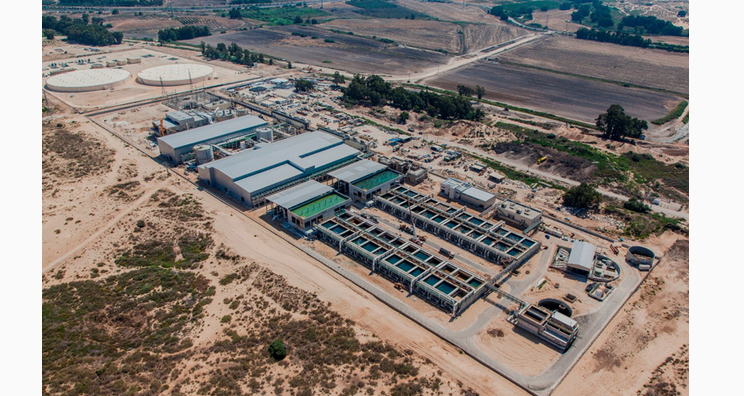
In October 2013, IDE Technologies did various tests to check the functions and operations of Sorek Desalination Plant. During next month, it cleared all tests and was in a full operational mode. The facility has the ability to produce 26,000 m3 of water per hour, 624,000 m3 of water per day and approximately 150 million m3 of water on annual basis. The technology applied in Sorek project is different from a traditional seawater desalination plant. Normally, a seawater desalination plant has horizontally installed membranes (each with a size of 8″) in a series of 6, 7 or 8 membranes, respectively. In Sorek desalination plant, each membrane is installed vertically and has a size of 16″ (i.e. twice the size of an average membrane). As a result, Sorek project is capable of producing 4.3 times more water under same operational conditions than a traditional reverse osmosis desalination plant. The principle technology applied in Sorek project is reverse osmosis and it is the largest and most advanced desalination facility in the world. It produces water at a price of 68 cents /m3.
IDE Technologies has two other reverse osmosis based desalination facilities in Israel namely Ashkelon Desalination Plant with an output capacity of 396,000 m3 / day and Hadera Desalination Plant with an output capacity of 525,000 m3 / day. All in all, Israel is systematically applying the technology of reverse osmosis to desalinate seawater to mitigate water scarcity. Besides desalination, the country recycles 90% of its wastewater and is a global leader when it comes to water recycling. The second on the list is Spain which recycles 20% of its waste water. World Resource Institute (WRI) has categorized Israel as a water stressed country, however, through the application of technological solutions, Israel is gradually overcoming its water scarcity to sustain its economy and exports. Israel is certainly an example when it comes to sustainable water resource management and countries with a similar environmental challenge can consider it as a case study to improve things further.
© Copyright 2017 Ayoub Hameedi. All rights reserved.
Jordan’s Journey To Achieve Sustainable Development Goals Through The Promotion Of Clean Energy Technologies
Ayoub Hameedi
Kingdom of Jordan received independence from United Kingdom in 1946 and is amongst the most politically liberal countries in the Middle East. It shares a border with Israel & West Bank in West, Syria in North, Iraq in East and Saudi Arabia in South East & South (Source: Encyclopaedia Britannica. Inc).

Desert represents 80% of the geographical area of Jordan and the remaining 20% is suitable for living. Agriculture is an important sector for Jordanian economy and it formulates over 12% exports on annul basis. The potential of renewable energy resources particularly solar and wind is extremely rich. With proper policy making and implementation, these resources can produce over 60 times the total expected electricity demand of Jordan in 2050. Unfortunately, Jordan still spends around USD 4 billion (approximately 13.5% of GDP) on annual basis to import resources to satisfy its energy demand. In comparison, the price of solar modules have dropped around 75% since 2009 and is further expected to decrease in future too. According to Bloomberg New Energy Finance, solar panels will generate 15% of total electricity at global level by 2040. Likewise the cost of a wind turbine has dropped between 30% – 40% since 2009 and is further expected to decrease another 24% – 30% by 2030. As per International Energy Agency and Global Wind Energy Council, wind turbines would generate 6% – 15 % of global electricity by year 2040. Therefore, it makes financial sense to develop solar and wind parks in Jordan. It also highlight the fact that energy policy making in Jordan is not coherent with the ground realities. The development of clean energy resources will provide a business opportunity to Jordanian Government to export clean electricity to its neighboring countries and to earn revenue. From a critical approach, all the neighboring countries of Jordan would be interested in buying clean electricity provided offered at a reasonable price. A solar radiation map of Jordan is as follows:
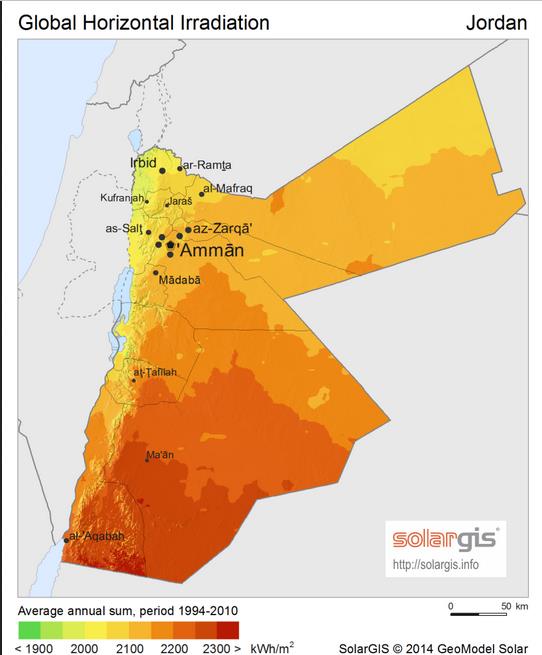
The geographical location of Jordan is ideal to generate electricity through solar photovoltaic panels. The intensity of solar radiation is the highest in southern region. At present, the country has an installed electricity generation capacity of 3.3 GWs. From a policy approach, replacing a conventional infrastructure of 3.3 GWs with clean energy technologies within 12 months is quite realistic and achievable, for example, India installed 4 GWs of solar photovoltaic capacity in year 2016. The implementation of this strategy would enable Jordanian authorities to save USD 40 billion in a decade which could be reinvested into developing local economy to uplift masses out of poverty. Even half of that money would be sufficient enough to turn things around in a positive manner.
According to Jordan Times, financial unsustainability pushes 33% of Jordanians into poverty for few months every year. A strategic solution of developing a 100% clean electricity generation system would enable authorities to promote sustainable economic growth in Jordan and achieve Sustainable Development Goals (SDGs) in a decade. The total population of Jordan including refugees is a mere 8.1 million. With proper policy making, achieving SDGs for 8.1 million is a realistic and achievable target. An investment of USD 40 billion can enable authorities to eradicate poverty on absolute basis. Once poverty is eliminated, prevailing hunger will be eradicated too. Both of these factors would then lead to an effective strategy making when it comes to provision of clean water and sanitation facilities to Jordanian people. The satisfaction of basic needs would then improve the quality of life of masses, promote gender equality, eliminate corruption and would reduce overall inequality in the country. However, a transparent accountability system needs to be in place to ensure the continuity of the process. In-short, clean energy technology is a key to achieve Sustainable Development Goals in Jordan.
© Copyright 2017 Ayoub Hameedi. All rights reserved.
Climate-Smart Solutions To Mitigate Water Scarcity in Balochistan
Ayoub Hameedi
This report gives a short but brief summary of water scarcity issue in Balochistan and how this environmental challenge can be resolved in a sustainable manner. But first, a quick overview of water scarcity in Pakistan would be presented to the readers. As per a Deutsche Welle (DW) report, water scarcity in Pakistan is a far bigger challenge than terrorism. It further states that the country is likely to run out of water by 2025. Pakistan, as a whole is the third most water stressed country in the world. The per capita water availability is only 1,017 cubic meters in comparison to 1500 cubic meters in 2009. The severity of this issue can be understood through this remarkable decrease in per capita water availability within a span of a decade. The economy of Pakistan is certainly the most water intensive in the world and it secures fourth spot when it comes to the usage of water across the globe. All these facts point in the direction that some serious policy measures needs to be taken at both local and national levels before this environmental challenge runs completely out of hand.
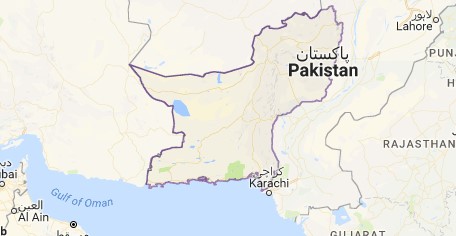
Balochistan is the largest province in terms of its size. It spans over an area of 0.35 million square kilometers which represents 44% of the total geographical area of Pakistan. The length of its coastline is 770 kilometers which represents 70% of the total coastline of Pakistan. Certainly, Balochistan is the gateway to Pakistan and therefore, it is in the best of interest of Government of Pakistan to invest financial and human resources to develop the potential of this province. The key environmental challenge for Balochistan province is the extreme shortage of water. World Bank has categorized Balochistan as the least water secure province in Pakistan. Among all other sectors, Agriculture sector is the most water intensive as it utilizes 97% of the total water in the province. Consequently, farmers are the most vulnerable to acute shortage of water. However, the introduction of sustainable practices in agriculture sector can minimize the risk of water shortage over the period of time. A geographical map of Balochistan is as follows (Source: Google maps):
A question which arises at this point is what can be done to introduce sustainable practices in the agriculture sector of Balochistan. The first and the foremost step is to introduce drip irrigation system. The Government of Balochistan can focus on three points in this regard: i) train farmers to apply drip irrigation technique (ii) construct infrastructure to ensure a sustainable supply of water (iii) introduce a legislation in provincial parliament of Balochistan that agriculture sector needs to be more resource efficient (i.e. to produce more from less). The provincial government can seek help from Netafim company, a pioneer when it comes to the drip irrigation technique. It is important to mention here that the Indian unit of company won a project of worth USD 62 million to efficiently drip irrigate 29,000 acres (11,800 hectares) of land in Bagalkot in the state of Karnataka, India. It is certainly the largest drip irrigation project in the history of Netafim Irrigation India Private Limited.
Applying drip irrigation technique can bring a “Green Revolution” in Balochistan. It would enable the farmers to grow more food from less water. More food means more access to financial resources which would then improve the quality of life of farmers and their families. This would introduce a sustainable socioeconomic revolution at provincial level. It cannot be ignored that an exponential economic growth in Balochistan means an exponential economic growth in Pakistan, so actions must be taken accordingly, in this regard. Besides drip irrigation, a key step in this regard would be to recycle the household wastewater for the sake of irrigation. Israel recycles more than 80% of its household water (i.e. approximately 400 million cubic meters) and then utilize it to grow food. Recycling would not only increase the access to water but would also create more jobs in the recycling sector. Another idea to increase water supply for the sake of irrigation is to opt for seawater desalination plants powered by wind farms and solar parks. Israel Desalination Enterprise (IDE) Technologies is operating a reverse osmosis desalination plant “Sorek Seawater Desalination Plant” which is located in the outskirts of TelAviv, the capital city of Israel. The plant has been established with a cost price of USD 400 million and can produce 624,000 m3 of water on daily basis. It is capable of satisfying domestic household water demand of 1.5 million people in Israel.
In terms of policy recommendation, the plan is to replicate the same strategy in Balochistan to increase water supply for the sake of irrigation. Assuming that the Government of Pakistan allocates a budget of USD 500 million to implement this strategic solution to mitigate water scarcity in Balochistan. 80% of the allocated budget (i.e. USD 400 million) can be utilized to establish a desalination facility whereas, the remaining 20% budget (i.e. USD 100 million) can be used to ensure clean energy supply to the desalination plant. Altogether, with an investment of USD 100 million, approximately 50 MWs of wind power and 27 MWs of solar power can be installed which could generate over 28 GWs (i.e. 28,000 MWs) of clean electricity on annual basis. The price of solar photovoltaic modules have decreased 80% since 2009. Similarly, the price of a wind turbine has also fallen approximately 30 – 40 % since 2009. These prices are further expected to fall in future too. It can be concluded that clean energy technologies are becoming price competitive to their counterparts.
With an investment of USD 2 billion, Government of Pakistan can construct four seawater desalination plants in Balochistan. The project could provide province with 2.5 million m3 (i.e. 624,000 m3 of water x 4 desalination plants) of drinkable water on daily basis. A total installed capacity of 308 MWs of renewable energy (i.e. 108 MWs as solar based and 200 MWs as wind based) would be there to satisfy the electricity demand of these seawater desalination plants. Besides being carbon-neutral, these facilities would be able to generate 112.4 GWs (i.e. 308 MWs x 365 days) of clean electricity on annual basis. Government of Pakistan can create “Balochistan Clean Energy and Seawater Desalination Board” for the effective management and execution of this project.
An investment of USD 2 billion would enable Government of Pakistan to generate over 911 million m3 of clean water on annual basis (i.e. 2.5 million m3 x 365 days) which could be utilized to promote agriculture in Balochistan via drip irrigation technology. The proposed project would guide Balochistan and its masses towards food, water and electricity independence and certainly open a new window of opportunity to conduct business in the province. Moreover, 112 GWs of clean electricity could be used to supply electricity to households in rural areas, once the electricity requirement of desalination plants are satisfied. Lastly, the proposed project is financially feasible, socially equitable and environmentally sustainable to implement. The problem is not the availability of natural resources but lack of financial resource, technical expertise and a sheer will to get things done.
© Copyright 2017 Ayoub Hameedi. All rights reserved.
Transforming Lahore Into A Truly Sustainable City
Ayoub Hameedi
It is believed that the ancient city of Lahore was founded by Lava the son of a Hindu God Rama. As settled in Hindu mythology, Rama or Ramacandra was the seventh avatar of Hindu God Vishnu. The city itself has both brutal and beautiful aspects of history. It served as the capital of Ghaznavid Dynasty from 1163 to 1186. The city was then ramsacked by Mongols from 1241 to 1398. It was Trukish Conqueror Timur who ruled city from 1398 onwards. The city was then captured by Mughal Emperor Babur in 1524, who also lead the foundation of Mughal Dynasty in sub-continent. Lahore was selected as a place for Royal residence and therefore it acquired a central place in the Mughal Dynasty. Mughal Emperor Akbar maintained Lahore as his headquarters from 1584 to 1598. Between 1707 – 1750, Lahore was a battlefield between Mughals and Sikhs but out of the blue, the city fell a victim to an Iranian conqueror Nadir Shah around 1750. Close to the end of century, Ranjit Singh took control of Lahore. After his death in 1839, political scenario started to deteriorate and by the mid of 19th century, Britishers were the absolute rulers of Lahore. A century later, it became the capital city of Punjab province in Pakistan.
Lahore is also a mosaic of fine arts, theatre, architecture and literature and it has produced legends in these fields too. Sir Ganga Ram, Syed Maratib Ali Family, Chughtai Mughal Family and particularly Abdur Rehman Chughtai, Qizilbash Family and Sheikh Family are few examples in this regard. City also hosted reknown artist Gimmy Engineer during his tenure at National College of Arts (NCA) for three years. Lahore is amongst the financial engines when it comes to gross domestic product share in the region of Asia Pacific.
The current administration of Chief Minister Shehbaz Sharif is working hard to implement sustainability specifically in the sector of public transport through the introduction of metro bus service which is already in an operational phase and an extension of it in the form of an urban rail system which is already in a constructional phase. It is important to highlight here that an efficient and environment friendly urban transport system is a must for every sustainable city. Metro system in Delhi is an example in this regard as it facilitated over a billion passengers during April 2016 to March 2017. It is appreciated that the current administration is trying its best to preserve the historical essence of the city during the construction of urban rail project however there are still concerns among general public which needs to be addressed sustainably. It is a basic right of Lahorites to satisfy their appetite for history and culture and it should be preserved on priority basis. Besides an efficient public transport system, there are three key areas namely forest cover, renewable electricity generation and water recycling which will decide whether city & its inhabitants will have a sustainable future or otherwise. An implementation of these strategies is slightly complex in nature as the city has limited resources and its population is growing astronomically. However, the proposed solutions are realistic and achievable provided proper planning, physical and financial resources are invested in this area.
A key challenge is to enhance the number of trees as every sustainable city in the world has an adequate forest cover. A sustainable solution is to use the available space within city in an efficient manner. There are a number of steps which can be taken in this regard. First and foremost is to use the available space on all footpaths to plant trees. As a second step, city administration can create more space within the boundaries of city to establish parks with dense forest patches so that the inhabitants would have a place to relax and have a quality time. This would also reduce the pollution in city and would minimize stress among its inhabitants. It would also reduce the expenses of local government when it comes to health related expenditure in public hospitals. An effective method could be to prefer a vertical growth of city instead of a horizontal one. As a third step, plantation of trees along the ring road will be a good idea too as all the major cities across the globe have forest cover that lies in the outskirts of the city. An important point to consider is to have a strong check and balance in place so that the planted saplings would grow mature and would not suffer from deforestation. A diagram representing the idea is as follows:

Imagine that the white space in center resembles Lahore city and its infrastructure whereas the green space encircling it is the proposed forest patch in the outskirts. The city of Gandhinagar in India has 3.2 million trees and is therefore an example in this regard. Likewise, Johannesburg is the amongst the largest urban areas in South Africa but still manages to have 6 million trees in its vicinity.
In terms of renewable energy, it would be resource efficient to install both micro and macro scale renewable energy projects in Lahore. An effective strategy is to install solar panels on top of canal in Lahore. It will reduce water loss through evaporation and will produce electricity too. A one megawatt (MW) solar photovoltaic project on top of Narmada canal in India generates 1.6 million units of electricity on annual basis. It also prevents evaporation and thus saves 9 million liters of water as well. Another idea is to install solar panels on the roof tops of metro buses and trains in Lahore. Again an example can be considered from India where the aforementioned strategy is in implementation phase. Once completed, the plan will facilitate Indian Railways to save 7 billion Indian Rupees on annual basis. It also means that Indian Railways would be able to save 70 billion Indian Rupees (i.e. over USD 1 billion) in a span of decade which could be further reinvested to promote sustainability within Indian Railways. The city government of Lahore can also choose to replicate the same strategy in order to harvest the same benefits over the span of a decade. The roof tops of government buildings in Lahore can also be equipped with solar panels. It is important to highlight here that the prices of solar panels in international market have decreased 85% since 2009 and is further expected to decrease another 59% by 2025. On the contrary, generation of electricity through fossil fuels is an expensive method and is also anti to Paris climate agreement too. Cleantech companies in China can provide required expertise to install the clean energy projects in Lahore. They can also facilitate in the maintenance of the installed infrastructure through the transfer of required technical expertise.
Lahore Waste Management Company collected 6150 tons of waste on 25th of August 2017 which is seriously harmful for environment if it ends up in landfills. On the contrary, it would be an extremely valuable resource if channelized for the sake of power production through waste to energy power plants. Sweden is an example when it comes to the production of electricity through waste as it produce 3 MWs of energy from each tonne of waste. As a result of this strategy, the amount of waste ending up in landfills in Sweden has sharply reduced since 1994. Keeping the figure for collected waste in Lahore as static, a production of 1 MW of energy per tonne of waste would generate over 6000 MWs (i.e. 6 GWs) of energy on daily basis. Combine that with the micro scale solar photovoltaic projects in Lahore, these initiatives will collectively guide Lahore to a complete energy independence even when considered running proposed metro rail and in operational metro buses on clean energy. Most importantly, less waste will end up in landfills and more land would be available for housing and employment generation activities.
Another key challenge for city government is to satisfy the water demand of its inhabitants. The problem is expected to become worse in the coming decade due to an exponential growth in population. A sustainable solution is to install water recycling plants in order to reuse the water for agricultural purposes, watering the plants, washing cars and for other secondary activities. Rain water harvestation can also improve the availability of water. What can be done in this regard is to equipped the buildings in Lahore with rain water harvestation system and allow the water to be collected in artificial lakes within the city. This would improve the underground water table of Lahore too. When it comes to water recycling, Spain is the second most water efficient country in the world as it recycles 17% of its used water. On the other hand, Israel is the most water efficient country as it recycles 86% of its water and reuse it for agricultural purposes.
In order to increase the attractiveness of Lahore, City government can choose to install art pieces and sculptures in squares across the city. It will increase the number of tourists in Lahore which will then lead to more revenue earnings with reference to tourism. Combine that with the financial savings likely to take place as a result of clean energy generation, the city administration will have ample money to reinvest in whole of the province for the sake of development. Chief Minister Shehbaz Sharif and his administration is already working hard to address these issues however, there is always a room for improvement.
All of the aforementioned strategies are realistic in terms of implementation however, any sustainable change will take at least a decade to occur. These strategies will make Lahore more sustainable in terms of resource utilization and will help it to attain the same status it once enjoyed in history. Finally, it is a must to ensure proper maintenance of the installed infrastructure and a follow-up of the implemented strategies so that same system could be handed over to the coming generations too.
© Copyright 2017 Ayoub Hameedi. All rights reserved.
Solar Energy As An Excellent Window of Opportunity for Pakistan
Ayoub Hameedi
Climate Change is a crucial environmental issue of 21st century and countries across the globe are taking appropriate policy measures to address it in a sustainable manner. All the developed and rapidly developing countries have signed Paris Climate Agreement to reduce carbon dioxide and other greenhouse gases emission. The primary objective of Paris Climate Agreement is to keep the global temperature rise below 2°C and a key strategy to achieve this target is to promote the use of clean energy technologies across the globe. It’s only United States of America, Syria and Nicaragua who didn’t agree to it. Pakistan signed the Paris Climate Accord on 22 April 2016 and ratified it on 10 November 2016. It was then implemented on 10 December 2016. A key question which arises concerning the implementation of Paris Climate Agreement in Pakistan is what can be done to achieve it’s goals and objectives. The answer is realistic, achievable and a perfect financial opportunity to turn things around positively in Pakistan. Prime Minister Shahid Khaqan Abbasi has all the powers to make it happen for the greater good of Pakistan and it’s masses.
Transport, power production and industrial sectors are the three largest consumer of oil in Pakistan. Transport accounts for 48% followed by power generation with 36% and industrial sector with 12% of oil consumption on annual basis in Pakistan. As per an article published in The Nation newspaper in Pakistan, the country planned to spend USD 15.68 billion on the import of oil during fiscal year 2014 – 15. The amount was almost the same the Government of Pakistan spent in 2013 – 14 to import oil. So, collectively, the Government of Pakistan spent USD 31.36 billion on the import of oil during 2013 – 15. Now assuming that the price of oil remained static which is quite unlikely, the Government of Pakistan spent USD 156.8 billion during last decade to import oil in Pakistan. Again assuming the price would remain static, the government of Pakistan will spend another USD 156.8 billion in the coming decade. All the previous, present and coming Governments in Pakistan will spend a hefty figure of USD 313.6 billion during 2004 – 24 to import oil to satisfy energy demands in the sectors of transport, power production and industry. It is equally important to mention here that if one-third of this amount (i.e. USD 104.5 billion) is invested to promote solar energy in Pakistan, the country can easily satisfy 100% of its electricity demand in all three areas. At global level, solar energy technology is one of the most preferred renewable energy resource and it’s installed capacity is likely to hit a milestone of 390 GWs by the end of 2017.
In 2015, the total installed power generation capacity of Pakistan stood at 24,857 MWs (or 24.85 GWs). The mosaic of power production in Pakistan was based on hydro, thermal, nuclear, solar and wind sources of power generation. When it comes to installed solar photovoltaic capacity in Pakistan, Quaid-e-Azam (QA) solar park is a milestone with an installed capacity of 100 MWs. The solar park has produced 320.6 GWs (i.e. 320.6 million Kilowatts) of solar energy since its inauguration and has also managed to earn an audited and unaudited revenue of USD 23.7 million (i.e. Pkr 2.5 billion) from 2015 – 17. However, the installed QA solar park is just a fraction of the available solar energy potential in Pakistan.
Pakistan is one of the most blessed countries in the world as it receives 200 – 250 watts per meter square and a total of 1500 – 3000 hours of sunshine each year. As per an estimation, the solar energy can produce 2900 GWs (i.e. 2.9 million MWs) of clean electricity on annual basis in Pakistan. Keeping in mind the installed solar photovoltaic capacity of 100 MWs, the energy authority can still utilize over 2800 GWs of unexploited potential of solar energy in Pakistan. It is 111 times more than the current installed capacity of 25 GWs in Pakistan. If utilized to its fullest potential Pakistan can produce 100% of its electricity through solar energy to satisfy its demand at both domestic and industrial level. Even after that, the administrative body would still have ample electricity to export to neighboring India, Afghanistan and Iran to earn a fat revenue. Moreover, the Government of Pakistan can ban the sale of fossil fuel powered cars and can replace all vehicles with electric cars by 2030. The power minister of India Piyush Goyal has suggested this strategy to the Government of India in order to ease the compliance of Paris Climate Agreement and to achieve it’s goals and targets.
A 100% clean production of electricity in Pakistan will allow the Government to save over USD 156.8 billion expected to be spent by Government of Pakistan on the import of oil during the next 10 years. Let’s assume even if USD 78.4 billion would be spent on the installation of 100 GWs of solar energy in Pakistan with a uniform electricity transfer system in all across Pakistan to cope with power shortages, still 78.4 billion would there to reinvest in local economy to uplift masses out of poverty. A uniform electricity transfer system will help in the storage of surplus electricity which can then be transferred to other areas within Pakistan which would be suffering from electricity shortage on temporary basis for an hour or so. It would also facilitate the energy authority to monitor as to how much electricity was generated, how much of it was consumed and how much of it was left to be exported to neighboring India, Afghanistan and Iran for the sake of revenue earnings. An installed capacity of 50 GWs can be utilized to satisfy domestic and industrial demand in Pakistan whereas, the remaining installed 50 GWs can be used to export electricity to Iran, India and Afghanistan. It will also create tens of thousands of jobs in Pakistan to keep the system in operation in a sustainable manner. It will also decrease unemployment ratio and will also increase the current tax ratio for Government of Pakistan.
As per the United Nations Development Program (UNDP), almost 39% of population lives in poverty in Pakistan. The figure is the highest in FATA with 73%, followed by Balochistan with 71%, Khyber Pakhtunkhwa with 49%, Gilgit – Baltistan & Sindh with 43%, Punjab with 31% and finally Azad Jammu & Kashmir with 25% respectively. An investment of USD 78.4 billion will promote socio-economic growth in Pakistan and will set the GDP growth ratio at a constant rate of at least 5 – 6% per year for the coming 10 – 20 years. It will facilitate the Government of Pakistan to construct and upgrade schools, colleges, Institutes, Universities, roads and hospitals in far flung areas of Pakistan. It will also facilitate the Government to offer either free education & medical facilities or at a bare minimum fees to every Pakistani without any discrimination on the basis of either caste or religion. Moreover, it will also facilitate the Government of Pakistan to get rid of its circular debt which currently stands at a hefty amount of USD 3.93 billion (i.e. 414 billion PKr). In addition, an export of electricity to neighboring countries will create a constant source of revenue for Government of Pakistan. It would also help Pakistan to be a part of rapidly developing economies of Brazil, Russia, India, China and South Africa (BRICS) and might modify the group as BRICSP with P resembling Pakistan in the league.
Summing things up, the cost of solar photovoltaic modules has dropped 80% since 2009 and is further expected to drop an additional 59% by 2025. The technology has matured a lot during last decade and the neighboring India has already installed over 12 GWs of solar energy. Likewise, China has installed 30 GWs of solar photovoltaic capacity in 2016 and plans to install an additional 30 GWs in 2017 as well. Now is the perfect time for Government of Pakistan to expedite the installation and expansion of solar energy in Pakistan. Solar energy is the best strategy to achieve the targets of Paris Climate Agreement and to set Pakistan on a constant growth rate of 5-6% on yearly basis for next 10 – 20 years. It will uplift masses out of poverty and will increase the number of middle class families in society. Finally, there is a dire need to have a monitoring body in place which would ensure transparency and a sustainable supply of electricity to end the prevailing darkness in urban and rural areas of Pakistan.
© Copyright 2017 Ayoub Hameedi. All rights reserved.
Waste-To-Energy Power Plants can set Pakistan on the path to achieve Sustainable Development Goals by 2030
Ayoub Hameedi
In 2017, World Bank categorized Pakistan as a lower middle income country and further stated that it performed the least in human development indicators particularly in education and stunting in the region of South Asia. The given facts represented serious priority areas to focus on to achieve sustainable development goals in Pakistan by 2030. The given problem might appear complex in nature however the required solution is both feasible and realistic provided proper attention and enough resources are diverted to address the issue. Punjab province is the largest province in terms of population in Pakistan and it maintained a progressive economic growth ratio of 3.6% on annual basis from 1999 to 2014. The cities of Faisalabad, Lahore, Gujranwala, Rawalpindi, Sialkot and Multan are the engines of economic development in Punjab. On per annum basis, the city of Faisalabad alone generates around 20% of the national gross domestic product (GDP) with a revenue of USD 20.5 billion, followed by Lahore with 13% share of the national GDP and a revenue of USD 13 billion, respectively. With right policies in place, the annual revenue from Lahore is expected to grow exponentially to USD 102 billion by 2025.
All of the already spoken cities within Punjab province produce municipal solid waste in a staggering amount on daily basis. The city of Lahore generates over 6000 tonnes of waste in a day . Likewise, the city of Faisalabad generates over 1100 tonnes of waste within 24 hours. The cities of Rawalpindi, Gujranwala, Multan and Sialkot collectively produce over 3000 tonnes of waste on daily basis. Altogether, the six major cities in Punjab province collectively produce over 10,000 tonnes of municipal solid waste in 24 hours. Now, the policy makers in Pakistan can either choose to see it as a major environmental problem or as a useful resource to generate clean electricity and heat. By choosing to see it as a solution, the policy makers will certainly reduce the fossil fuel import bill of Pakistan and the saved billions of dollars in that case could then be used to pay the financial debts that now stands at a whooping USD 89 billion. The sustainable waste management and establishment of waste-to-energy power plants will provide jobs to the unemployed and the cumulative effect will then trickle to rest of the families too.
Now assume that 10 waste-to-energy (WTE) power plants are installed each with a capacity to process 1000 tonnes of waste and an ability to produce 1 MW of clean energy from each ton of waste, all plants would generate 10 GWs of clean energy on daily basis in Punjab province. The given idea is both realistic and feasible as Sweden generate 3 MWs of energy from each tonne of waste. It must be appreciated that Sweden extracts more energy from each tonne of waste than any other country in Europe. A primary lesson that Sweden leaves for Pakistan is to see its waste as a precious resource to produce energy. It is equally important for policy makers in Pakistan to place emphasize on reducing the creation of waste in the first spot. Unfortunately, 31% of masses in Punjab are poor and thus are not capable to play their role when it comes to the economic development in Punjab. On top of that, the province alone consumes 67% of the total generated electricity in Pakistan and there still exist a gap of 4 GWs when it comes to demand and supply of electricity in Punjab. Thus generation of clean energy from municipal waste in Punjab will reduce the amount of waste ending-up in landfills that would be sustainable from an environmental point of view, increases the clean power generation and would create jobs for the unemployed. Besides that, the establishment of waste-to-energy power plants in Punjab will certainly leave enough electricity that could then be delivered to energy deprived masses in other parts of Pakistan.
It is quite unfortunate to mention that Pakistan spends over USD 11 billion on per annum basis to import oil products to generate electricity and power transport sector. Thus, if policy makers would reduce the import of oil by 36% by replacing that need with waste-to-energy power plants, it would allow the government of Pakistan to save USD 4 billion per annum, USD 40 billion in a decade and USD 80 billion in 20 years. This amount could then be utilized to pay 90% of the existing foreign debts of Pakistan by 2038. Installation of waste-to-energy power plants all across Pakistan will certainly leave more land that could then be used for better purposes like housing and food production. A lion’s share of power will be produced through clean sources that could sharply reduce oil import and to further promote socio-economic growth in Pakistan. Finally, an increase in forest cover to minimize emissions from waste-to-energy power plants will be another right step in the right direction. Pakistan has one of the lowest forest cover in the world and certainly needs to address the issue if it wants to ensure a sustainable future for coming decades. It is a commonly known fact that trees are a nature’s carbon capture and storage devices as they reduce the concentration of greenhouse gases in atmosphere. The given solutions to achieve Sustainable Development Goals by 2030 are both realistic and attainable provided proper time, energy, financial resources and an effective follow-up are channelized in this direction.
© Copyright 2018 Ayoub Hameedi. All rights reserved.
The Implementation of Sustainable Development Goal 6 In Pakistan
Ayoub Hameedi
Pakistan is a developing country and like all other progressing countries, it has a lot of challenges to address. Sanitation is just one of them. A report “The economic impacts of inadequate sanitation in Pakistan” published by Water and Sanitation Program (WSP) reflects that inadequate sanitation facilities caused a financial loss of USD 5.7 billion (3.94% of Gross Domestic Product) to Pakistan in year 2006. Similarly, another report “Progress on Sanitation and Drinking Water – 2013 update” published by World Health Organization (WHO) and United Nations International Children’s Emergency Fund (UNICEF) pointed out that 23 percent of the population (i.e. over 40 million) lacked access to adequate sanitation facilities in year 2011. However, the same report also recognize the improvements shown by Pakistan during last 2 – 3 decades. Almost, 52 percent of population in the country lacked access to sanitation facilities in 1990. Continuous efforts by Government of Pakistan and various non-for-profit organizations have reduced the figure by 29 percent during last 2 decades. Nonetheless, more needs to be done to tackle the figure down to zero percent.
A case study from India will highlight the benefits of having access to toilets. The residents of Pongvnantnagar village in Krishnagiri district in Tamil Nadu, India lacked access to toilets before 2008 and everyone used to perform call of nature in open areas, which created numerous problems. However, the situation improved a lot with the introduction of an innovative solution “EcoSan toilets”. These toilets are capable of collecting feces, urine and wash water separately. The feces are stored in a sealed chamber to be used as a high quality manure in later stages and urine is used for farming. The waste water is utilized for the purpose of kitchen gardening. The story started with “Venu” who was the first one to opt for ECOSAN toilets in Pongvnantnagar village in India. The example of Venu motivated others to adopt zero waste toilets. Likewise, introduction of an ECOSAN toilet in Thimmapuram Government High School was appreciated by the students, who later encouraged their parents to construct a similar facility at home in villages across Thimmapuram Panchayat. The design of an ECOSAN toilet is available as under (Source: Google images):

Government of Pakistan (GOP) can introduce ECOSAN toilets in schools across all districts in Pakistan. Besides installation, children should be encourage to use the facility without any hesitation. It would initiate a chain reaction as children would then motivate their parents to have toilets at home too. In the areas with no academic facility, toilets should be installed free of cost and masses should be encouraged to use them. International organizations like Bill & Melinda Gates Foundation, Water.org, DFID UK, AUSAID, UNICEF and Global Water are already extensively working on this issue and their rich experience can benefit GOP in this regard.
To Summarize, an inadequate sanitation facility is a serious social, economic and environmental challenge for Pakistan and it should be addressed on priority basis. The solution is realistic and financially feasible provided resources like time, finances and energy are invested in this direction. It is only then the policy makers in Pakistan would achieve Sustainable Development Goal 6 “Clean water and sanitation” in a sustainable manner.
© Copyright 2017 Ayoub Hameedi. All rights reserved.
Paris Climate Agreement & An Untapped Geothermal Energy Potential In Indonesia
Ayoub Hameedi
Indonesia was a Dutch Colony from 1600 to 1942 and was commonly referred to as Dutch East Indies. In 1670, Netherlands introduced political reforms and started implementing colonial rule via a single government. The centralized form of governance lasted till 1900 due to the beginning of a political turmoil in Dutch East Indies. The situation for colonial empire became even worse around 1929 – 1930 as the masses decided to tackle colonial rule as one nation with same language. Japanese invasion of Dutch East Indies during World War II (in 1942) proved to be a blessing in disguise as it eased the path of Indonesian decolonization with the help of independence leader Sukarno. Finally after the years of guerrilla war, Netherlands recognized the independence of Indonesia in 1949.
Indonesia has 17,058 islands which are spread over 5,000 kilometers from Southeast Asia to Oceania. It shares border with Papua New Guinea, Timor Leste, Malaysia, Singapore, Philippines and Australia. It is rich with both conventional and unconventional sources of electricity production. It has around 120.5 billion tons of coal reserves enough to satisfy domestic consumption for 146 years, proven oil reserves of around 3.69 billion barrels enough to meet domestic demand for 23 years and 101.54 trillion cubic feet of natural gas reserves which are enough to satisfy the domestic needs for 59 years. It is also the fourth largest exporter of liquefied natural gas (LNG) surpasses only by Qatar, Malaysia and Australia. In addition, it has a hydropower potential of 75 GWs, biomass potential of over 32 GWs and has 40% of the global geothermal resources. The proven geothermal resources are estimated to be around 28 GWs. Indonesia has a total population of over 257 million with a gross domestic product (GDP) of over USD 858 billion. It has a total installed capacity of 55 GWs with 6% of it as renewable sources of electricity production. It plans to escalate the share of renewable energy resources to 23% by 2025. According to an Asian Development Bank report, 95.24% of primary energy in Indonesia is generated through fossil fuel reserves namely oil, coal and gas. Oil contributes 46.08%, coal generates 30.90% and gas produces 18.26% of the total primary energy. On the contrary, renewable resources namely hydropower and geothermal hardly generates 4.36% of primary energy. Hydropower generates 3.21% of primary energy followed by geothermal with a mere share of 1.15%, respectively. There is a dire need to enhance the share of geothermal energy in the overall energy mix of Indonesia With proper policy making and implementation, the role of geothermal energy can be optimized efficiently.
In 2004, the Ministry of Energy and Mineral Resources (MEMR) published a blueprint for the promotion of geothermal energy in Indonesia with an aim to install 6 GWs of it by 2020. The policy was designed to enhance the share of geothermal energy several-fold however, a decade later in September 2014, the total installed geothermal capacity was a mere 1.396 GWs. It represented only 4.3% of the original goal initiated through the publication of blueprint. One of the key challenges for Indonesia is to reduce its reliance on fossil fuels particularly on both coal and oil which are amongst the most carbon intensive sources of power generation and produces 77% of total energy. A sustainable alternative would be to neutralize these two sources via optimizing geothermal resources to their fullest available potential. From a strategic point of view, minimizing CO2 emissions is a must if Indonesia has to commence sustainable economic progress. It is equally important to mention here that Indonesia is amongst the largest emitters of carbon dioxide on annual basis across the globe. It produced 760 million metric tons of carbon dioxide in year 2012. The emission scenario becomes even worst if the deforestation and other land uses are taken into account too for 2012. In that particular case, the combined GHG emission was around 1,981 million tonnes. Indonesia signed the Paris Climate Agreement on 22 April 2016 and it came into force on 30 November 2016. Therefore, it has a responsibility to take strict measures to reduce its GHG emissions. It plans to reduce 29% of its emission by 2030 and what strategy could be better to achieve this target than to utilize indigenous geothermal energy resources. Assuming that the total installed capacity of Indonesia becomes 60 GWs in 2022, an installed 20 GWs of geothermal energy at that point will represent 33.33% of the total generational capacity. It would also mean that 33.33% of GHG emissions are neutralized too. The promotion of geothermal energy will push Indonesia towards clean energy independence and will facilitate the current and incoming governments to achieve the target of Paris Climate Agreement in a sustainable manner.
© Copyright 2017 Ayoub Hameedi. All rights reserved.
Enlil : A cleantech solution to increase sustainability in cities
Ayoub Hameedi
According to United Nations (UN), 54% of the global population lived in urban areas in 2014 and the same figure is expected to reach 66% by 2050. An exponential growth in urban population presents us challenges that have never been addressed before in human history. Common examples of these challenges are adjusting billions in urban areas in the coming 32 years plus satisfy their food, transportation and electricity demands in a sustainable fashion. Different stakeholders are carrying out research on developing solutions that could facilitate us in addressing the aforementioned challenges in an eco-friendly manner. One such example is Enlil, a cleantech solution developed by Devecitech to harness the wind power potential of highways. Enlil is basically a vertical axis wind turbine and is capable of producing 1 kilowatt of electricity in an hour. Collectively, a single enlil turbine is capable of producing enough clean electricity in a day sufficient to satisfy the electricity demand of two households. Enlil is easier to install and remove depending on the situation and therefore has the ability to increase the share of clean power production when it comes to meeting the electricity demand of both urban and rural areas.
The invention of electricity and light bulb has improved our quality of life significantly. However, our unsustainable reliance on fossil fuels for electricity generation has disturbed the natural balance of greenhouse gases in our atmosphere. This disturbance has triggered climate change. In order to mitigate climate change, we need to eliminate the use of fossil fuels for electricity production & transportation and must completely rely of renewables. To accomplish this inspirational target, it is important to utilize every possible mean to generate clean electricity. Enlil is one such solution as it acts as a dual edge sword. It basically harnesses the wind potential of highways but since the device has a solar panel installed on top of it therefore, it is equally capable of harnessing energy from the available sunlight. Thus it produces clean electricity from both wind and available sunlight. Enlil can be installed in between the two roads so the wind that the passing by transport produces could be utilized to propel turbines that would then generate clean electricity. Enlil can also be installed in coastal cities that have high wind potential than other urban areas. Likewise, it can also be installed on the roof-tops of sky-scrapers to harness the available wind energy potential. A youtube video giving a brief overview of Enlil is as follows:
(*The shared video is an intellectual property of Devecitech)
An installation of enlil in rapidly developing urban areas in developing world would increase awareness among masses on clean energy technologies. Plus, these urban areas would be steered in the right direction from the very beginning instead of a decade or two from now. It will also increase investment in low emissions technology that could help governments across the globe to save USD 54 trillion in health care costs by 2050. It will be a right step in the right direction to keep temperature increase below 2 degrees. Motorways, metro buses routes, skyscrapers, roads in urban areas provide feasible ground where enlil could be installed first on pilot project basis and than to gradually upscale it to a more mature level. The required solutions are there, the need of hour is that both the state and non-state actors would invest much-needed technical, architectural expertise and financial resources to achieve Sustainable Development Goals.
© Copyright 2018 Ayoub Hameedi. All rights reserved.
 Project GE