
Countries in rest of the Europe
____________________________________________________
Airborne Wind Energy (AWE)
Ayoub Hameedi
According to the United Nations (UN), global population crossed 8 billion mark on November 15 (2022) and it is further expected to exponentially increase up to 10.3 billion by mid-2080. At that point the global population will peak and will then gradually start to decrease. It is astonishing to mention here that we added a billion people to our cumulative population during last 12 years and are expected to add another billion people to the cumulative population during the next 1.5 decade. This rapid increase in our global population is also directly proportional to the consumption of resources like food, energy and water. We need to act fast to ensure that every person would have access to electricity that is produced through clean sources of power production. Unfortunately, with the existing development pace, almost 660 million people would still have to live their lives in darkness once the sunsets. Likewise, even when the sun’s up they won’t be able to do anything productive since they would be without access to electricity. Thus, we can clearly see that there exists a direct relationship between poverty mitigation, access to electricity and particularly, what source we use to produce electricity, either conventional fossil fuel based or renewable source of power production. It is crucial to have clean sources of power production in place that are plug and play in nature and can be deployed quickly.
Kitepower is a Dutch clean energy start-up that has developed a plug and play solution to shun our reliance on conventional sources of power production in remote areas. As per Kitepower start-up, the solution can deliver electricity both during day and night and can even generate electricity during cloudy and rainy days. It is important to mention here that Kitepower consumes 90% less resources than traditional wind energy technology. It is assembled in a 20 feet container and can be deployed within 24 hours. It is made specifically for remote locations and is quite easy in transportation. The Kitepower solution itself operates in two phases where phase 1 refers to a stage where the kite is released from the container and is allowed to fly freely, normally in an eight shape pattern. During this time, the solution generates electricity. When the kite reaches its maximum height, the phase 2 kicks-in by pulling in the kite and gradually bringing it down to a point where it can again start with phase 1. Contrary to phase 1 where system generates power, in phase 2, it consumes 20% of the power it produced to achieve the maximum height. When this is done in repetitive cycles, Kitepower system then produces more clean electricity than it consumes to complete the cycle.
The below video is an intellectual property of Kitepower:
Summing up, Kitepower offers an excellent alternative to solar PV technology especially during cloudy weather and in the rainy season. Similarly, it is equally viable to harness energy from winds at higher altitude that is currently non-exploitable through conventional wind energy technology. Kitepower can serve as an excellent addition to solar PV and wind energy technologies and can certainly help remote areas in phasing out their reliance on diesel generators. However, there is a dire need to mature this clean source of power production. If we can mature solar PV and wind energy technologies we can also mature Kitepower as a clean source of electricity generation. It might require sometime but it is possible and crucial to ensure a sustainable future for all.
© Copyright 2025 Ayoub Hameedi. All rights reserved.
Regeneration of urban forest in European Union
Ayoub Hameedi
United Nations (UN) has named this decade (2021 – 2030) as UN decade on ecosystem restoration. We are highly dependent on nature, no matter what we do, and we simply cannot choose to ignore the crucial role nature plays in our daily life. Either we live in the middle of a forest or we are surrounded by concrete jungle with no green space in sight, we rely on ecosystem products and services. As per World Economic Forum (WEF), nature plays a crucial role in producing over half of our total global GDP worth over whooping USD 44 trillion. This single fact highlights the dire need to do whatever we can to protect and preserve nature. Unfortunately, the reality is far from this. As per BBC, an area roughly the size of a football pitch is deforested in Amazon rainforest each minute. In-fact, Rainforest Action Network (RAN) say that almost 3.5 – 7 billion trees are deforested each year in countries across the globe. We need to change this to create a sustainable world for us and our coming generation.
Do you know that by 2050, 68% of the global population is expected to live in urban areas. In-fact, as per United Nations (UN), urban population has already exponentially increased from 751 million in (1950) to 4.2 billion (in 2018). It is pertinent to mention here that India, China and Nigeria alone will add 860 million people to their respective urban population by 2050. The largest share of urban population will be from India with 416 million people, followed by China with 255 million and Nigeria with 189 million people. Thus, urban areas can certainly be referred to as battle grounds where we will fight for our survival against climate change. There is a dire need that we must prepare our urban areas accordingly.
One such strategy is to plant trees that would absorb carbon dioxide gas from atmosphere and would also keep our urban areas cool. An urban forest regeneration initiative is being implemented in Madrid that is comprised of 35,000 hectares spreading over 75 kilometers around the urban centre. Similarly, Prague plans to plant 1 million trees by 2030 and last by not the least, the city of Milan is aiming to plant 3 million new trees. Do you know that 56% of the global population is city resident and cities are responsible for emitting 70% of the greenhouse gases at global level. As per European Commission’s website, cities represent only 4% of the EU’s land area however, these are home to 75% of the EU citizens. Thus, three-fourth of the EU’s population live in cities and as a result cities represents a unique opportunity for us. In-fact, I firmly believe that we will fight our battle against climate change in cities. Therefore, we must prepare our cities accordingly and one constructive step is to plant a million trees in the outskirts of each of the capital city in European Union. By doing so, we will add 27 million trees to urban areas in EU. Do you know that tree’s are the most inexpensive and best available solution to remove greenhouse gases from atmosphere and to store it in biomass. As per US forest service, trees are responsible of producing USD 114 billion worth of ecosystem services including carbon storage, air pollution removal and wood products are to name a few. By increasing an area covered with urban forests in EU, each of the capital city can also reap similar financial benefits.
European Union must make it compulsory for its member states to plant 1 million trees in surrounding areas of their respective capital city by 2030. If successfully implemented, EU will have an additional 27 million urban trees by 2030 – 2040. These will be a home to wide range of species in biodiversity and will exponentially increase ecosystem products and services for EU. Most importantly, urban trees will make European capital’s more resilient and well prepared to fight climate change. It can certainly help European cities to reduce energy consumption for cooling purpose and will of-course help citizens in reducing their stress level due to an increased exposure to urban forest. Finally, urban forests across EU will remove greenhouse gases from atmosphere and thus help European parliament in bending the greenhouse gases emission curve. We need to act now.
© Copyright 2025 Ayoub Hameedi. All rights reserved.
We should make wind turbines more friendly for birds
Ayoub Hameedi
Wind energy technology is playing an extremely crucial role to facilitate world in achieving a zero-carbon future. In 2023, world had a cumulative installed windpower capacity of 1047 GWs and it altogether generated 10% of the global electricity. As per World Wind Energy Association (WWEA), countries like Denmark generated almost 56% of its electricity from windpower. On the other hand, Germany, the Netherlands, Portugal, UK and Uruguay produced at least one-third of their electricity from windpower. Once a wind turbine complete its lifecycle, a lion’s share of it can be recycled. Canadian Renewable Energy Association (CANREA) say that 85% – 90% of the total mass of a wind turbine can be recycled once it comes to an end of its life. However, the most crucial challenge is to recycle blades. Siemens Gamesa Renewable Energy is already working on to build 100% recyclable turbines by 2040 and has already matured recyclable blade technology. In-fact, it has already deployed first batch of recyclable blades back in 2021. Other stakeholders are putting blades of decommissioned wind turbines to creative uses including a children playground in Rotterdam and bicycle sheds in Denmark. It is remarkable that renewable energy industry is placing a huge emphasis on wind circularity but there is one more aspect that we need to work on and that is to minimize the deaths of birds through collusion with wind turbines. As per BBC Science Focus Magazine, at least 10,000 and up to 100,000 birds are killed each year in UK alone through collusion with turbine blades. As per Council of European Union, wind energy is expected to produce 50% of EU’s electricity by 2050. All of the EU member states have an installed windpower capacity. Imagine, if 10,000 birds are killed each year in each member state due to collusion with turbine blades this means a death of 270,000 birds per year and whooping 2.7 million birds per decade in European Union. Now, is the time for European Union to take bird collusion incidences with wind turbine blades more seriously.
Norwegian Institute for Nature Research (Norway) has tested a hypothesis that say “painting wind turbine blades would enhance their visibility and as an outcome reduce the fatality rate among birds”. An experiment was conducted between August 1 – August 8 (2013) at smola windpower plant in Norway where turbines 1, 9, 16 and 20 were painted black on one of the three rotor blades. On the contrary, turbines 2, 10, 15 and 19 were identified as control turbines with no black paint on any of the rotor blades. The fatality searches were carried out using trained dogs. The conducted experiment produced result that painted wind turbines had 71.9% less fatality rate than the control turbines without painted blades. The researchers have further recommended to execute the same experiment at different wind power plants and to observe if similar results are obtained at other places too.
As per Bundesverband WindEnergie e.V. (BWE), there were 28,766 onshore wind turbines in Germany at the end of 2024. According to France-renouvelables, France had 9500 wind turbines at the end of 2022. Likewise, Spanish Wind Energy Association (AEE) say that the country has over 22,000 wind turbines that altogether generated over 61000 GWh of clean electricity. Altogether only Germany, France and Spain had over 60,000 installed wind turbines. This highlights a dire need for European Union to take the already spoken hypothesis and subsequent experiment even more seriously. What if, European Parliament will make it mandatory for each of its member state to execute a similar experiment and gather result. Findings from 27 different territories and wind power plants will further validate the outcome of the already spoken experiment. In case, outcome of the experiment is similar to that of smola wind power plant in Norway, European Parliament can then make it mandatory that all wind turbines in EU should have one rotor blade painted as black to reduce fatality among birds due to collusion with wind turbine blades.
Summing up all, its excellent that European Commission is emphasizing on adopting a circular approach for wind turbine. It is equally great that companies and other stakeholders are coming up with innovative ideas to prevent blades ending-up as waste. Now is the time for European Parliament to execute this experiment and to test the hypothesis. Once confirmed positive, then making it mandatory for member states to colour a blade on each turbine to prevent collusion of birds with turbines. Together, we can make make Europe greener, safer and sustainable for us and other species in biodiversity.
© Copyright 2025 Ayoub Hameedi. All rights reserved.
Spain can mitigate poverty and foster transition to Sustainable Development through high skilled labour
Ayoub Hameedi
As per European Parliament, Spain has amongst the worst child poverty statistics in European Union. In 2023, roughly 29% of the children in the country were below the moderate poverty level. Unfortunately, again as per the European Parliament, households with children have 50% higher chance of getting caught in poverty than households without children in Spain. I believe that this must change for Spain, if it wants to become a sustainable place to live in for its coming generations. It is pertinent for any society to offer an excellent quality of life to its children in order to be a socially equitable, economically viable and ecologically sustainable place for everyone. A society free from hunger and child poverty is a pre-requisite, no matter what part of world we live in and certainly Spain is not an exception to it as well. Unfortunately, more than 2 million children and teenagers live in poverty in Spain. This is what this short report is all about.
As per Human Rights Watch, price inflation skyrocketed to 10.5 percent during August 2021 – August 2022. As per the Spanish National Statistics Institute (INE), during 2021 women in Spain experienced higher fiscal poverty risk than men. During the aforementioned year, 22.2% women faced monetary poverty. On the contrary, 21.1% men had to face shortage of money. Adding insult to injury, 28.7% of children under 16 were at the risk of poverty and almost 17.5% of the people over 65 were at the risk of poverty during the same time period. Majority of the regions in Spain had households with low work intensity. It is really important for current Spanish Government to come up with policies that can offer its population a decent job and thus would help them in living a respectable life without having the fear of not being able to put enough food for themselves and their families on the table.
We should appreciate the fact that Spain produced almost half of its electricity from clean sources of power production namely solar PV, windpower, biofuels and hydropower in 2023. However, it also means that Spain has produced remaining half of its electricity from non-sustainable sources like nuclear power, natural gas and oil. There is a dire need that an existing Spanish government would phase-out its reliance on fossil fuels and nuclear power. It might be bit challenging in the beginning but eventually with right policies implemented in the right direction, Spanish Government can produce 100% of its electricity from clean sources of power production.
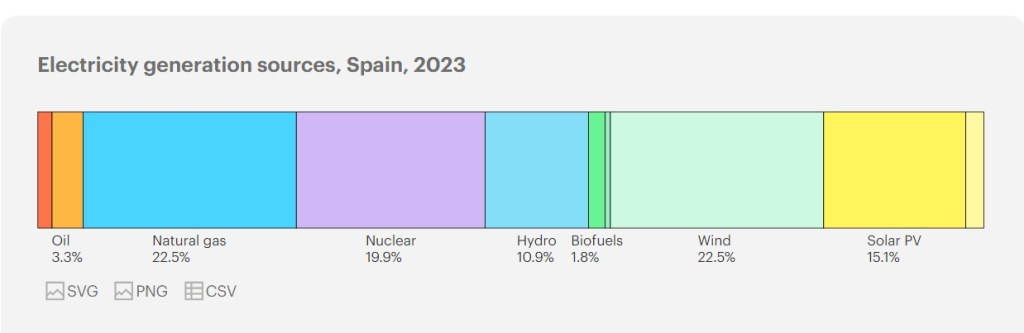
It is equally crucial for Spain to start developing and maturing wave energy technology and eventually to turn Spain into a global wave energy technological hub. By doing so, Spanish Government would mature a technology that could then be exported to countries across the globe and to earn revenue in billions of dollars. Simultaneously, Spanish Government can encourage its unemployed masses to get technical knowledge and know how of how to work in wave-energy technology sector. It is vital for Spanish Government to focus on building the work capacity among women when it comes to wave energy technology. This would decrease an existing financial inequality among men and women in Spain and would certainly help women in mitigating monetary poverty. As per the World Economic Forum, women are quite often prove to be better investors than men and generally yield higher return on the commenced investment when given the power to make decisions at financial firms.
Switzerland is an excellent example for Spain. The former might be poor in raw materials but it is extremely rich in high skilled labour. Spain also need to create a pool of high skilled workers like Switzerland. Swiss watch industry is an excellent example in this regard. In 2023, Switzerland exported watches worth USD 30 billion (i.e. CHF 26 billion). Similarly, Denmark exported wind energy technology and services worth almost 9 billion euros in 2019. Switzerland earned revenue worth CHF 4,678 million (i.e. CHF 4.67 billion) from the export of surplus electricity in 2023. As per Fraunhofer ISE, Germany earned over 13 billion euro’s in revenue through the export of electricity from 2006 – 2016. If Denmark, Switzerland and Germany can earn billions in revenue through export based on high skilled labour, so can Spain as well. As per Federal Association of Offshore wind energy ev, Germany employed roughly 24,500 masses in offshore wind energy sector that generated an overall revenue worth 9 billion euros in sales in 2018. As per ETLA (Finland), digital economy generated 12.3 billion euros in value addition and accounted for 6.4% of gross domestic product for Finland in 2017.
Summing up all, Spain must create policies that would transform its otherwise unemployed masses into high skilled and well trained labour that would then help Spain in expanding its export portfolio. As discussed earlier, if Switzerland, Denmark, Finland and Germany can make it happen so can Spain as well. With right policies implemented at the right place and right time, Spain can enhance its revenue earned through the export of clean energy technologies and IT services in general. An equally important task is to phase out Spanish reliance on oil, natural gas and nuclear power when it comes electricity production. By doing so, Spain will strengthen its economy and will also certainly put a dent in its greenhouse gases emission curve. Simultaneously, the country will uplift more children and adults out of poverty. Thus, it would be a win-win situation for all stakeholders involved. The proposals given in this report are realistic provided enough policy attention and resources are diverted in this direction.
© Copyright 2024 Ayoub Hameedi. All rights reserved.
Green transition can help Italian Government to eradicate poverty
Ayoub Hameedi
As per Eurostat, in 2022, Italy produced a lion’s share of its electricity roughly 63.3% from fossil fuels. It must be appreciated that the country produced 32.8% of its total electricity from renewable sources of power production. Hydropower produced the most electricity roughly 10.1%, followed by solar energy with another 10% and windpower with 7.3% share respectively. Biofuels contributed the least among all clean sources of power production with a share of 5.4% electricity in 2022. It is excellent that Italy produced almost a third of its total electricity from renewable energy however, this should just be the beginning of green transition for the country. Italy must really aim to produce over two-third of its cumulative electricity from clean sources by the end of this decade. If Italy can produce 32.8% of its electricity from renewable sources in 2022, so can it produce at least 67% of its total electricity from clean sources by 2030.
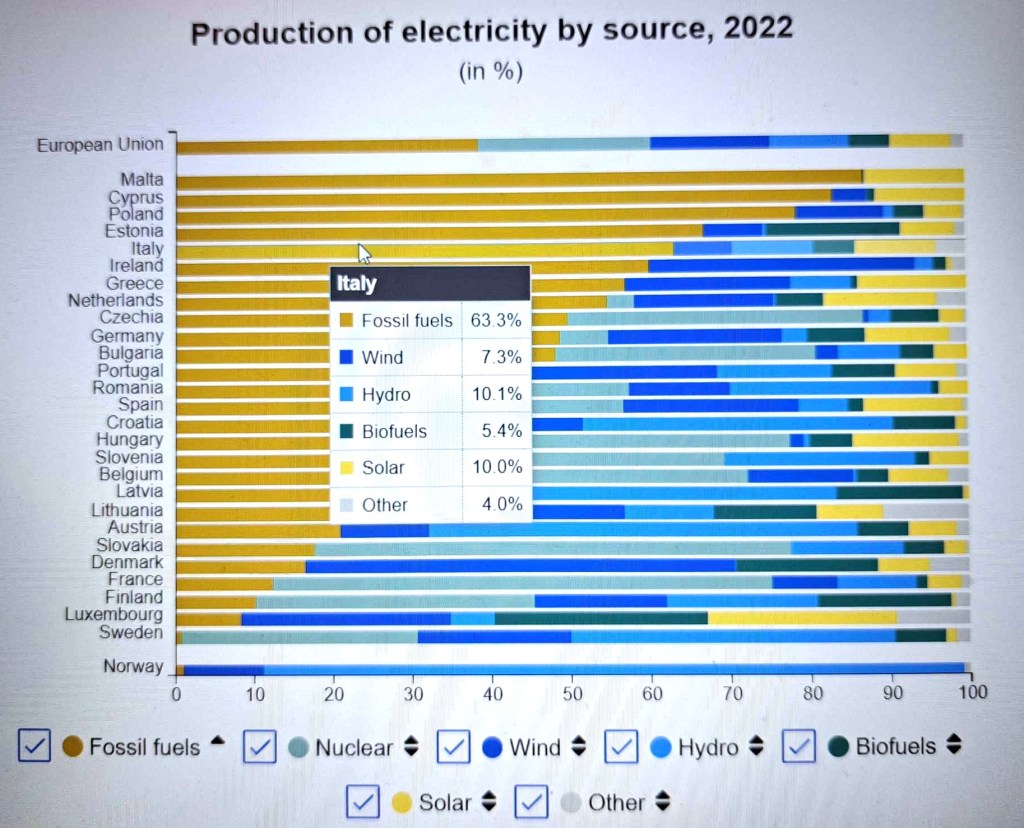
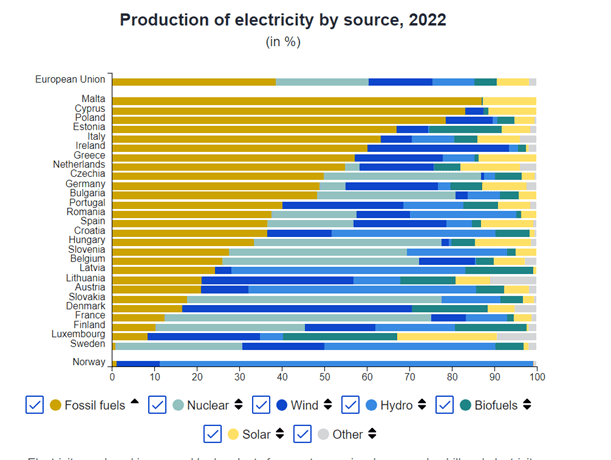
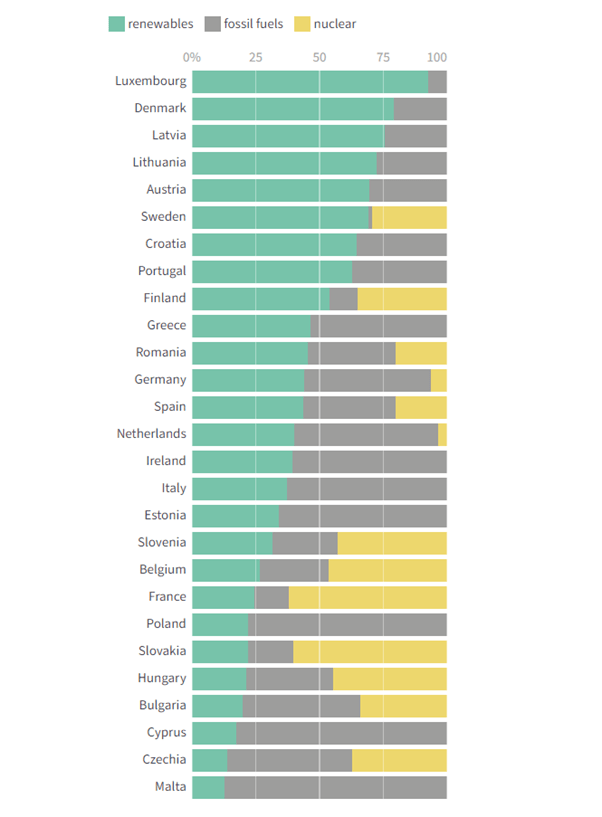
The bar graph given below represents an overall source of electricity production in each of the member state in European Union during 2022. We can clearly see that majority of member states relied heavily either on fossil fuels or on nuclear power for electricity production in 2022. This is not really a good sign and this unsustainable trend must change as quickly as possible. European Union has what it takes to phase out fossil fuel and nuclear power and to produce 100% of its electricity from renewable energy.
It is quite unfortunate to mention here that 1 in 12 Italians suffered from absolute poverty in 2022. Likewise, in 2021 14.2% of the children (that’s roughly 1.4 million children) lived in absolute poverty in Italy. In 2022, 24.4% of the population in Italy were at the risk of falling in poverty or faced social exclusion due to financial challenges. Unfortunately, as per Eurostat, the number of children at risk of poverty or social exclusion was roughly 27% in 2023. This percentage is higher than the EU’s average percentage and unfortunately Italy stood on 5th position when it comes to children at risk of poverty or social exclusion in all EU member states. This should serve as a wake up call for Italian politicians and society as a whole.

This highlights the dire need for both Italian Government and European Parliament to bridge an existing gap between policies and their implementation to combat absolute poverty in European Union. One such policy is phasing out fossil fuel and to power 100% of European Union through clean sources of power production. As per European Commission, Italy imported 43% of its natural gas from Russia. Similarly, it imported 11% of its total oil and 56% of total coal from Russia as well in 2020. Unfortunately, European Union spent a whooping 604 billion Euro’s on the import of fossil fuel in 2022. It is equally important to mention here that the fossil fuel import bill stood at a historic low of 163 billion Euro’s in 2020. Thus in a span of 4 years, European Unions spending of fossil fuel import increased by 441 billion Euro’s. By fostering transition to green and circular economy, European Union can actually save these energy dollars that could then be invested to mitigate absolute poverty in member states.
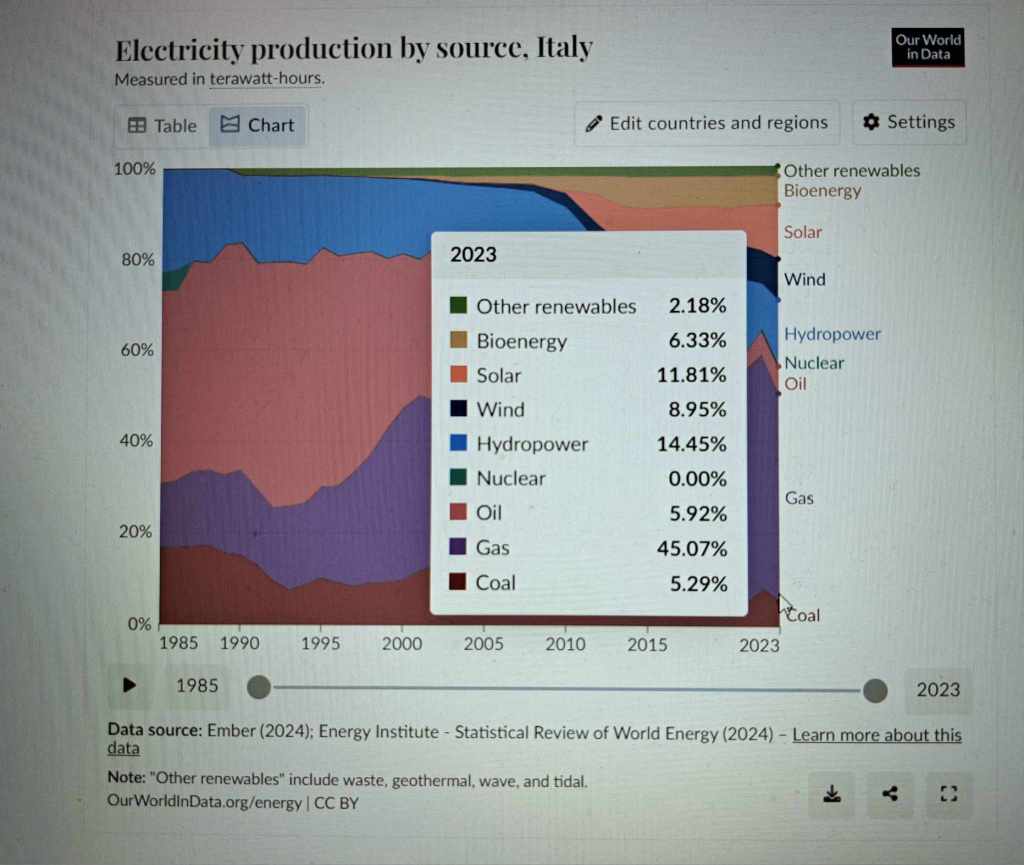
As per Our World in Data, Italy produced over 56% of its electricity from fossil fuels namely coal, oil and gas in 2023. It must be appreciated that Italy produced 41.5% of its electricity from renewable sources of power production during the same year. We can see that Italy imports a lion’s share of fossil fuel it uses on annual basis. It is obvious if EU as a whole is spending 100 of billion Euros on energy import thus Italy is also paying a hefty price to keep its economy running and to provide basic necessities to people. By switching to 100% clean sources of power production, Italy can save energy dollars that can then be invested on improving the life of citizens in the country.
As per Italian Institute of International Political Studies (ISPI), Italy was one of the largest importer of Russian gas in EU. In-fact, Italy imported 29 billion cubic meters of natural gas from Russia in 2021. To reduce its reliance on Russian gas after Russia’s invasion of Ukraine, Italy started importing liquified natural gas (LNG) and is now consequently amongst the largest importer of LNG in European Union. We can easily estimate that if EU is spending 100 of billion of Euro’s on the import of fossil fuel and Italy is amongst the largest importer of natural gas and liquified natural gas, it means that Italy is paying a hefty price for the import of natural gas and LNG. By quickly expanding an installed solar PV capacity, offshore and onshore installed windpower capacity, Italy can save billions of euro’s that can help the Italian Government in fighting poverty and particularly reducing child poverty. An investment to develop wave energy technology would certainly reap benefit for the country in a decade or two from now. It will help the Government in putting a dent in greenhouse gases emission curve and to phase out fossil fuels. The given idea is extremely realistic and possible provided enough public policy attention and financial resources are diverted in this direction. Italian politicians, public policy makers and Italian society as a whole can certainly do better than the existing status-quo.
© Copyright 2024 Ayoub Hameedi. All rights reserved.
Malta can phase out fossil fuels by 2035
Ayoub Hameedi
Malta can most certainly be referred to as a member state relying the most on fossil fuels to produce electricity in European Union. As per The Council of the European Union, Malta produced 87% of its total electricity from fossil fuels in 2022. When compared with other member states in European Union, Malta relies the most on fossil fuels for electricity generation. European Union plans to be climate neutral by 2050. However, to achieve this plan, it is crucial that each member state in European Union must initiate green transition and do what needs to be done as one team, like the players in ice-hockey team. The graph given below is an intellectual property of The Council of European Union and is shared here for educational purpose only. We can clearly see that Malta lies at the bottom of the list when it comes to production of electricity through renewable sources. Green colour represents electricity generated through renewable resources in EU member states. Grey colour represents fossil fuels and yellow resembles nuclear power.
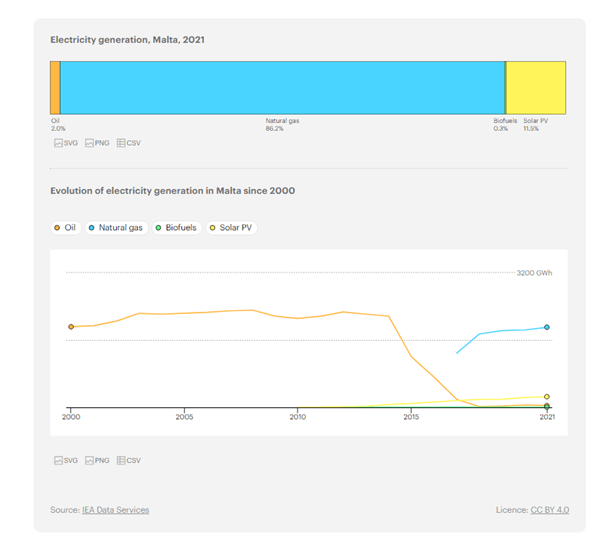
According to the International Energy Agency (IEA), Malta generated 2% of its total electricity from oil, followed by natural gas that produced another 86.2% of its electricity in 2021. Bio-fuels and solar PV produced the remaining 11.8% of the electricity where bio-fuels generated a mere 0.3% of electricity and solar PV produced 11.5% respectively. The graph given below reveals that Malta has drastically reduced its reliance on oil for electricity production from the start of 21st century. However, if Malta has drastically reduced its reliance on oil, it has also sharply increased the use of natural gas for electricity production. Thus, Malta has replaced oil with natural gas as a primary source of electricity production.
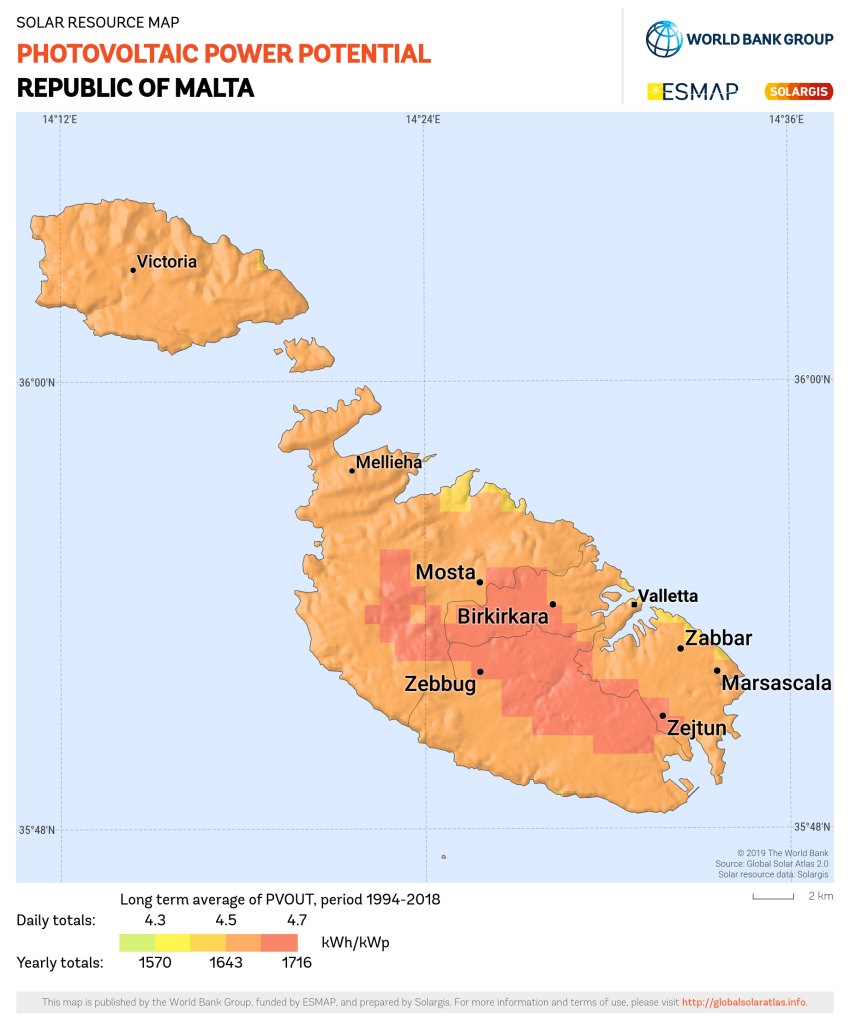
It is quite encouraging to know that solar PV already produced 11.5% of the total electricity in Malta in 2021. Thus, we can confidently say that solar PV technology is already matured in Malta and thus with bit of a policy attention and financial resources channelized in this direction, solar PV can play an even bigger role in the total electricity mix of Malta. There is a dire need that an installed solar PV capacity is further expanded in the country. Malta has an excellent potential to generate clean electricity through solar PV and simultaneously to reduce its reliance on natural gas and to bend its greenhouse gases emission curve. The solar resource map for Republic of Malta show that almost whole of the country has at least a photovoltaic power potential of over 4.5 kWh/kWp and some areas even have a higher photovoltaic power potential of 4.7 kWh/kWp as well. Thus, Malta has excellent conditions to produce clean electricity from solar PV technology plus, solar PV as technology is already matured in the country. With a bit of policy attention and political will, Malta can easily increase the share of solar PV from 11.5% (in 2021) to may be close to 50% by 2030. It is absolutely possible for Malta. As per Solar Power Europe, Germany installed 14.1 GWs of solar PV in 2023. Altogether, Germany has a cumulative installed solar PV capacity of 81.7 GWs a the end of 2023. If Germany can install over 14 GWs of solar PV in a single year, so can Malta as well. In a least desirable scenario, Malta can still choose to install 7 – 10 GWs each year for a decade. This can really help Malta in enabling a green transition and to put a serious dent in its greenhouse gases emission curve.
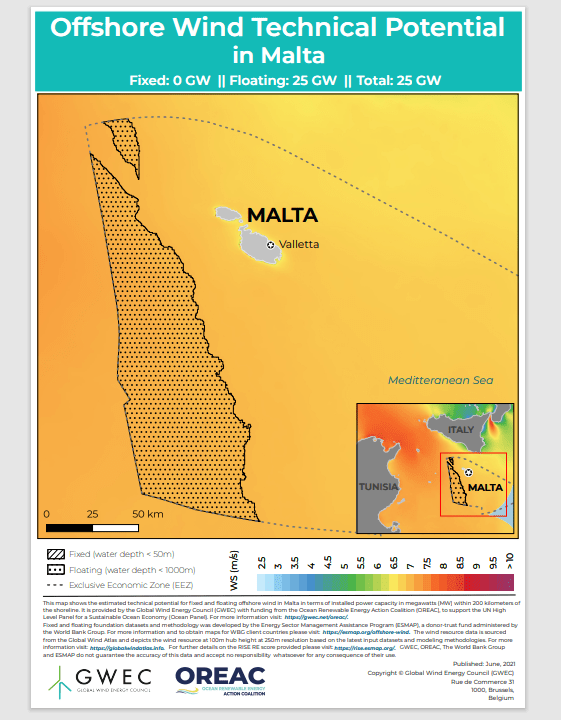
Likewise, as per Deutsche Windguard Gmbh, Germany installed 745 onshore wind turbines in 2023 with a cumulative installed capacity of 3.6 GWs respectively. In 2000, Germany had over 6 GWs of installed onshore windpower capacity which then exponentially grew to over 61 GWs in 2023. Malta has an excellent technical potential for offshore windpower as well. Malta can actually install offshore windpower in multiple gigawatts. Theoretically, it can install 25 GWs of offshore windpower capacity in its offshore areas. However, even if Malta is able to harness 50% of this technical offshore windpower potential, the country can have over 10 GWs of offshore windpower capacity. In 2021, Malta had neither offshore nor onshore installed windpower capacity. There is a dire need for policy makers to stop ignoring windpower and to embrace it as a serious source of electricity production.
Summing up all, Malta must prioritize solar PV technology, onshore and offshore windpower and wave energy technology over fossil fuels. It is excellent that solar PV technology is already matured in Malta. The country simply now need to invest more resources to exponentially expand an installed solar PV capacity to a point where it could provide 25% of the total electricity demand for Malta. Onshore and offshore windpower and wave energy technology did not exist in Malta in 2021 and would thus be considered as technologies in their early phase of development. It is equally important for Malta to invest financial resources and public policy attention to mature onshore and offshore windpower and wave energy technologies to a point where these sources could provide at least remaining 75% of the total electricity demand during day and night. Malta has what is needed to produce 100% of its electricity demand from clean sources of power production like solar PV, onshore & offshore windpower and wave energy technologies. A bit of political will with right policies in place can facilitate Malta to generate 100% clean electricity from renewable resources by 2035.
© Copyright 2024 Ayoub Hameedi. All rights reserved.
Sun Ways: A cleantech company with a creative idea of turning railway tracks into sustainable source of electricity production
Ayoub Hameedi
European Union has the needed skills and knowledge to exponentially increase an installed solar PV capacity to a terawatt during this decade. This goal is pretty realistic and achievable provided European Union affectively utilize every possible infrastructure to install solar PV panels. Rooftops are the most common space where solar PV panels are normally installed. An other common form of solar PV panels installation are the mega solar PV farms that we can easily find in many countries across the globe. Today, we are even installing solar PV panels on lakes and reservoirs of dams. Such projects are normally referred to as floating solar PV plants. India is also installing solar PV panels on top of Narmada canal to save precious land for food production and to prevent water loss due to evaporation. Such an innovative solution is now referred to as solar canals in India. However, the topic under discussion for this writing piece is quite different from all the already spoken ideas. This is what makes this idea unique in nature and most importantly, it can be implemented quickly in almost every country across the European union and rest of the world.
Sun Ways is a Swiss cleantech company that has developed a removable solar PV solution to sustainably utilize an available space between the railway tracks. It can most certainly be referred to as a solar PV carpet that can be spread out and rolled back in to use space between railway tracks to produce clean electricity. The video given below gives us a brief overview of the removable solar PV solution and how it can be quickly implemented on railway tracks:
As per swissinfo.ch website and Sun-Ways, railway tracks in Switzerland are capable of producing 1 terawatt hour of solar energy on annual basis. It is important to highlight here that an available space between railway tracks normally remains unutilized. However, Sun-Ways innovative solution helps us to affectively utilize this available potential to the fullest. According to World Bank, Germany had 33,401 kilometers of rail lines in 2021. Likewise, as per United Nations Economic Commission for Europe (UNECE), total length of railway network in France is over 25,000 kilometers, followed by Poland with close to 20,000 kilometers of railway track. Similarly, both Italy and Spain have over 15,000 kilometers of railway track each, followed by Sweden and Romania with over 10,000 kilometers of railway track each. Czechia, Hungary, Finland, Austria, Bulgaria, Slovakia, Netherlands, Croatia, Portugal, Greece, Denmark, Lithuania, Latvia, Slovenia, Estonia and Luxembourg each have less than 10,000 kilometers of railway track. All of the already spoken member states within European Union represents a collective length of railway tracks of over 150,000 kilometers. Just imagine, if we would install a GW of solar PV between railway tracks in each of the EU’s member state. By doing so, we can collectively increase an installed solar PV capacity by 27 GW in European Union. We can actually make this happen in less than a year’s time. The graph given below is an intellectual property of UNECE.

Summing up all, an installation of solar PV panels between railway tracks may seem odd but is realistic in nature. It is important to understand that member states in European Union have over 150,000 kilometers of railway track that can easily be used for this purpose. If we would use 5,000 kilometers of railway track to install a GW of solar PV panels, the already spoken figure of 150,000 kilometers is big enough that it can facilitate European Union to install 30 GW of solar PV capacity. Most importantly, we can make this happen within this decade. I personally believe that European Union can install a terawatt of solar PV capacity by 2030. Solar PV as a technology is already matured in European Union and we have the needed skills and knowledge as well. All we need is a firm political will and a single voice across member states to make this happen.
© Copyright 2023 Ayoub Hameedi. All rights reserved.
SolaRoad: An innovative solution to transform roads into micro engines of clean electricity production
Ayoub Hameedi
Roads are the most useful form of infrastructure as they connect one part of a city to another. Likewise, roads also connect different cities and parts of a country to each other. Roads allow swift mobility of persons and goods within a city, between cities and quite often between countries as well. Thus, roads can most certainly be referred to as one of the most innovative solution we have ever made. A typical asphalt coated road absorbs heat and thus causes the temperature in nearby areas to increase due to urban heat island effect. What if the asphalt in the road is replaced with unbreakable solar PV panels. What if the same solar PV road would absorb solar radiation during the day and then uses the same energy during night to power street lights. This is exactly what this short report is about.
SolaRoad BV is a Dutch cleantech company that has made solar PV roads for bicycle tracks. These roads are made of unbreakable solar PV panels that could absorb sunlight during day time and after the sunset uses the absorbed radiation to power street lights. Solar bicycle paths are located in the municipality of Haaksbergen and also in Blauwestad in Netherlands. The video given below explains how a solar bicycle path works in reality.
As per European Cyclist Federation report “The EU Cycling Economy“, cycling helped European Union with 2.2 billion euro’s financial benefit in terms of avoided/reduced carbon dioxide gas emission in 2016, followed by another 0.73 billion euro’s worth of environmental benefit through reduced air and noise pollution. European Union economies enjoyed another financial benefit of 97 billion euro’s due to people living longer and healthier lives as a result of cycling, followed by 2.8 billion euro’s in terms of fuel savings, another 0.8 billion euro’s worth of financial benefit in the form of reduced fatalities, serious and light injuries. There is also another way to maximize the benefits of cycling for European Union. Just imagine, if we would add solar PV panels on all the cycling routes within European Union. It will help us in lightning up the street lights through solar PV as a renewable source of power production. Thus another added advantage in the form of clean electricity on top of all the already spoken advantages. By doing so, we can transform all our cycling routes within European Union into micro engines of clean electricity production.
In conclusion, European Union must take solar PV technology more seriously and thus use every possible opportunity to exponentially increase an installed solar PV capacity in member states. As per European Commissions report “Photovoltaics in European Union: Status report on technology development, trends, value chain and markets (2022)”, EU had a cumulative installed solar PV capacity of 170 GW at the end of 2021. Member states in EU installed another 41.4 GW of solar PV capacity in 2022. Thus, altogether EU-27 had 211.4 GW of cumulative installed solar PV capacity at the end of last year. I personally think Solar road is an excellent initiative by SolaRoad BV and if such projects are replicated on bicycle tracks all across European Union, it can really help us in turning our bicycle paths into micro engines of clean electricity production. If Netherlands can make this happen, so can rest of the member states in European Union as well. A terawatt of installed solar PV capacity in European Union by 2030 is possible.
© Copyright 2023 Ayoub Hameedi. All rights reserved.
Status of solar PV technology in European Union
Ayoub Hameedi
Solar PV technology can facilitate European Union (EU) in energy independence and moving European economies in a post fossil fuel era. I personally believe EU has all it takes to exponentially increase an installed solar PV capacity in each of its member state. In order to make this happen, each member state in the Union must prioritize solar PV on all other source of power production. We cannot really afford to de-prioritize solar PV and simultaneously aim to put a serious dent in EU’s greenhouse gases emission curve. There exist a big difference between countries in terms of installed solar PV capacity in EU. An excellent example is the existing difference in installed solar PV capacity between Finland, Sweden and Denmark. According to the Solar Power Europe’s document “EU Market Outlook for Solar Power 2022 – 2026” Finland had a cumulative installed solar PV capacity of 607 MWs in 2022. On the contrary, Sweden had a total installed solar PV capacity of 2674 MWs at the end of 2022. Thus, Sweden had 2 GWs more of an installed solar PV capacity than Finland. Denmark had almost 4 GWs of installed solar PV capacity at the end of 2022. Most importantly, Finland is amongst those countries in EU where 1 GW of installed solar PV capacity milestone still remains to be unfulfilled. Likewise, Germany and Poland are neighbouring countries in European Union. Germany had an installed solar PV capacity of 68.4 GWs in 2022. On the contrary, Poland had a total installed solar PV capacity of 12.5 GWs in 2022. Again, a huge difference of almost 56 GWs of installed solar PV capacity between Germany and Poland. Germany can certainly be referred to as an undisputed champion of installed solar PV capacity in European Union. Belgium had an installed solar PV capacity of roughly 7.92 GWs in 2022 whereas, neighbouring Luxembourg had barely 404 MWs in installed solar PV form. Again, a significant difference 7.5 GWs of installed solar PV capacity between Belgium and Luxembourg.
Many countries within European Union does not even have solar PV technology in mature form. Croatia (208 MWs in 2022), Cyprus (447 MWs in 2022), Estonia (788 MWs in 2021), Finland (607 MWs in 2022), Ireland (494 MWs in 2022), Latvia (67 MWs in 2022), Lithuania (394 MWs in 2022), Luxembourg (404 MWs in 2022), Malta (238 MWs in 2022), Slovakia (574 MWs in 2021) and Slovenia (771 MWs in 2022) are examples in this regard. Unfortunately, 11 out of 27 countries in European Union does not even have a GW each of an installed solar PV capacity. As already spoken, countries within European Union must take a more serious approach to solar PV technology. We cannot take this for granted. As per International Renewable Energy Agency (IRENA), India has installed 62.85 GWs of solar PV during last 12 years (between 2011 – 2022). The graph given below is an intellectual property of IRENA:

China during the same time period (between 2011 – 2022) had installed 392 GWs of solar PV capacity.
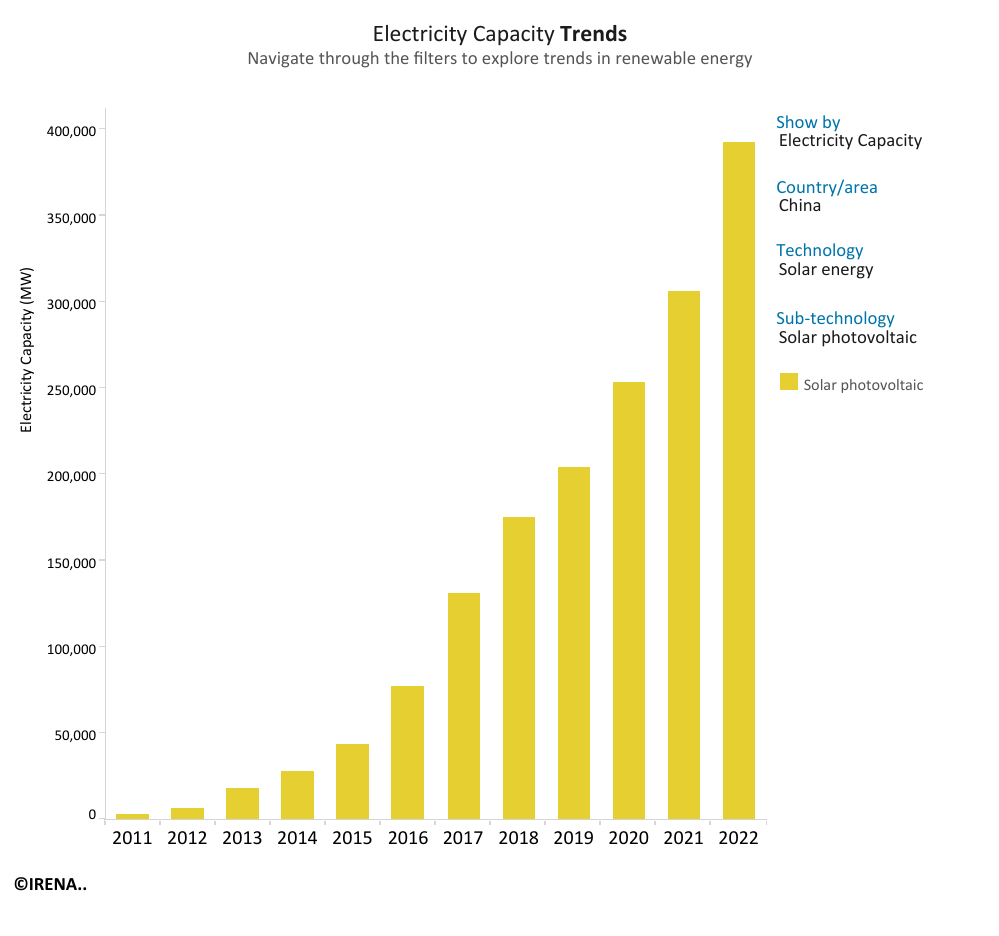
China and India altogether had installed 455 GWs of solar PV capacity between 2011 – 2022. On the contrary, as per European Commission, EU had a cumulative installed solar PV capacity of 52 GWs in 2011 that then exponentially increased to 160 GWs in 2021. EU installed another 41.4 GWs of solar PV in 2022. Thus altogether EU installed 149.4 GWs of solar PV between 2011 – 2022 in comparison to 455 GWs of solar PV from India and China combined. It is quite clear that European Union must increase its pace when it comes to an installation of solar PV capacity in Europe.
To sum up, European Union must take solar PV technology more seriously. It should encourage each member state to use all possible opportunities for the deployment of solar PV technology. Rooftop is an excellent example in this regard as all the available rooftops in EU might potentially produce 680TWh of solar PV based electricity on annual basis. Similarly, agrivoltaics is another excellent opportunity for EU’s agriculture sector where all member states can choose to use their agricultural areas for solar PV and wind turbines installation. By doing so, EU member states would potentially increase their revenue through the production of food and clean electricity. As per European Commission, covering just 1% of utilized agricultural area with solar PV and wind turbines can increase our installed clean electricity generation capacity up to 944 GWs. We have what it takes to guide European Union into a post fossil fuel and post nuclear power era.
© Copyright 2023 Ayoub Hameedi. All rights reserved.
European Union must increase its pace to install solar PV technology
Ayoub Hameedi
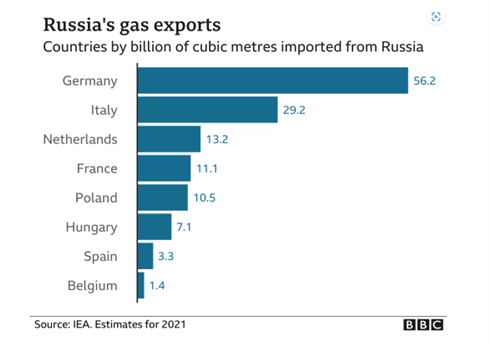
European Union is an excellent political and economic collaboration of 27 countries in European continent. The main aim of this collaboration is to foster freedom, democracy, equality, rule of law, promoting peace and stability in each member state. In my opinion, most of the already spoken factors are largely based on European Union’s ability to be independent when it comes to satisfying its energy needs. As per BBC, Germany imported 56.2 billion cubic meters of gas from Russia, followed by Italy with 29.2 billion cubic meters, Netherlands with 13.2 billion cubic meters, France with 11.1 billion cubic meters, Poland with 10.5 billion cubic meters, Hungary with 7.1 billion cubic meters, Spain with 3.3 billion cubic meters and finally Belgium with 1.4 billion cubic meters of gas. Altogether, the already spoken 8 EU member states imported 132 billion cubic meters of gas from Russia in 2021. The graph given below is an intellectual property of BBC and is shared only here for educational purposes.
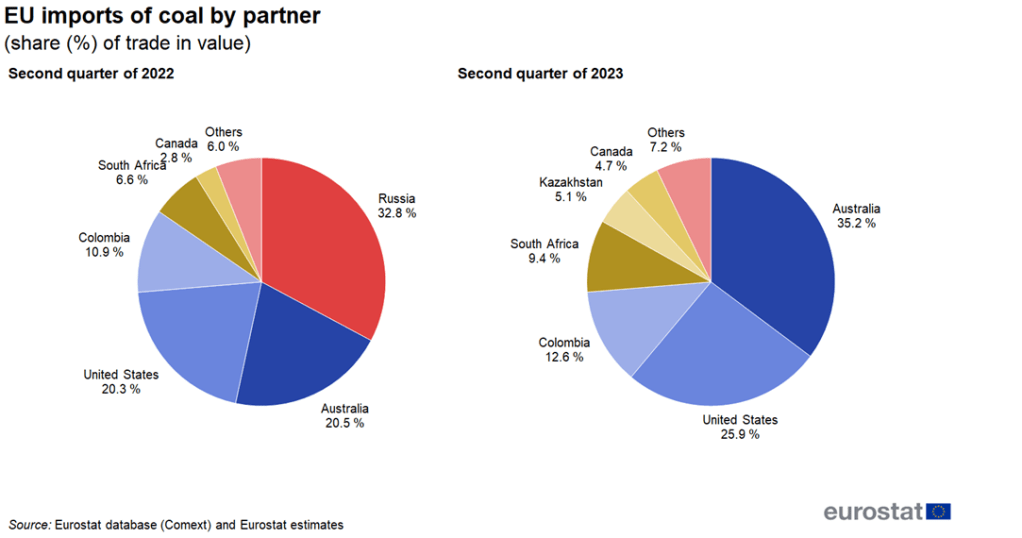
After the Russian invasion of Ukraine, European Union more or less maintained the same policy when it comes to the import of fossil fuels, all it did was to replace Russia with other actors. We can see that in second quarter of 2022, Russia was the biggest supplier of coal to EU. On the contrary, in second quarter of 2023, EU simply replaced Russia with Australia as the largest source of coal import and increased its reliance on all other import sources as well.
When it comes to oil import, EU drastically reduced its reliance on Russian oil thus decreasing its import share from 15.9% in Q2 2022 to just 2.7% in Q2 2023 and significantly increased its reliance on all other countries in the supply chain.

European Union again drastically reduced its reliance on Russian gas from 28.3% in Q2 2022 to 13.8% in Q2 2023 and subsequently increased its imports from Norway and Algeria respectively.
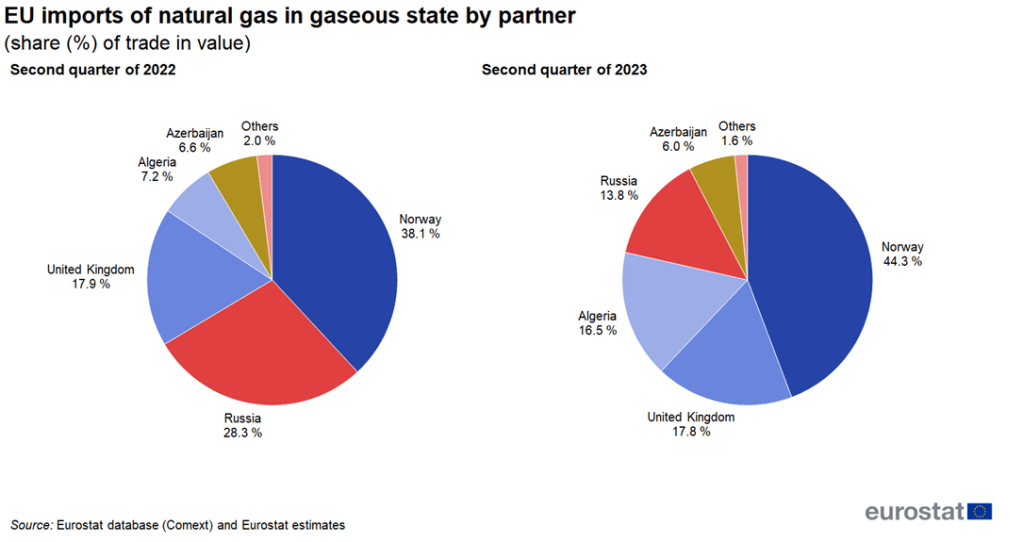
It is good that European Union (EU) is working day in and out on reducing its reliance on fossil fuel imports from Russia. But in my opinion, EU is placing a lot more emphasize on replacing Russia with other countries that have ample fossil fuel reserves to export. In all three case, EU has either reduced its reliance on Russia from 28.3% in Q2 (2022) to 13.8% in Q2 (2023) for natural gas in gaseous state, from 15.9% in Q2 (2022) to 2.7% in Q2 (2023) for petroleum oil, or completely stopped importing coal from Russia in Q2 (2023). European Union must place an equal emphasize on phasing fossil fuels out of the energy equation and quickly increasing the share of renewable resources to a point where whole of the EU would be powered by clean sources of power production.
Each and every member state in EU have to play a pivotal role to achieve this goal. EU’s length and breadth can prove to be its biggest strength to put a dent in greenhouse gases emission curve. It must be appreciated that EU installed 41.4 GWs of solar in 2022. A lion’s share of this almost 27 GWs were installed by Germany (7.9 GWs), Spain (7.5 GWs), Poland (4.9 GWs), Netherlands (4 GWs) and France (2.7 GWs) alone. Energy efficiency, an increased use of public transport at an inexpensive price, electric car pools to reduce reliance on private vehicles, electrification of transport sector, exponentially increasing the production of green hydrogen to run hydrogen powered trains all across EU are few steps that can foster green transition in EU. It must be appreciated that EU is planning to completely stop importing fossil fuels from Russia by the end of this decade. We must use the same strategy to completely stop relying on fossil fuels once and for all. We can power EU with clean sources of power production without relying neither on fossil fuels nor on nuclear power. 100% renewable energy should be the way forward for European Union.
© Copyright 2023 Ayoub Hameedi. All rights reserved.
Solar PV and other renewable sources in 2022
Ayoub Hameedi
As we all know, sun is the focal point of our solar system. All the planets in our solar system rotates around sun and it is basically sun that has given each planet a particular environment it enjoys. Some planets are quite close to sun and thus cannot support life. As per NASA, day temperature on Mercury can go as high as 430 degree Celsius whereas, during night time the temperature can drop as low as -180 degree Celsius. Others are far from Sun and thus are too cold and does not have the right conditions for life to exist and flourish. Uranus is one such example is this regard. Fortunately, it is only planet earth in our solar system that has the right distance from sun and thus receives just the right amount of solar radiation that then enables life to exist and flourish on earth. As per the United Nations, Solar energy is the most widely available source of energy and earth in-fact receives 10,000 times more energy than we consume in our business-as-usual approach. Now, it is on us if we choose to use this sustainable source of energy or otherwise.
Fortunately, solar PV installations across the globe seems to be shinning as bright as sun. As per Solar Power Europe, countries across the globe cumulatively installed 239 GWs of new solar PV capacity in 2022. As a result, solar PV installation crossed the landmark of 1 terawatt (1 TW) in 2022. Just like last year, 2023 can prove to be even better for global installed solar PV capacity. Again, as per an estimation by Solar Power Europe, we might install another 341 GWs of new solar PV capacity in 2023. Countries across the globe altogether installed 362 GWs of renewable energy capacity in 2022. The graph given below is an intellectual property of Solar Power Europe:
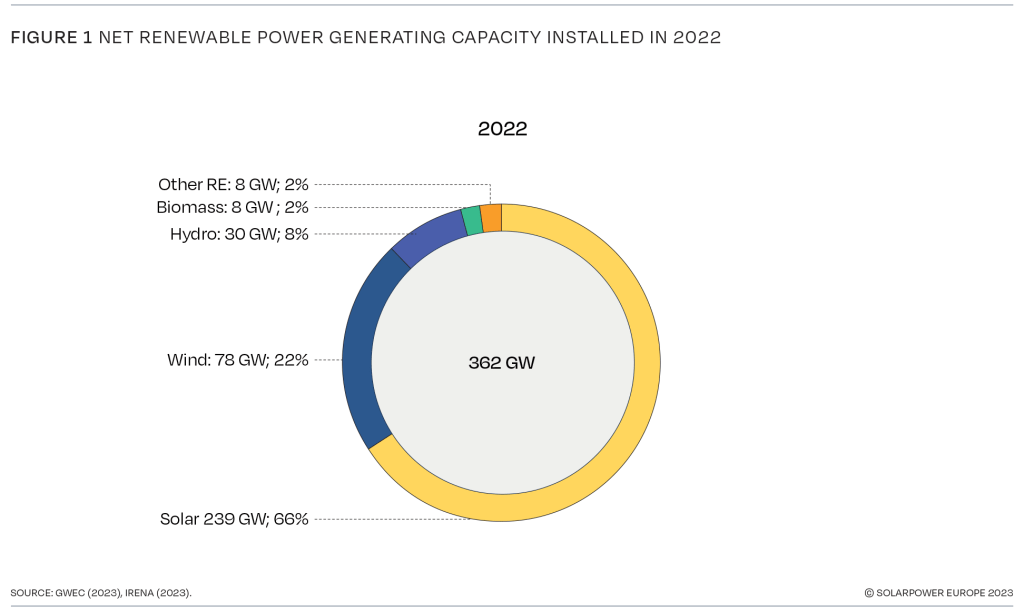
The top source was of-course solar PV with 239 GWs, followed by wind energy with 78 GWs, hydro with 30 GWs, Biomass with 8 GWs and other renewable sources with 8 GWs respectively. Altogether, cumulative installed renewable energy capacity of 362 GWs in 2022 represented almost 30% of the cumulative new installed electricity generation capacity last year. Unfortunately, the remaining 70% of the new installed capacity was the conventional sources of power production primarily dominated by fossil fuel sources.

Another important positive point to highlight here is the non renewable sources of power production represented a lion’s share of 75% of new installed capacity to grid in 2017. This drops down to 70% share in 2022. Thus, renewable sources of power production eliminated 5% reliance on fossil fuels in 6 years in terms of new installed capacity from 2017 to 2022. This is really good but we need to do even better. With this pace, we simply have to wait another 70 years to completely eliminate fossil fuels from our power generation landscape. We can do better and we must increase our pace to install more and more clean sources of power production each year. Unfortunately, the current installation pace is simply not enough. We can and must do better.
All in all, 2022 was an excellent year as we cumulatively installed 239 GWs of solar PV technology. It is indeed good but not adequate enough and we must increase our pace and we must install more and more of solar PV technology each year. As per United Nations, we only have this decade to limit temperature increase to 1.5 degrees and to prevent irreversible damage to our previously stable climate. We cannot take this for granted. We must do all we can to put a serious dent in greenhouse gases emission curve. Rapidly increasing our reliance on clean source to eliminate fossil fuels from energy landscape is one of the most affective ways to mitigate climate change and to limit temperature increase to 1.5 degrees. We are accountable to ourselves and our coming generations and we must do all it takes to give a sustainable future to everyone on this beautiful planet.
© Copyright 2023 Ayoub Hameedi. All rights reserved.
Innovative reusage of wind turbine blades
Ayoub Hameedi
As per the Global Wind Energy Council, the cumulative installed wind power capacity now stands at a whooping 837 GWs. This installed wind power capacity facilitated us in preventing an emission of 1.2 billion tonnes of carbon dioxide gas on annual basis. This is roughly equivalent to the cumulative carbon dioxide gas emission from South America each year. On one side, having an installed wind power capacity of 837 GWs is an excellent strategy for bending the emissions curve. However, it comes with a price as well. All of the already installed wind turbines that would get decommissioned by 2050 would produce 43 million tonnes of turbine blades waste. There is a dire need for us to find sustainable solutions to effectively reuse blades from decommissioned wind turbines and this is exactly what this short report is about.
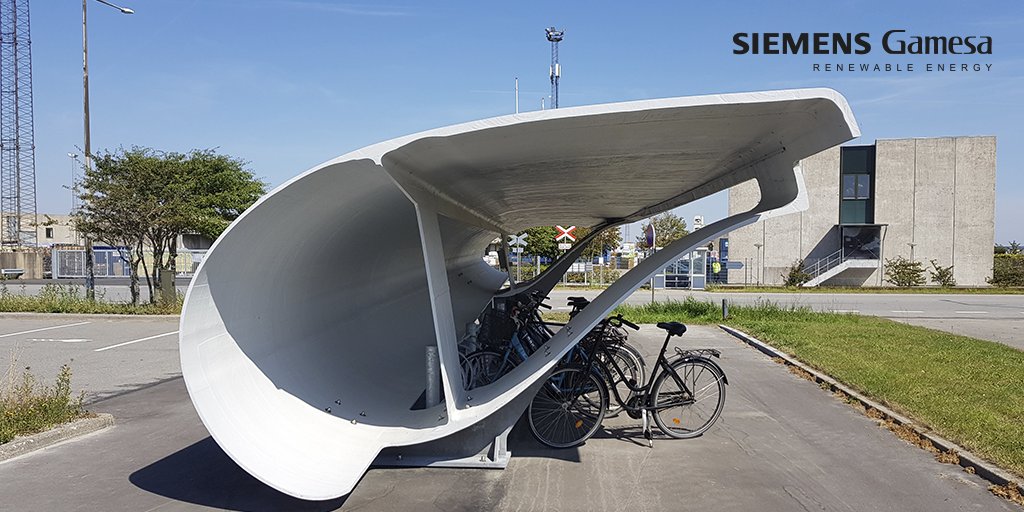
We can actually reuse the blades from a decommissioned wind turbine for a number of purposes. We just need to think out of the box and solutions are available around the corner. In Denmark, DecomBlades that is a consortium of 10 project partners including Siemens Gamesa Renewable Energy, Vestas Wind Systems, Orsted, University of Southern Denmark and Technical university of Denmark are to name a few, has designed a solution to promote circular approach in wind energy technology sector. The solution designed by the consortium is a bicycle shed made completely out of a decommissioned wind turbine blade. Indeed, an excellent example of thinking out of the box and putting waste to a better use. The photograph given below is an intellectual property of Siemens Gamesa Renewable Energy and is used here only for awareness creation purpose.
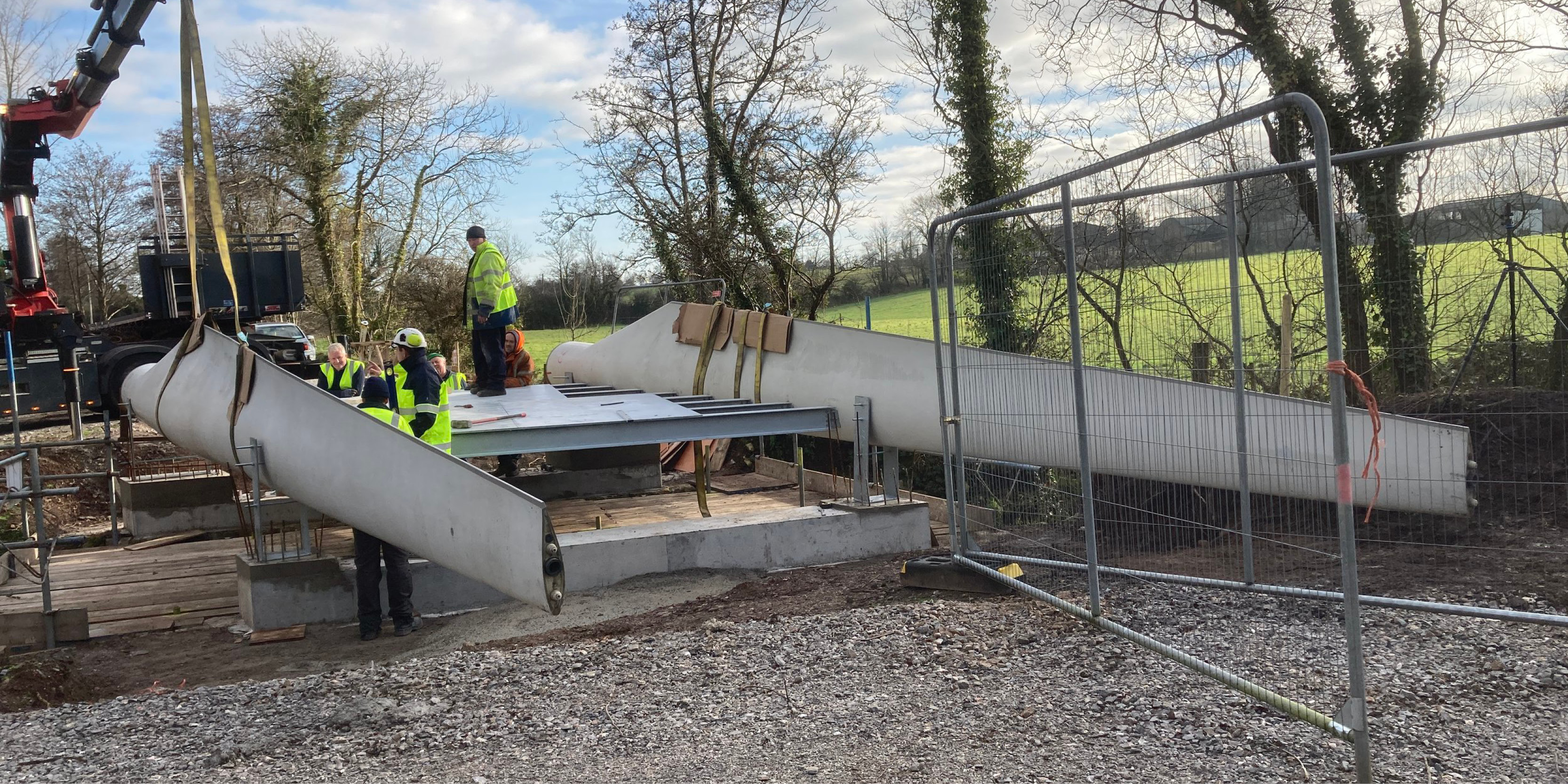
Ireland is also following the footsteps of Denmark by reusing the decommissioned wind turbine blades and thus preventing them from ending up either in incinerators or in landfills. Re-Wind is a transatlantic research project based on a mutual collaboration between Queen’s University Belfast, University Collage Cork, City University New York, Georgia Institute of Technology and Munster Technological University Cork. Re-Wind has successfully installed two foot bridges made completely out of decommissioned wind turbine blades one in Draperstown (Norther Ireland) and the other in Cork, Republic of Ireland. It is important to highlight here that these bridges were tested severely to determine their ability to sustain weight. Re-Wind placed 34 blocks with a cumulative weight of over 35000 kilograms and surprisingly these bridges were able to sustain the immense weight without collapsing. The picture given below is an intellectual property of University College Cork, Ireland and is shared here for awareness creation purpose.
Miljoskaerm is a Danish company that extracts fiberglass from wind turbine blades and then use the recovered fiberglass in their product manufacturing technique to form noise barriers to reduce traffic noise. These noise barriers can be installed next to highways, in residential areas and parking lots to reduce the noise pollution from the passing by vehicles. Likewise, Gjenkraft contacted Vattenfall when the latter decommissioned Irene Vorrink Wind Farm to recycle the wind turbine blades from the decommissioned wind park. Gjenkraft then used the recovered glass and carbon fibres from the turbine blades to form skis and snowboards. Again Danish and Norwegian companies applied out of the box thinking to form creative products out of wind turbines blades. Netherlands is also following the footsteps of Norway and Denmark when it comes to reusing wind turbine blades in a productive manner. Supper use is company based in Netherlands that has used the decommissioned wind turbine blades to upgrade and renovate a kids playground in Rotterdam. Such playgrounds are now referred to as blade made play grounds.
Summing up all, companies across Europe are developing solutions to reuse the decommissioned wind turbines blades and to promote circular growth in the clean energy sector. Bicycle shade in Denmark, foot bridge in Ireland, noise barriers in Denmark, skiing gadgets in Norway and a kids playground in Netherlands are nothing but creative solutions where we have used end of the life turbine blades in a creative way. We can certainly use the blades in other creative ways too that we have not thought of yet, for example, using blades to construct houses and entrance doors to our homes and buildings. With a bit modification in design technique, we might also be able to use end of life blades to assemble busses and trucks from. All we need is out of the box thinking to find creative solutions to put a dent in the waste curve for wind turbines blades.
© Copyright 2023 Ayoub Hameedi. All rights reserved.
Uneole’s innovative solution can help cities to bend their greenhouse gases emission curve
Ayoub Hameedi
Our world is experiencing rapid urbanization. As per the United Nations Population Fund (UNFPA), almost half of global population now lives in urban areas and with the current pace of urbanization, almost 5 billion people would be living in urban areas by 2030. This should be considered as a good thing as more and more people are leaving behind the agriculture-based lifestyle and adopting a more flexible one, where you have an access to multiple employment opportunities to make ends meet. However, rapid urbanization comes with a price. According to United Nations (UN), cities across the globe consumes over three-fourth of the produced energy and are a source of over 60% of the greenhouse gases emission. Thus, rapid urbanization can be considered as a primary cause of an increased concentration of carbon dioxide gas in our atmosphere which is then causing our once stable climate to change. This highlights the dire need to prioritize Sustainable Development in urban planning, so our urban areas would be resilient enough to accommodate an exponential growth in population and also have no negative impact on environment. We must consider sustainability at the heart of urban planning as only then our urban areas would be socially equitable, economically viable and ecologically sustainable to live in.
Uneole is a French start-up that has designed a solution where rooftop solar PV panels can be perfectly blended in with rooftop micro wind turbines. In my opinion, this offers a perfect solution to the biggest limitation faced by solar PV panels. As we all know that solar PV panels performs the best, when sun is shining and sky is almost cloudless. On the contrary, solar PV panels functioning gets severely affected on a cloudy day. Likewise, solar PV panels sit idle during night. However, if solar PV panels are combined in with micro wind turbines, this can help us in overcoming the basic limitation of PV panels. By doing so, micro wind turbines can help produce clean electricity on an extremely cloudy and windy day. Most importantly, it will serve as a reliable back-up to solar PV panels and would generate clean electricity even after sunset. Thus, a combination of micro wind turbines and solar PV panels is a match made in heaven, when it comes to transforming urban rooftops into micro engines of clean electricity production. The video below serves as a perfect example in this regard:
Uneole designed micro wind turbines when combined with solar PV panels can really help us to produce clean electricity in all shades of weather. As already discussed, our urban areas consumes a lion’s share of produced energy and are thus responsible for 60% of the greenhouse gases emission. Our reliance on fossil fuels and the resulting greenhouse gases emission is the root cause of an increased carbon dioxide concentration in atmosphere, an increase in global average temperature and a consequent change in our previously stable climate. However, there are solutions available that can help our cities to bend the greenhouse gases emission curve. We must see rooftops in our urban areas as battlegrounds where we will fight our war against climate change and by turning these rooftops into micro engines of clean power production, we will maximize our chance to win our fight against climate change. We can turn our urban areas into low-carbon economies with a positive impact on environment, society and businesses in general.
© Copyright 2023 Ayoub Hameedi. All rights reserved.
France can make a better choice this time
Ayoub Hameedi
The current energy situation in France is an outcome of a choice made by the then Prime Minister Pierre Messmer who can be referred to as the father of French nuclear power movement that enabled France to produce a lion’s share of its electricity from nuclear power. The primary objective was to make France more independent when it comes to domestic production of electricity and to sharply reduce French reliance on fossil fuels from Middle East. But every choice has a price. France is working on to develop The Cigeo Project to store the radioactive waste produced by its existing nuclear power plants. As per the French Ministry for Ecology, Sustainable Development and Energy, The Cigeo Project will be completed with an estimated cost of 25 billion euros. On the contrary, Greenpeace France claims that the cumulative gross cost for The Cigeo Project was 32 billion euros at the end of 2018. I really believe that France can do better and it has all the right reasons to do better when it comes to sustainably producing electricity from clean sources of power production like solar PV, wind power and wave energy technologies. It is important to point out here that we cannot claim nuclear power to be a sustainable source of electricity production. It never really was and it never really will be a socio-economic and environment friendly way to produce electricity. According to World Nuclear Association, France due to its heavy reliance on nuclear power and low generational cost is the world’s largest net exporter of electricity. United Kingdom and Italy are its primary customers when it comes to the purchase of electricity. The country earns 3-billion-euro worth of revenue through the export of electricity on annual basis. However, I still believe its not worth it and solar PV, wind power and wave energy technology is the way forward for France. The sooner France realises this, the better it would be for everyone in French society.
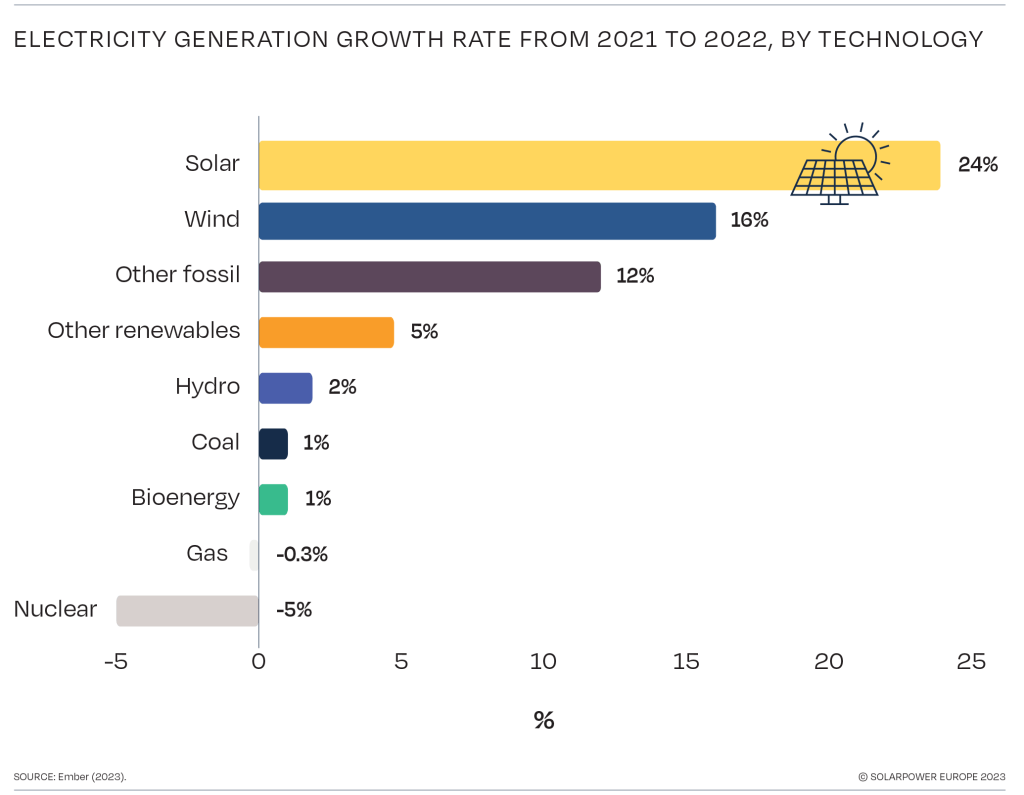
According to Solar Power Europe, solar PV technology produced 24% more electricity in 2022 than it did in 2021. Thus, solar PV technology experienced the fastest growth when it comes to cumulative electricity production in 2022. Likewise, wind power stood second and thus generated 16% more electricity in 2022 than it did in 2021. On the contrary, nuclear power experienced a decline in electricity production and thus produced 5% less electricity in 2022 than it did in 2021.
As per the International Renewable Energy Agency (IRENA), France had a cumulative installed solar PV capacity of 17.4 GWs in 2022. Likewise, France had a cumulative installed wind power capacity of 21.1 GWs in 2022, out of which a lion’s share of installed wind power capacity roughly 20.6 GWs was onshore whereas, only 0.5 GWs of installed wind power capacity was offshore. This highlight the basic fact that both solar PV and wind energy technologies are already matured in France. So the much needed ground work is already there and we can easily scale it further to a point where solar PV and wind power technologies would eliminate the use of nuclear power, coal, oil and gas from energy landscape in the country. France is also working on maturing marine energy technology as well. It is quite important to mention here that France had an installed marine energy capacity of 211 MWs in place in 2022. On the contrary, European Union (27) had a cumulative installed marine energy capacity of 218 MWs in place. Thus, France even represents a lion’s share of installed marine energy capacity within European Union (27). France is blessed to have an extensive coastline thus it would be in the best of interest of France to invest financial resources on offshore wind parks and maturing marine energy technology to go 100% renewable within a decade or two.
Summing up all, France has what it takes to produce 100% of its needed electricity from clean sources of power production. Critic’s might say that an annual 3 billion euro worth of revenue through the sale of electricity is a lot and France should not give up on nuclear power. However, in my opinion, it’s not really worth it especially if one would consider the price whole society pays to safely store nuclear waste for coming centuries. Those billion of euro could be reinvested in French society to educate people, create green jobs, construct sustainable inexpensive houses and improving medical facilities across France. Solar PV and onshore wind energy technologies are already matured in France. Now is the time to expand the installed solar PV and onshore wind power capacity into hundreds of Gigawatts by the end of this decade. Likewise, it is equally important to mature offshore wind power and wave energy technology in France. Altogether, solar PV, onshore and offshore wind power and wave energy technology can phase out nuclear power and fossil fuels from the energy landscape in the country. French society and its citizens deserve a future where France would phase out nuclear power and fossil fuels and produce 100% clean electricity from solar PV, offshore and onshore wind power and wave energy technology. France has what it takes to produce 100% clean electricity during a decade or two.
© Copyright 2023 Ayoub Hameedi. All rights reserved.
Recyclable blade technology and Kaskasi offshore wind power plant
Ayoub Hameedi
Wind energy technology can prove to be a David in our fight against climate change which can easily be referred to as Golaith here. As per the Global Wind Energy Council (GWEC), countries across the globe have managed to install 743 GWs of windpower that is helping us to avoid 1.1 billion tonnes of carbon dioxide emission on annual basis. However, it is simply not enough and more needs to be done, in fact, much more needs to be done in this regard. To minimize the negative affects of a changing climate and to bend the emissions curve, we need to install windpower 3 times more quickly and we’ve got to do this in a circular manner. Keeping this in mind, RWE Renewables Germany is collaborating with Siemens Gamesa when it comes to the commissioning of Kaskasi offshore wind power plant in Germany. This offshore wind power project is promoting circular approach in wind energy technology and is certainly the first project of its kind in the world.
Kaskasi offshore windpower plant is located 35 km from Heligoland in the German North Sea and is comprised of 38 wind turbines. It is in construction phase right now and is expected to be fully commissioned by the end of 2022. Upon completion, it would have an installed windpower capacity of 342 MWs respectively. Each wind turbine in the Kaskasi offshore wind power project has an installed capacity of 9 MWs and collectively, the project will produce enough clean electricity to power 400,000 households in Germany. It is important to mention here that the construction of the Kaskasi offshore wind farm was started in March 2022 and is expected to be fully commissioned by the end of December 2022. Thus, it took 9 months to complete the construction of offshore windpower project with an installed capacity of 342 MWs respectively. The unique feature about this project is recyclable blades of wind turbines that has been designed and developed by Siemens Gamesa. As per Wind Europe, we can easily recycle 85 – 90% of total mass including cement, steel, copper wire, electronics and gearing from a windpower project upon completion of life cycle and decommissioning. However, the most challenging task is to recycle the blades of a wind turbine. Wind Europe estimates that countries across Europe would decommission a total of 25000 tonnes of blades on annual basis by 2025. Unfortunately, the total volume of blades being decommissioned in Europe would grow twice as much roughly 52000 tonnes on annual basis by the end of 2030. We cannot simply allow blades of a wind turbines to end up in landfills as waste. There is a dire need to develop blades that we could recycle upon the completion of their life span and decommissioning of a windpower project.
The recyclable blade technology developed and designed by Siemens Gamesa is an excellent attempt to promote circular approach when it comes to wind energy technology. As per the Siemens Gamesa, the core process for the development of blades is the same as used previously. However, the change occurs when it comes to the use of resin and this basic difference enables the recycling of blades afterwards. By dissolving these recyclable blades in a heated mildly acidic solution, we can easily remove resin and recover materials which could then be used in a number of applications afterwards. This is an excellent step and a video presentation regarding recyclable blade technology is given below:
Summing up all, If Siemens Gamesa can make it happen once, it can make it happen for another time as well. It would be great, if Siemens Gamesa would now develop another innovative technology to recycle blades that would be decommissioned during this decade and if nothing would happen, would cause a big environmental issue for us all. As mentioned earlier, 52000 tonnes of blades would be decommissioned on annual basis by the end of 2030 in Europe. If we would develop an innovative solution to recycle these blades, we would have an ample amount of recycled resources at our disposal. In the absence of such technological solution, we would simply waste precious resource that could have been recycled otherwise. Such kind of an action would not only be damaging for environment but will be against resource and financial efficiency as well.
© Copyright 2022 Ayoub Hameedi. All rights reserved.
Vortex Bladeless
Ayoub Hameedi
Vortex Bladeless is a Spanish cleantech startup working on the idea to make wind energy technology more user friendly in nature and more flexible in operation. When it comes to wind energy technology, we immediately gets the picture of conventional wind turbines that can either be installed in an offshore or an onshore area. However, Vortex Bladeless is breaking the barrier when it comes to the applicability of wind turbines. Vortex Bladeless prototypes and designs are without blades. In fact, when one looks at the bladeless wind turbine for the first time, one does not even realize that one is looking at a wind turbine. But that’s the beauty of the whole concept. I personally believe that bladeless wind turbines can prove to be a game changer when it comes to the installation of wind turbines in residential areas. The bladeless wind turbine technology once matured can easily be installed on the roof tops of residential areas. Imagine a roof top hosting both the solar pv panels and bladeless wind turbines. It would indeed act as a micro power plant with the ability to produce clean electricity via sun and wind. This mixture of both technologies can really help in optimizing the electricity generation in all types of weather e.g. on a warm day with no wind at all, or on a cloudy day with lots of wind and no sun.
An installation of bladeless wind turbines in urban areas can also help us in a positive public opinion formation and acceptance of wind energy technology by masses in general. It would also help us in neutralizing the NIMBY “NOT IN MY BACKYARD” effect. Many people are against the installation of wind turbines particularly in residential areas because in their opinion, an installation of a wind turbine would simply spoil their natural view of the landscape. In my personal opinion, its quite irrational to support a technology just because its power plant is located in a far-flung area and it does not affect us immediately. Nuclear power plants and fossil fuel power plants are perfect examples in this regard. The former produces waste that is meant to stay in ecosystem for thousands of years whereas, the latter emits greenhouse gases that are the root cause of a changing climate.
An important point to highlight here is that the compact size of these vortex bladeless turbines makes them extremely appropriate for the sake of installation on the roof tops in residential areas. This can then pave the way for YIMBY “YES IN MY BACKYARD” effect, where people would gladly install bladeless wind turbines on their roof tops and in their yards. A video representation of Vortex Bladeless turbine is given below:
This video is an intellectual property of Vortex Bladeless
All in all, an innovative solution like Vortex Bladeless is a ray of hope when it comes to decentralizing the concept of electricity generation regardless of, if you either live in a thriving urban area or you belong to a remote area. It’s like empowering the consumers with an ability to produce their own green electricity through sustainable sources to satisfy their own demand. In case of surplus electricity production due to an excellent weather condition, the consumer should always get the chance to sell it off to the local grid. We can confidently say that innovative solution like Vortex Bladeless is a much needed step in the right direction and once matured, it can really help households in bending their greenhouse gases emission curve.
© Copyright 2022 Ayoub Hameedi. All rights reserved.
Greece can sharply reduce its fossil fuel related import bill through the use of solar pv technology
Ayoub Hameedi
According to Eurostat, Greece generated slightly over 63% of its electricity from fossil fuels in 2020. Wind energy technology helped Greece to produce another 19.3% of its electricity during the same time period. Hydro power delivered 7.1%, solar pv contributed 9.2% and finally biofuels produced close to 1% of the remaining electricity in Greece in 2020. We can easily say that fossil fuels produced a lion’s share of electricity in Greece in year 2020. It must also be appreciated that renewables delivered slightly over 36% of total electricity in Greece. However, Greece is capable to increase the share of renewables in its overall electricity generation capacity especially though the use of solar pv technology. As discussed earlier, solar pv technology produced only 9.2% of electricity in Greece in 2020, however, if the Government would take the much needed steps in the right direction, it can easily produce even more clean electricity through the use of solar pv technology. As per the World Bank Group, an estimated solar pv power potential map of Greece is given below:
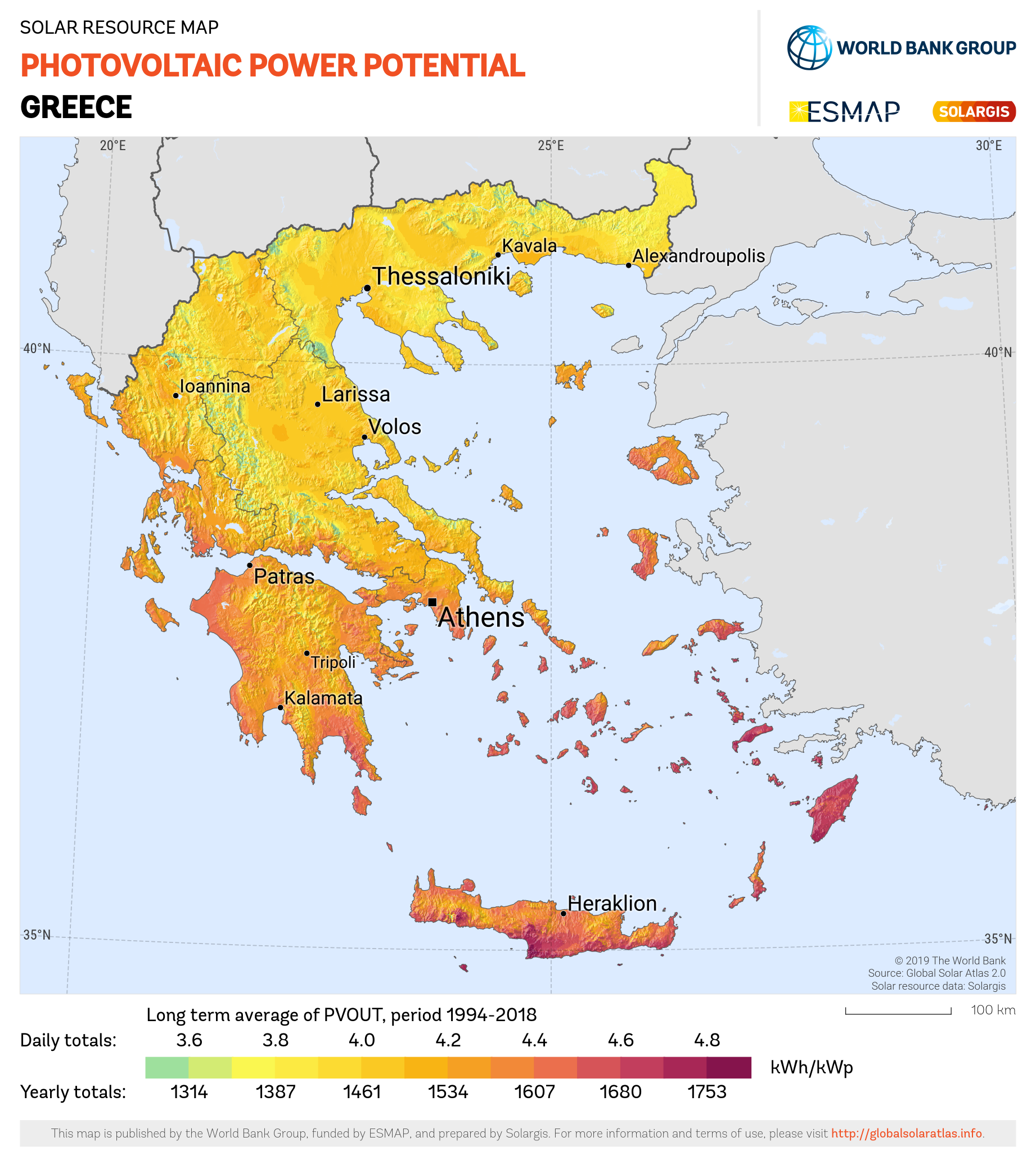
As per the Photovoltaic Barometer, a study conducted by EurObserver, Greece had a cumulative installed solar pv capacity of 2.8 GWs by the end of 2019. In a first glance, 2.8 GWs might feel quite a lot but when compared with other countries in EU it feels quite less. In comparison to Greece, Belgium had an installed solar pv capacity of 4.5 GWs by the end of 2019. Similarly, Netherlands had an installed solar pv capacity of close to 7 GWs during the same time period. Spain had an installed solar pv capacity of over 9 GWs. France had installed over 10.5 GWs of solar pv technology, UK (back then a part of EU) had 13.6 GWs of solar pv, Italy had close to 21 GWs of installed solar pv capacity and finally Germany with an installed solar pv capacity of 49 GWs close to the end of 2019. An exponential growth in installed solar pv capacity in Greece is the way forward for the country. It will be a key that would unlock the door of energy independence for the country. Simultaneously, a clean energy transition in Greece will certainly facilitate rest of the European Union in bending the emissions curve even quicker. If Germany can make solar pv technology work so can Greece as well. If it is possible for Italy to have an installed solar pv capacity of 21 GWs in 2019. It is equally possible for Greece to have an installed solar pv capacity of 21 GWs by 2025. As per a study, roof top solar pv panels can generate 32% of total electricity consumed by the consumers on annual basis in Greece.
Summing up all, I personally believe that solar pv technology can really help Greece in reducing its reliance on the import of fossil fuels. As per a European Commission report, Greece imported 61.6% of its natural gas, 20% of its crude oil and 64% of its hard coal from Russia in year 2015. A rapid transition to clean energy sources like solar pv technology can really help Greece in reducing its import bill regarding fossil fuels. The saved energy dollars can then be invested to create job opportunities and to improve infrastructure that would then help the country in mitigating its financial crisis in a sustainable manner in the years to come.
© Copyright 2022 Ayoub Hameedi. All rights reserved.
PLANERA is producing sanitary products that does not cause pollution in our ecosystem
Ayoub Hameedi
Sanitary products plays a crucial role in a women’s life regardless of what part of world she lives in and what financial background she belongs too. It is a must for every female and because of this basic fact it can be categorized as one of the most selling products across the globe. As per AHPMA (UK), women uses up to 4.3 billion sanitary items each year in UK alone. Likewise, a single female probably uses around 11,000 sanitary products in her life time. The figure is not so different in United States of America where as per National Geographic close to 6 billion sanitary products were purchased in 2018 alone. Altogether this marks over 10 billion sanitary products in a single year in just two countries. Unfortunately once used, most of these sanitary products would either end up in a landfill or in a water body where it would primarily cause plastic pollution and would remain there for few hundred years before the plastic in the sanitary products would break down. There is a dire need to produce sanitary products that are eco-friendly in nature and would thus produce least negative impact on environment. This is what this short report is all about.
PLANERA is a UK based company that has developed an answer to an already spoken problem. Their products are made of plant fibers, a special biopolymer and tree sap and are thus easy to dispose. PLANERA’s manufactured sanitary products also leave a minimal impact on the environment. Once used, PLANERA encourages its customers to flush the sanitary products down the toilet. Yes, quite contrary to the regular sanitary products available in markets and quite opposite to instructions posted in public toilets. PLANERA has designed sanitary products that gets easily dissolved in water when flushed and by the time waste water reaches the municipal water treatment plant, their sanitary products have been dissolved completely. The wrapping packet that contains the sanitary products and peel papers are also made of the same material as the sanitary pad itself. Thus we can also flush wrappers and peel papers down the drain too along with sanitary pad. The below video gives us a practical demonstration of how PLANERA’s designed products gets dissolved in water and are thus friendly for both environment and developed infrastructure.
All in all, we can confidently say that sanitary products are one of the most used products across the globe. It is a basic necessity for women and thus it is quite important that it should be designed in an innovative manner that would leave least impact on environment and infrastructure. As discussed earlier, any ordinary pad primarily made of plastic would remain in our ecosystem for few hundred years before it would break down. On the contrary, PLANERA’s products breaks down pretty quickly and does not choke our ecosystem and infrastructure with plastic waste. It creates a win-win situation for all where products can be designed in a eco-friendly manner with least impact on environment. As a result, both the businesses and the consumers emerges as a winner as there would be less plastic waste that would end up in our landfills and oceans.
© Copyright 2022 Ayoub Hameedi. All rights reserved.
Solar PV technology can create a serious dent in France unsustainable reliance on nuclear power
Ayoub Hameedi
According to International Atomic Energy Agency (IAEA), France had 56 nuclear power reactors in operation last year. French government was also in the planning process to decommission two of its nuclear power units in 2020. We can consider decommissioning as a much needed step in the right direction. However, France still relies heavily on nuclear power that as a technology is not only catastrophic for environment but can prove to be a constant security risk for France as well. Fortunately, France as a country has a strong potential to produce electricity with the help of solar pv technology. A map from Solar GIS reflecting the same is given below:

Solar PV technology is already mature in France as the country crossed the 10 GWs mark of installed solar pv capacity last year. This might seems to be a big figure however when compared with neighbouring Germany, it seems like France can do much better than its existing pace and this is what this short report is all about. I personally believe that France as country can play a defining role when it comes to exacerbating the installed solar pv capacity and phasing out nuclear power in the European Union (EU). It is worth mentioning here that the neighbouring Germany had an installed solar pv capacity of roughly 54 GWs by the end of 2020. Thus it won’t surprising to mention here that Germany had 5x more solar pv installed capacity than France close to the end of last year. A primary reason can be that France per annum rate of solar pv installation is quite slow for example, as per International Energy Agency (IEA) the country installed less than a GW of pv capacity in 2017. It installed slightly over a GW in 2018, followed by again less than a GW solar pv capacity in 2019. Last two years (2020 and 2021) were fairly good years for solar pv technology in France, as the country installed around 1.5 GWs in 2020 and around 2.5 GWs last year. Altogether, France installed 6.7 GWs of solar pv capacity from 2017 – 2021. It is important to mention here that this installed solar pv capacity represents utility, commercial and residential scales.
An important step for French President Emmanuel Macron would be to enable facilities in terms of tax reduction to residential areas who would choose to install solar pv panels on their roofs. Among all three previously stated levels (utility, commercial and residential), it was the residential areas that represented the least amount of installed solar pv capacity in France during last 5 years. Thus, tax reductions for households with roof-top solar pvs would be a much needed step in the right direction. Plus, it would be equally important to bring down the cost for solar pv panels itself and the price that incur on the installation of solar pv systems in residential areas. French Government can choose to pay a certain percentage of solar pv systems and its subsequent installation in all residential areas in France. This will certainly help President Emmanuel Macron’s administration to reduce its reliance on nuclear power and to astronomically increase the installed solar pv capacity in France. Let’s say that even if France manages to install 5 GWs of residential solar pv capacity each year in the coming 5 years, they country will have an additional 25 GWs of residential solar pv capacity to rely on. This can then be used by the French Government to decommission nuclear power plants in the country.
I firmly believe that increasing the installed solar pv capacity in France and decommissioning nuclear power plants will certainly boost the clean energy transition within European Union. France has the lion’s share of installed nuclear power capacity within EU. France can reverse this trend and can choose to be a land with the lion’s share of installed solar pv capacity in European Union. If France can make this happen for nuclear power plants, it can certainly make the same happen for solar pv technology as well. France should have phased-out nuclear power half a decade ago, however, it can now choose to phase out nuclear power technology in the coming decade. Yes, I believe that it is POSSIBLE for France.
© Copyright 2021 Ayoub Hameedi. All rights reserved.
How Paris is mitigating climate change and protecting bees with an increase in its urban forest cover
Ayoub Hameedi
Paris retains a special place among all other cities in the world due to its picturesque landscape and the most beautiful art pieces humans has ever produced. The city represents a perfect environment to its citizens where they can enjoy finest of the fine arts, river, beautiful landscapes and food all in a single place. However, with an increase in fossil fuel powered vehicles, the city is facing an ever increasing challenge of pollution that is not only decreasing the quality of life but also fostering the negative impacts of climate change. The city administration of Paris is however, taking required actions to fight climate change. First and foremost is to encourage people to use less of the fossil fuel powered vehicles. Another is to increase the number of trees in Paris as it is an effective strategy to remove greenhouse gases from atmosphere. It is important to mention here that a bunch of 10 – 15 trees are capable of absorbing a tonne of carbon dioxide on annual basis.
The city of Paris has previously passed a law that allows its residents to apply for a permit if they want to grow a garden within the vicinity of the city. The main aim of passing the already spoken law is to increase the green area that would not only promote biodiversity in the city but would also ensure a healthy population of bees that are vital for pollination. Bees relies on flowers for food and also pollinate other flowers too. This relationship that exists between bees and flowers is extremely vital for the spread of flowers in areas across the city. It would be extremely impressive if such an initiative would be replicated by other cities in France too. By doing so, France would no doubt be the most bee protecting nation in Europe. Likewise, if all of the existing countries within European Union (EU), would replicate the same project to promote and protect the bee population, it would be a right step in the right direction to ensure a healthy bee population. It is extremely important to mention here that bees plays a vital role in ensuring food supply for us. Almost 33% of the food that is produced across the globe on annual basis is dependent on bees for the sake of pollination.
All in all, bees play an extremely critical role in increasing the numbers of plants, trees and flowers in far flung areas. The already spoken process is referred to as pollination and is vital to ensure a sustainable supply of food for us. The city administration of Paris is executing an excellent initiative by granting its residents the permits to plant flowers, plants and trees within the vicinity of Paris city. This would attract more and more bees to the city that would then accelerate further the process of pollination and to ensure a sustainable supply of food within Paris. There is a dire need that the other cities within France would replicate the same initiative so that the whole country would be at the front line of the campaign to preserve and protect bees for us and our coming generation. If all of the other countries within European Union (EU) would replicate the same project, Europe as a continent will prove to be a heaven for bees and for humanity in general too.
© Copyright 2019 Ayoub Hameedi. All rights reserved.
Hydrogen Trains – A giant leap towards an emission free rail transport system
Ayoub Hameedi
According to International Energy Agency (IEA), transport sector produces a whopping 23% of the total share of greenhouse gases emission on annual basis. In a rapidly warming world due to our reliance on fossil fuels, we need a system that could replace the existing rail transport infrastructure in terms of service & carrying ability without leaving any negative impact on the environment. Today, trains are an excellent alternative to aeroplanes however, by 2050 we would certainly need a railway system that could transport large number of people and would leave no negative impact on environment. Keeping this thought in mind, Alstom has designed a train that is capable of blending in hydrogen with oxygen to power the train. A pilot project is in implementation in Lower Saxony in Northern Germany and operates on a 62 miles long track. This gives a hope that as the hydrogen powered trains would be mature with passage of time, we can have a future where trains would emit nothing but water. A world with a temperature increase of 1.5 degrees is certainly impossible with a fossil fuel powered rail transport infrastructure. A needed solution required to limit temperature increase to 1.5 degrees is here and the need of hour is that countries and governments across the globe would accept and implement it on a much faster pace to fight climate change.
An important question that a reader might ask is how a hydrogen powered train works. The answer is pretty simple. A hydrogen powered train carries a tank that is filled with hydrogen. The filled gas is then mixed with oxygen captured from atmosphere. The mixture of these two gases produces electricity that is then stored in batteries used to supply electricity to operate trains. The installed batteries are kept cold through fans installed on the roof of the trains. A hydrogen powered train produces water as emission and thus have a neutral impact on environment. It is an excellent alternative to diesel trains and are inexpensive to operate too. In comparison, diesel powered trains are inexpensive to purchase but are expensive to operate as it requires diesel and produces greenhouse gases emission that causes climate change. It is equally important to mention here that climate change causes a financial damage of USD 1.2 trillion to global GDP on annual basis and the aforementioned amount is sufficient enough to eradicate extreme poverty from every country across the globe. A video representation of a hydrogen train is as follows:
(The shared video is an intellectual property of BBC)
Alstom has also pledged that it would help the operators with maintenance of hydrogen-powered trains and developing infrastructure for an easy supply of hydrogen. In the beginning, Alstom extracts hydrogen from industrial emissions but is also working on other green methods to supply hydrogen. The whole project of GHG emissions free trains in Lower Saxony in Germany was enabled with the financial support of Federal Government that provided funds from National Innovation Programme for hydrogen and fuel-cell technology. The state of Lower Saxony will introduce another 14 hydrogen trains by year 2021. All in all, a replacement of diesel trains with hydrogen ones is a right step in the right direction to reduce greenhouse gases emission from Lower Saxony in particular and for Germany as a whole in general. Following the German footsteps, France plans to introduce its first hydrogen-powered train in 2022 and Britain, Netherlands, Canada, Denmark, Norway and Italy have shown their interest in hydrogen trains too. It would be right to say that with the passage of time and further development of technology, the purchase price of hydrogen trains will decrease in coming 2 – 3 decades and the idea would certainly be more convenient to implement in countries across the globe.
© Copyright 2019 Ayoub Hameedi. All rights reserved.
Solar PV technology can facilitate European Union to phase-out coal and implement Paris climate agreement
Ayoub Hameedi
It took nature 4.5 billion years to create the world, as we see it today. We were the last ones to arrive and we share this planet with millions of other forms of life. Yet since, the beginning of industrial revolution and particularly from 1950, we have managed to exponentially raise the concentration of carbon dioxide gas in our atmosphere. According to NASA, the most recent figure for CO2 concentration is 409 part-per-million. This reading highlights the dire need that we need to take drastic measures to reduce the concentration of CO2 gas and to mitigate climate change. European Union as the third largest emitter of carbon dioxide gas has a major responsibility and simultaneously an opportunity to show rest of the world that by replacing coal and natural gas with solar PV technology, we can bend the emissions curve and abide by Paris climate agreement.
According to a policy brief by Carbon Market Watch, only Sweden, Germany and France are taking steps in the right direction to deliver Paris climate agreement. We can change this by exponentially increasing the installed solar photovoltaic capacity in all of the 28 countries in European Union. If every country chooses to install 2 GWs of solar PV each year, the collective install solar PV capacity in EU would exponentially expand to another 560 GWs in the next 10 years. If utilized properly, the sheer magnitude of EU can prove to be its biggest strength. The given suggestion is realistic and achievable provided proper policy attention and finances are diverted in this direction. According to REN21 Renewables 2017 global status report, the global installed solar PV capacity grew from 6 GWs in 2006 to 303 GWs in 2016. During the same year, a lion’s share of installed solar PV capacity came from China, Japan, Germany, United States and Italy. In 2017, China installed a whopping 53 GWs of solar PV capacity and its total installed solar PV capacity now stands at 130 GWs. If China can install 53 GWs of solar PV in a single year, an installation of 56 GWs each year by 28 countries in European Union between 2019 – 2030 would not be that difficult.
In European Union, there exists a gulf in energy policies of different countries for example both Germany and Finland receives an equal amount of solar irradiation however, the former has an installed solar PV capacity of around 43 GWs whereas, the later needs to develop the infrastructure to produce clean electricity from solar technology. Similarly, Portugal, Spain, Italy, France, Greece, Malta and Cyprus receive the highest solar radiation in Europe. These countries have the potential to act as mecca of solar energy for the rest of EU. By doing so, EU would reduce its greenhouse gases emission and its reliance on coal as a source of power production. In 2017, EU produced around 20.6% of its electricity from coal and around 20.9% of its electricity from renewables. This reliance on coal is one of the key reasons why EU is the third largest emitter of carbon dioxide gas in the world. EU has an installed coal power capacity of 157 GWs and implementing the already spoken plan of installing 2 GWs of solar PV per member state each year for a decade can easily help EU to phase-out both coal and natural gas by 2030. The development of solar energy technology in Mediterranean regions would create jobs, promote economic development, reduce greenhouse gases emission, reliance on fossil fuels and will certainly steer EU in the direction of energy independence. Lastly, the given suggestion will for sure facilitate countries within EU to achieve the goals outlined in Paris climate agreement.
It is important for the citizens of EU member states to vote for green parties in the next elections of EU Parliament. Apart from voting, we as consumers must choose renewable energy over conventional sources of power production. By purchasing electricity from green companies, we as consumers can play our role to eliminate the use of coal and natural gas for power production. Once the coal and natural gas is out of equation, EUs carbon footprint will sharply decrease. It must be appreciated that France plans to phase-out coal by 2021, United Kingdom and Italy aims to phase-out coal by 2025. Netherlands, Denmark and Portugal plans to eliminate the use of coal by 2030. A sustainable change that would phase-out coal and natural gas completely and cause an installed solar PV capacity of 560 GWs by 2030 requires efforts from both governments and masses in general. By making right choices at right time, we would be able to reduce greenhouse gases emission, create green jobs, promote economic growth and would make solar PV price competitive to a point, where EU member states would prioritize solar PV technology over conventional sources of power production.
© Copyright 2018 - 20 Ayoub Hameedi. All rights reserved.
Maturing Solar PV technology is a must for Portugal to phase-out coal and natural gas
Ayoub Hameedi
Our unsustainable reliance on coal, oil and natural gas for power production, transportation, agriculture and for numerous other activities has disturbed the natural balance of greenhouse gases in atmosphere. As a consequence, earth is experiencing an increase in global average temperature that is the root-cause of climate change. It causes an annual loss of worth USD 1.2 trillion that could be avoided or minimized provided proper steps would be taken by countries, companies, cities and individuals across the globe. Some of the stakeholders are already taking actions to increase the share of clean sources in the overall energy mix, to reduce reliance on fossil fuels and to completely eliminate their use within next 2 – 3 decades.
Portugal is one such example that went down the path less traveled by producing 100% of its electricity through solar, hydro and wind sources for four days straight. It certainly created an unprecedented example for rest of the world to follow. The given fact serves as a hope for everyone that 100% clean electricity is possible and achievable provided much needed steps are taken in the right direction. The concrete actions like having right policies in place to support an exponential growth in clean sources of power production, imposing carbon tax on polluters and giving tax-relaxations to economic sectors who would rely on renewable energy resources are few examples to consider. In 2001, Portugal started its journey to produce clean power from wind turbines with an installations of 131 MWs. The country then kept on increasing the installed capacity and reached its first GW of wind power in 2005. The growth pattern remained steady and by march 2015, the cumulative installed wind power capacity in Portugal was around 5 GWs. It is important to mention here that the country took 15 years to mature wind energy technology. An installed capacity of 5GWs is sufficient enough to deliver much needed knowledge in the sector of wind power. Denmark with an installed wind power capacity of 5.3 GWs is an example in this regard.
Portugal has to rely on the import of fossil fuels to sustain its economy as it has no proven reserves of either oil or natural gas. This fact forced the energy policy makers to guide the country in the direction of clean sources of power production. In 1988, the then administration introduced a law that ensured independent power producers (IPP) within hydropower to have prompt access to grid. In 1995, the same facility was extended to windpower producers too. The then government also decided that the wind farm owners would reinvest 2.5% of the annual earning into the municipalities where the farms were installed. If have not already, the current government of Portugal needs to offer the same incentives for solar pv technology too. An introduction of concrete initiatives like swift access to grid, tax relaxation to companies working to expand the installed solar pv capacity and a reinvestment of 2.5% of revenue into the corresponding municipalities would certainly boost the confidence of investors in Portugal. All of the aforementioned recommendations will certainly facilitate central government of Portugal to create a carbon neutral future for everyone.
In 2017, the country generated around 59% of its electricity through coal and natural gas where the lions share (i.e. 33%) was produced through natural gas while the remaining 26% was generated from coal. In order to minimize reliance on these conventional sources, it is extremely important for central government to install at-least 7 – 9 GWs of solar pv by 2025. By doing so, solar pv would easily generate around a quarter of total electricity in Portugal. In 2017, the share of solar was only 2%, wind contributed 23%, hydro generated another 10% and biomass contributed 5% in the overall electricity production in the country. Thus, optimization of installed solar pv capacity is a must to ensure a future free from coal and natural gas for Portugal.
All in all, Portugal has set an unprecedented example where the country met all of its electricity demand through clean sources for 4 straight days. However, Portugal can do even better by optimizing the share of solar pv technology from the current figure. The move from EU to remove ban on the import of solar panels from China is a hope for the country to increase solar pv installed capacity to a point where it will completely eliminate coal and natural gas from power production. Portugal has ideal conditions for solar pv as it is one of the countries with highest solar radiation on annual basis in Europe. An implementation of policies based on the already spoken factors can easily mature solar pv technology to replace coal and natural gas. In my opinion, solar pv technology is a must for Portugal to provide 100% clean electricity and to ensure a sustainable future for everyone in the country.
© Copyright 2018 - 20 Ayoub Hameedi. All rights reserved.
Vertical Forest in Milan
Ayoub Hameedi
In my opinion, the two biggest challenges of 21st century are climate change and an exponential growth in urban population. According to United Nations, 68% of the global population is expected to live in urban areas by the mid of this century. This point out the fact that we will be in need of hundreds and thousands of new buildings, an appropriate amount of water, food, electricity and heat to sustain a decent quality of life. If left unaddressed, a changing climate due to an increase in global average temperature would create a lot of uncertainty and on top of that, billions of tones of concrete in the form of new buildings would increase both the urban heat island effect and energy demand to mitigate it. All of these facts highlight the dire need to design cities in a way that would turn them into carbon sinks rather than a source of emission. If we are able to do that, there is an ample chance that we would reduce the overall emissions and to sustainably accommodate growing population as well.
One such solution has been designed and implemented by Stefano Boeri Architetti in the city of Milan and is commonly referred to as vertical forest. It is basically a skyscraper but quite opposite to a conventional skyscraper. Vertical forest has 800 trees with a minimum height of 3 meters to a maximum of 9 meters. Besides trees, it also has 4,500 shrubs and 15,000 plants, respectively. A beautiful combination of trees, shrubs and plants certainly give vertical forest its unique feature that hardly another skyscraper in the city of Milan has. The two key ecological services of vertical forest would be a reduced demand of cooling and provision of habitat where the birds population might prosper. It is also a known fact that the presence of a green roof reduces the the cooling demand of any infrastructure up to 75%. An important point in this regard is to determine the effectiveness of vertical forest in terms of a decrease in energy consumption on annual basis. During the construction phase, the transportation of plantation from ground floor to the top, requires reliance on cranes powered by fossil fuels. Therefore, the project relies more on fossil fuels than a conventional project. However, if the constructed infrastructure reduces the energy demand up to 20% on annual basis, as a result, in the coming 5 years it would save the energy equivalent to a single year. This way the vertical forest has a higher chance to neutralize the impact of fossil fuel, it consumed during the construction phase. Moreover, in the coming 20 to 25 years, there is again a higher probability that the constructed building would be a climate positive project in nature.
As already spoken, the idea is certainly attractive and if proven to be effective in terms of reducing the energy consumption, it can facilitate policy makers and city planners in fighting the changing climate. It is important to mention here that a temperature increase between 1 – 3 degrees would negatively impact the Greenland ice-sheet, Artic summer sea-ice, Alpine Glaciers, coral reefs in Oceania and West-Antartic ice-sheet. All in all, vertical forests might have the ability to turn cities into carbon sinks rather than a source of emission. In my personal opinion, the energy demand of surrounding areas of vertical forest can be reduced further, if the roads would be carpeted with white asphalt as it is capable of reflecting sunlight and thus reducing the urban heat island effect. The aforementioned solution has been developed by GuardTop company and is referred to as CoolSeal. It is implemented in the city of Los Angeles where the applied area normally has a degree less of a temperature than the road coated with the conventional black asphalt. A combination of vertical forest with white asphalt might help the city planners to mitigate urban heat island effect. It might also bring the use of energy down for the cooling purpose. As a result, energy related emissions would decrease that would then help cities in the implementation of Paris Climate Agreement.
© Copyright 2018 - 20 Ayoub Hameedi. All rights reserved.
Tallinn is offering free public transport to its residents
Ayoub Hameedi
Public transport in any city or town ensures swift and sustainable traveling from one place to another. It is a human right that guarantees a decent quality of life to masses. It is also a mean to ensure socio-economic growth in any place and is equally good for the environment as it reduces the reliance on private vehicles. As the number of private vehicles decreases, the resulting greenhouse gases emission decreases as well. However, to make this happen, it is important that a strong focus should be placed on the quality of public transport service, so that masses would prefer public transport over private vehicles. In a rapidly warming world due to climate change, it is an environmental issue that we cannot choose to ignore. A recent evidence of a warming world is when the temperature hit 31.2 degrees in Finmark, an area that lies within the Arctic circle. Therefore with every passing day, it is becoming vital to make public transport more attractive than private vehicles. It is a mutual responsibility of central and local governments across the globe to invest more financial resources to provide optimal quality public transport to rural and urban residents. An increased number of private vehicles on roads lead to severe congestion that is another social and environmental issue to deal with. In 2013, traffic congestion costed United States of America around USD 124 billion in direct and indirect losses and the aforementioned figure is further expected to jump to USD 186 billion by 2030. Likewise in 2017, the city of Munich lost USD 3.1 billion due to traffic congestion. The story is not much different for Berlin that lost 7.5 billion, followed by Hamburg with 3.8 billion and Stuttgart with USD 1 billion, respectively. The congestion problem costed London city around USD 12.2 billion in losses in 2017. These are just few examples of financial losses due to traffic congestion. The issue can be sustainably resolved through the provision of optimal quality public transport on either free or on minimal charges, so that masses would prefer public transport over private vehicles.
The aforementioned strategy has been adopted by the city of Tallinn in Estonia that went for a referendum on the issue of providing free public transport to its residents on 19 March 2012. The end result of the referendum was a BIG YES to free public transport with over 75% of votes in favor. As a result, with the first sunrise of year 2013, the service became free of charge for the residents of Tallinn. An analyses of Fare Free Public Transport in Tallinn highlighted that the percentage of public transport users went up to 3% after the introduction of the policy. The increase in the usage was from the areas where the number of unemployed and elders were the highest. A positive outcome of the implemented strategy is that city of Tallinn has reported an increase in employment ratio and simultaneously attracted around 11,000 users for registration. The free public transport scheme works on the principle where €1,000 from the total paid tax of each registered user is transferred to Tallinn city administration on annual basis. As a result, the city now generates a profit of €20 millions on annual basis. Besides registration, each user is required to pay a bare minimum fee of €2 to get the green card to use the public transport. The implemented strategy is equally good for central government as it will ease out traffic congestion and would thus save time and money by decreasing the ratio of loss in productivity at workplaces. It will also improve quality of air in the Tallinn city and would certainly decrease the overall greenhouse gases emission for Estonia too.
All in all, the aforementioned strategy would naturally attract both critics and praises, however the need of hour is that the policy makers should neither be influenced by critics nor by praises. A close monitoring of the program will certainly highlight areas where improvements can be made on annual basis. There is a dire need that the program should be made resource efficient on annual basis so that each year it would consume less resources than last year. If the policy makers in Tallinn city would be able to do that there is a higher probability that the free public transport project would meet success in future too. Lastly, the aforementioned strategy is bound to reduce the greenhouse gases emission from private vehicles in Tallinn city and thus would help the city administration to implement sustainable development goals.
© Copyright 2018 - 20 Ayoub Hameedi. All rights reserved.
Life Straw: An innovative solution to provide clean water no matter where you are
Ayoub Hameedi
Clean drinking water is no doubt an important tool for us to survive and thrive. If we would study earlier human civilizations, almost all of them existed close to water bodies. Indus valley civilization existed on the fertile banks of Indus river. Likewise, Ancient Egyptian civilization also thrived along the banks of river Nile. Thus, a sustainable supply of water is a lifeline for every activity we have carried out in the past, present and likely to execute in future. A key achievement that we have made after World War II is to significantly improve the quality of life. As an outcome, the population rapidly increased and now is expected to reach 9.8 billion by 2050 and 11.2 billion by the end of this century. This rapid increase in population is decreasing the per capita water availability in certain parts of the world making them more prone to acute water shortages. Plus an increase in average global temperature due to climate change is also creating uncertainty in water supplies in regions across the globe. It points out the fact that every water body either polluted or otherwise should be seen as a resource and actions should be taken to mitigate the polluted ones. River Thames in London is another example that was declared as biologically dead by Natural History Museum in 1957. Then, a gradual improvement in the sewage system of London finally paved the way for life to survive and thrive in Thames. Today, river Thames is home to seals and dolphins. It shows that at times even small actions lead to big positive differences. This report is also about an innovative solution that is capable of cleaning polluted water and thus supplying drinkable water in areas where water quality is not up to a sustainable level.
The innovative solution is referred to as life straw and is comprised of a tube that contains several filters installed next to each other. Life straw can easily fit in a pocket and therefore, is easier to carry. The filters in the straw makes it sure that impurities would be remain behind and what comes out is clean drinkable water. It has been developed by the Swiss Company Vestergaard Frandsen and is capable to filter 1,000 liters of water that can keep a person hydrated for a year. LifeStraw has other products in its protfolio too namely lifestraw family for home use, lifestraw community for schools and clinics, lifestraw go as a refillable water bottle and lifestraw mission for camping in remote areas. It is quite unfortunate to mention here that diarrhea is responsible for killing 1,300 children each day and this makes a hefty figure of 480,000 children on per annum basis. The mortality rate among kids under the age of 5 can be reduced through an effective collaboration between state and non-state actors. It would also ensure the provision of innovative solutions to places where they are needed the most.
All in all, Life Straw device provides a ray of hope to minimize the infant mortality rate at global level. It is an effective tool to increase the implementation of sustainable development goals (SDGs) particularly ones dealing with good health and well-being, clean water and sanitation and lastly partnership for the goals. The need of hour is that the presented solution should be made available to those in need and a channel should be developed that would allow the swift supply from source to the users in a financially sustainable manner. It is only then we would be able to use human potential that we currently loose due to diarrhea. We don’t know how many Pablo Picasso’s, Michelangelo’s and Mozart’s we lose every year due to diarrhea. Life Straw is an effective step in the right direction to create a future that would be sustainable for us and our coming generations.
© Copyright 2018 - 20 Ayoub Hameedi. All rights reserved.
Plastic Road : A sustainable solution to reduce plastic waste
Ayoub Hameedi
Plastic waste for sure is one of the biggest environmental issues of the present era. According to United Nations (UN), in 1950 the global population stood at 2.5 billion that produced around 1.5 million tons of plastic on annual basis. The given figures skyrocketed with the beginning of 21st century as the global population soared to over 7 billion that went on to produce 300 million tons of plastic waste in 2016. We started using plastic in abundance around 60 years ago and since then we have produced over 8.3 billion metric tons of plastic. It is extremely important that plastic should either be reused or recycled at the end of its use as it takes around 400 years to decay. The reuse of plastic reduces the amount that ends-up as waste. Keeping the consequences in sight, there is a dire need to develop innovative solutions that would promote the reuse of plastic. Many stakeholders are working on to develop such solutions and one such example has been developed by KWS, a company under the umbrella of VolkerWessels. Their primary aim is to reuse the plastic so that it would not end up as a waste in oceans. The developed solution is plastic road and it is comprised of blocks made of used plastic. The blocks are easier to install, maintain and thus requires less human input, transportation and financial resources, when it comes to building a road. A youtube reflecting a quick quick visual presentation is as follows:
(*The shared video is an intellectual property of KWS and VolkerWessels)
It is important to mention here that roads are considered as a key to unlock development in any area. Therefore, roads if made from recycled materials can prove to be an effective tool to upscale sustainability. The positive impact of plastic road overlaps all three pillars of sustainable development. From the aspects of social sustainability and environment, it helps us to reuse plastic and thus reduces waste. From a financial perspective, it requires less resources to be installed. Unfortunately, around 60 garbage trucks of plastic waste ends up in oceans every hour. This means 1440 garbage trucks of plastic waste on daily basis. Plastic road is a ray of hope to turn things around in the right direction. The need of hour is that countries particularly in Asia, Africa and Latin America would consider and install plastic road on a large scale. The countries in these regions have a lot of a room for development and it is always price competitive to implement sustainable solutions right from the beginning. Simultaneously, it is an equal responsibility of the developed world to replace the existing roads with plastic roads, first on pilot basis and then to upscale it gradually.
All in all, plastic road can prove to be a much needed solution to reuse plastic to minimize the amount of plastic waste. The massive amount of plastic waste is unsustainable for us and our coming generations. It will eventually end-up in oceans where it would negatively affect marine life and then it will eventually make its way to our dining tables. Decades earlier, we made a choice to rely on plastics, now we can choose to reduce its usage, reuse and recycle plastic.
© Copyright 2018 - 20 Ayoub Hameedi. All rights reserved.
Solar Tunnel project in Belgium
Ayoub Hameedi
Belgium received independence from Netherlands in year 1830. Its capital city Brussels is considered as capital of Europe due to its important role when it comes to policy making and implementation. In year 2003, the parliament of Belgium passed a ruling to stop the use of nuclear power for electricity generation by 2025. The same ruling introduced an immediate ban on the construction of new nuclear power plants. The then Government of Belgium made a pledge to invest financial resources to promote renewable energy in the country. As a result of that pledge, Belgium generated 14% of its electricity through clean energy resources in 2016.
The aim of this report is to use the available physical infrastructure as a platform to generate clean electricity. The project in focus is comprised of 16,000 solar panels which are installed on top of a tunnel near Antwerp station in Belgium. The total surface area of the project is 50,000 square meters. A unique feature of solar tunnel project is that the project designers have spotted an area in an existing project which could then be utilized to promote the generation of clean electricity. Thus the project designers have optimized the utilization of an already existing infrastructure rather than opting to allocate new space for the solar pv project. The solar tunnel now provides Antwerp station with clean electricity and has facilitated the Belgium rail network “Infrabel” in reducing its carbon footprint by 2400 tons on yearly basis. Another stakeholder is Enfinity which is a green power production company in Belgium. The project is an end result of a public-private partnership and has been completed with an investment of 14.5 million euros in a span of 12 weeks. The total installed capacity of solar tunnel project is 4 MWs and it can collectively produce 3.3 GWs of clean electricity on annual basis. The generated electricity is sufficient enough to power all of the trains in Belgium for 24 hours. A birds eye view of the project is as follows:

The solar tunnel project is a ray of hope when it comes to decommissioning nuclear power plants and the promotion of clean energy in Belgium. As mentioned earlier, the country made a decision to decommission all of its existing nuclear power plants by 2025 but contrary to that pledge, it generated 55% of its electricity from nuclear power plants during last year. On top of that, the national Government in Belgium granted a ten year extension to 2 GWs of nuclear power beyond the targeted time frame of 2025. It is understandable that any sustainable change takes a considerable amount of time to occur. With the inauguration of solar tunnel project, the then Government of Belgium took an extremely effective initiative which then lead to a sustainable change in the sector of power generation in the country. The percentage of renewable energy in the overall energy mix of Belgium has soared during last decade from 2% in 2005 to 8% in 2014. The largest share of clean electricity comes from wind power (both on-shore and off-shore) followed by solar photovoltaic which is the second largest source of clean power production in Belgium. The country produced 81896 Gigawatts of electricity in 2016 out of which 16.89% (i.e. 13,835 GWs) were produced through renewable energy resources. The solar photovoltaic produced 2925 GWs of electricity and thus formulated 21.14% share of clean electricity when compared with other clean sources of power production in Belgium. With effective policy making, prioritization of solar pv and implementation of the designed policies, the share of solar photovoltaic can be increased sustainably.
The solar tunnel project can be replicated with slight modifications in areas all across the Belgium. There are 40 motorways in Belgium which provides an excellent opportunity to upscale the power generation from solar photovoltaic sources of power production. Solar panels can be installed on both sides of the motorways. As mentioned earlier, the goal is to utilize the available infrastructure to the fullest of its potential. The same idea can be replicated along the roads in cities, semi-urban and rural areas too. The surface area of residential and government buildings also provide another excellent opportunity to install solar photovoltaic cell and to sore the share of electricity generated from solar pv technology. The given recommendations are not extraordinary rather they are very common but the implementation will certainly facilitate the Government to reduce its reliance on nuclear power. It will also promote Sustainable Development within the sector of power generation in Belgium. Finally, the prices of solar panels are extremely competitive in comparison to fossil fuel based sources of power generation and on top of that, prices of panels are further expected to decrease in the coming years. The solar pv as a source of power generation is environment friendly and will certainly push Belgium towards electricity independence. Altogether, the factors of price competitiveness, carbon-neutrality and energy independence certainly make solar pv more attractive than fossil fuel and nuclear based sources of power generation.
Summing up all, the game changing factor when it comes to the promotion of clean energy technology is the optimal utilization of available infrastructure. Solar tunnel project is a good example in this regard. The goal now is to replicate the same idea in areas all across the Belgium. It will certainly increase the percentage of solar energy in the overall energy mix of Belgium. Lastly, it will not only reduce the country’s unsustainable reliance on nuclear power but will also facilitate the political administration to achieve its goals when it comes to implementing sustainability in the sector of power generation.
© Copyright 2017 - 20 Ayoub Hameedi. All rights reserved.
Germany Taking the Lead in Solar Energy Technology
Ayoub Hameedi
Solar photovoltaics (SPV) is a major source of clean electricity generation in Germany. According to the Energy Charts website, the installed SPV capacity has grown exponentially over the period of time from 2.06 GWs in year 2005 to 41.55 GWs in 2017. In year 2015, renewable resources produced 30% of the total electricity out of which SPV contributed 6%, household waste contributed 0.9%, Biomass 6.8%, hydropower 3% and finally wind power with a share of 13.3%. A graphical representation of the same is as follows:

It can be noticed that solar photovoltaics were the third largest source of renewable electricity generation in Germany during 2015. The top two sources were wind power with a share of 13.3% and biomass with a share of 6.8%, respectively. Similarly, another map representing registered photovoltaic systems with storage batteries in Germany can be found below:
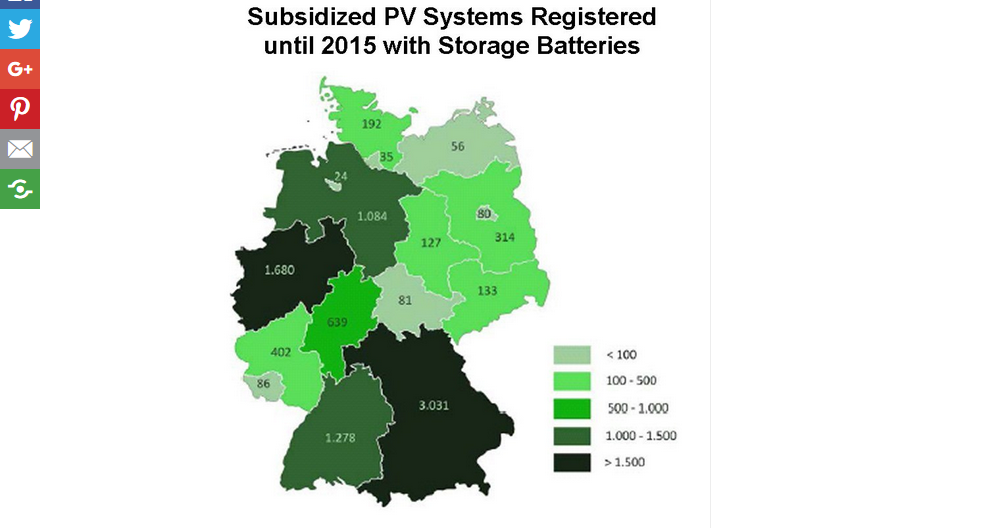
It can be concluded that the southern region has the most registered SPV battery systems followed by western region. The central region represents the least share. Waldspolenz Solar Park is amongst the largest solar farm in Germany with an installed capacity of 40 MWs and an output of 40 GWs on annual basis. A pictorial representation of Waldspolenz Solar Park is as under:
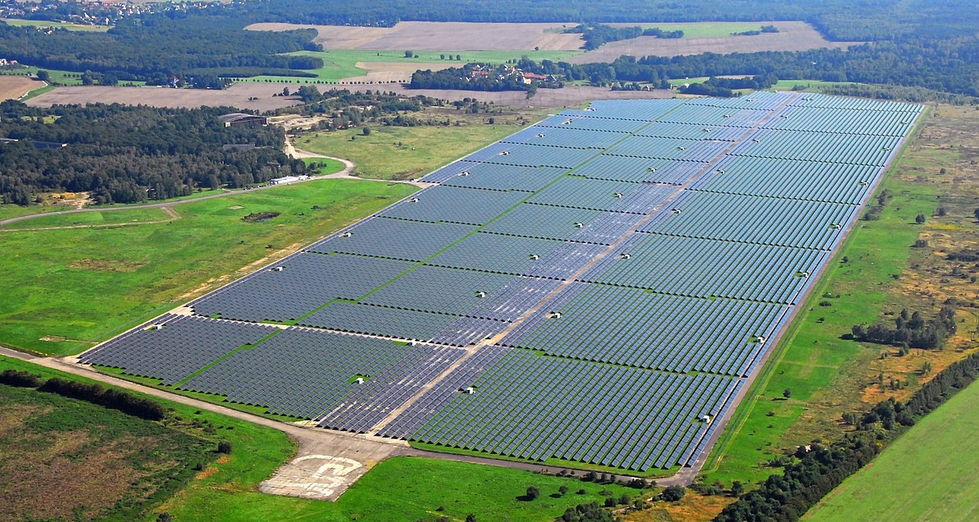
In 2016, a total of 1.2 GWs of solar photovoltaic capacity was installed in Germany. Energy authority plans to aim for a carbon-neutral status by year 2050. In order to achieve this ambitious goal, the authority needs to install 150 – 200 GWs of solar photovoltaic by year 2050. To break it down into smaller steps, the energy authority needs to install 4 – 5 GWs of solar PV on annul basis in Germany. Solar PV as a whole generated 38.3 TWh of electricity, representing 7.4% of the total electricity consumed in year 2016. A graph representing the installation of solar photovoltaics (PV) from year 2004 to 2018 is as under:
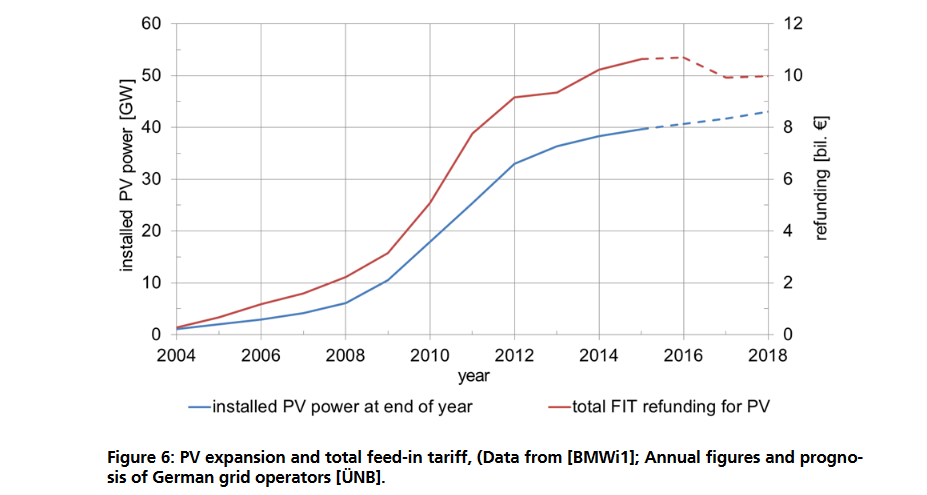
In 2004, the installed solar PV capacity was close to 1 – 1.5 GWs which then exponentially grew to 18 GWs in year 2010, finally reaching a point of 40 GWs by year 2015. It is further expected to reach up to 43 – 44 GWs by year 2018.
Finally, Germany reflects a promising future for the promotion of solar energy technology however, still a lot needs to be done in order to reduce reliance on coal, natural gas and nuclear energy technology which generates approximately 56% of total electricity in the country.
© Copyright 2017 - 20 Ayoub Hameedi. All rights reserved.
Forest Sector: An Effective Key To Promote Sustainable Economic Development In Estonia
Ayoub Hameedi
Republic of Estonia came into existence on 24 February 1918, however due to Soviet expansion, it was forced to become a Soviet state in 1940. It remained a part of Union of Soviet Socialist Republics (USSR) for 51 years. It reclaimed independence in 1991 with the fall of Soviet Union which also brought an end to the cold war era. Estonia is an Eastern European country and share borders with Russia in East and Latvia in South. Baltic sea is located on the west coast of Estonia whereas, Gulf of Finland lies in north. After its independence, it formally applied for European Union membership twice in 1995 and 1998 and after years of negotiations and a referendum in September 2003, it finally received the membership on 1 May 2004.
Estonia is blessed with ample forest reserves as almost 50% of it’s territory is covered with trees and 27% of that covered area has protective status. It is the sixth most densely forested country in Europe surpasses only by Finland, Sweden, Slovenia, Montenegro and Latvia. Wood and wood related products represents 14% of total exports from Estonia whereas, machinery and electrical equipment remains on top with an overall share of 28%. Another 22% of the total land area of Estonia is utilized for agricultural purposes. It has a total population of 1.32 million however, despite having a fairly small population, still 21% of Estonians are categorized as poor. There is a dire need to formulate socioeconomic policies which could eradicate poverty and give marginalized Estonians an opportunity to improve their existing quality of life. An ample forest reserve has the potential to flip things around positively.
An appreciative strategy in this regard would be to pursue furniture giants (i.e. large furniture manufacturing and selling companies) to establish their strong presence and execute their operations from Estonia. IKEA group earns a revenue of over €35 billion on annual basis and can be an excellent stakeholder in this case. IKEA has plans to establish its operations in Tallinn in coming years however, a clear date has not been given yet. Besides this, universities and research institutes in Estonia can generate comprehensive knowledge concerning the production of high quality wood products in Estonia (Source: Estonia, the new EU economy: Building a Baltic Miracle, Page 167). At the moment, both universities and research institutes are the weakest link in the overall equation when it comes to research and creation of knowledge. An important point to remember is that its basically the quality of a product that matters the most and in case of Estonia, it can be achieved by bridging an existing gap between the academics and industry. Switzerland is an excellent case to study in this regard as it is famous for converting imported raw materials into extremely high quality products for the sake of import. It is only possible due to the presence of a strong manufacturing sector in Switzerland. Estonia can replicate the same strategy when it comes to production of high quality wood products. The only difference would be that it won’t have to import wood as it has ample natural reserves. Government of Estonia can choose to focus on establishing a strong manufacturing sector to produce extremely high quality wood products in Estonia. However, a strong strategy is also needed to ensure a sustainable supply of wood without depleting or degrading the natural reserves. It will provide Government of Estonia a window of opportunity to narrow the gap between wood products and machinery, when it comes to exports. By doing so, sustainable economic development will take place and its positive impact will definitely trickle down to masses in Estonia. Finally, more jobs will be created and circulation of money will improve which will eventually decrease poverty in Estonia.
© Copyright 2017 - 20 Ayoub Hameedi. All rights reserved.
 Project GE