
Countries in North America
___________________________________________
USA must phase-out coal power plants to bend its greenhouse gases emission curve
Ayoub Hameedi
According to the US Energy Information Administration (USEIA), USA generated 60% of its electricity from fossil fuels in 2023. A lion’s share of this produced electricity was generated from natural gas (around 43.1%) followed by coal that produced another 16.2% of electricity while the remaining 0.7% of the electricity was produced from petroleum liquids, petroleum coke and other gases respectively. This unsustainable reliance on fossil fuels particularly coal is incurring a huge price on the country that is either paid by the households or businesses across the length and breadth of the country. As per United Nations Environment Program (UNEP), Lake Mead and Lake Powell had their lowest ever water levels in recent years. Again as per UNEP, the conditions around Colorado River basin have remained so dry for over last 20 years that UNEP now refers to it as the new normal. UNEP has stopped referring this dry condition as drought. Unfortunately, even during this extreme dry condition, USA maintained its business-as-usual approach towards electricity produced through coal power plants. Water shortage in Lake Mead and Lake Powell affected people across Nevada, Arizona, California, Wyoming, Colorado and New Mexico. As per USEIA, US electric power sector consumed over a whopping 428 trillion gallons of water from 2014 – 2021.
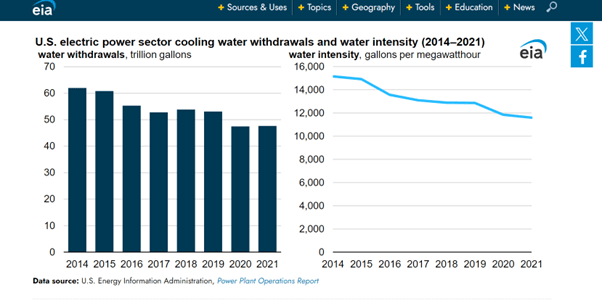
Coal is certainly the most water intensive source of electricity production. In USA, coal power plants on average used 19,185 gallons of water to produce a megawatt hour of electricity in 2021. On the contrary, natural gas combined-cycle generation consumed 2,803 gallons of water to produce a megawatt hour during the same time period. Thus, coal based power plants on average used 6 times more water per megawatt hour of electricity production than natural gas combined-cycle generation. Renewable energy technologies like windpower and solar PV do not need cooling water and thus have a very low water withdrawal intensity than coal and natural gas based power plants.
Other than water usage, do you know that coal mines are also responsible for methane gas emission as well. As per US Energy Information Administration, the concentration of methane gas in underground coal mines can lead to an explosion. Thus, it is crucial to prevent the accumulation of methane gas in underground coal mines. The business-as-usual way to stop the accumulation of methane gas is to release it in the atmosphere. In 2021, methane gas emissions from coal mines represented 7% of the total methane gas emissions for the country. Altogether, methane gas emissions represented 1% of the total greenhouse gas emissions for USA in 2021. It is equally important to mention here that burning of coal for electricity production also leads to sulphur dioxide emission that is the primary cause of acid rain. Nitrogen oxide emission primarily due to burning of coal also causes smog. Both sulphur dioxide and nitrogen oxide cause respiratory illness as well. Finally as per United States Environmental Protection Agency (USEPA), coal produced only 20% of total electricity in USA in 2022, however, it was responsible for 55% of the carbon dioxide emissions from electric power sector.
We must appreciate the fact that USA produced 21% of its electricity from renewables in 2023. However, there is a dire need for USA to sharply reduce its unsustainable reliance on fossil fuels and nuclear power for electricity production. Other than the fossil fuels and renewables, nuclear power produced 19% of electricity in 2023. USA has what it takes to rapidly increase an installed renewable energy capacity across the country. Renewable energy technologies are already matured in USA as windpower produced 425 billion kwh of electricity in 2023 followed by 162 billion kwh of clean electricity by solar PV. It is important to point out here that USA installed 32.4 GWs of installed solar PV capacity in 2023 that brought the cumulative installed solar PV capacity to 177 GWs. Likewise, as per Solar Energy Industries Association, cumulative installed solar PV capacity right now stands at 209.8 GWs. Now is the time for USA to phase out coal power plants and to rapidly increase an installed solar PV and windpower capacity to produce 100% electricity from clean sources of power production.
© Copyright 2024 Ayoub Hameedi. All rights reserved.
ZeroAvia: A sustainable solution to neutralize aviation’s negative impact on environment
Ayoub Hameedi
As per WWF, air travel is a key point source of greenhouse gases emission. In-fact, if the whole aviation industry is imagined as a country, it would be amongst the top ten most polluting nations in the world. Aviation industry already facilitate billions of people to travel from one destination to another on annual basis and is expected to grow multiple times in the coming 2 decades. According to Air Transport Action Group (ATAG), 4.5 billion people took flights in 2019 out of which 1.9 billion people travelled internationally and 2.6 billion people took domestic flights. Altogether, 46.8 million flights took place in 2019. Now imagine, if these already spoken figures are exponentially increased to 3.5 times. How catastrophic would that be for environment and climate. Unfortunately, this is exactly what is expected to happen in the coming decades. WWF say that 2.4 billion people took flights in 2010 and this figure is expected to exponentially increase to 8.2 billion in the coming decade or two). Thus, their is a dire need to develop technology that would help aviation industry to end its unsustainable reliance on fossil fuels and rather adopt green fuels with no harmful impact on environment. This is what this short report is all about.
ZeroAvia is a US based company working on to mature hydrogen-electric engines for aeroplanes. It’s functioning is fairly simple where hydrogen runs through fuel cells to produce electricity which is then used to run the motors and thus power the aeroplane. ZeroAvia is working on two different types of hydrogen-electric engines where the first one ZA600 engine is meant for 9 – 19 seats aeroplanes. On the contrary, the second engine ZA2000 would be able to lift 40 – 80 seats aircraft in the air. In January 2023, ZeroAvia successfully lifted a 19 seat aeroplane in air with the help of ZA600 and was then subsequently named as one of the most influential companies in 2023 by TIME Magazine.
The biggest positive impact we get by using hydrogen-electric engine is that it does not emit greenhouse gases in atmosphere. In-fact, only emission that takes place due to the use of hydrogen as a fuel in hydrogen-electric engines is water. An extremely crucial point to focus on is how do we actually produce hydrogen as a fuel. This extremely important factor can either make or break the environment friendly movement to lift aeroplanes using hydrogen as a fuel. There are 3 different types of hydrogen fuel namely grey hydrogen, blue hydrogen and green hydrogen. In the first case, we use fossil fuels to produce hydrogen. Consequently, we emit greenhouse gases in atmosphere during hydrogen production process. As a result, we call this type of hydrogen as grey hydrogen. The production process of blue hydrogen is fairly similar to grey hydrogen but in this case we store the greenhouse gases in deep underground geological formations. Lastly, green hydrogen is produced through the use of clean electricity that is generated from 100% renewable sources of power production like solar PV, windpower and hydropower. It is only the use of green hydrogen that would make the whole flying process 100% clean and green. If the hydrogen gas is either grey or blue, we cannot call the use of hydrogen as an eco-friendly option in that case.
Summing up all, green hydrogen can really prove to be a game-changer when it comes to putting a dent in the greenhouse gases emission curve. It is a mutual responsibility of Governments and companies across the developed world to invest in technologies that can really help us phasing out fossil fuel based technologies. ZeroAvia is one such example in this regard that is working day in and out to mature hydrogen-electric engines so that we can push aviation sector towards zero carbon future. Every technology that we use right now was once a dream or just an idea. With right policy actions, taken at the right place and in the right direction we can certainly phase out fossil fuel usage in aviation sector. It is difficult but not impossible.
© Copyright 2024 Ayoub Hameedi. All rights reserved.
Water scarcity and a sustainable solution to mitigate it
Ayoub Hameedi
Water scarcity is one of the most pressing issues affecting large number of people and if counter actions are not taken in time to reduce its intensity, this problem will only exacerbate. Do you know that as per UNICEF more than two billion people lives in areas with inadequate water supply. Adding insult to injuries, almost half of the global population will live in areas suffering from water scarcity as early as 2025. Do you know that extreme water shortage can force 700 million people to migrate to other places by 2030. Such mass migration both within a country and from one country to another can trigger social unrest and political instability. Water scarcity is not just an environmental issue, it is indeed a very big social and economic question as well. Our life is based on water and without an adequate access to water we cannot have a healthy and active life. We must do all we can to preserve water and do more with less water. Do you know that about 70% of the earth’s surface is covered with ocean. What if, we find a way to convert that ocean water into clean and fresh drinking water. That can really help us out in mitigating water shortage in countries across the globe. Normally seawater desalination is an energy intensive process and requires a lot of fossil fuel consumption if not powered from solar PV and wind energy technologies. Saudi Arabia is an excellent example in this regard as it was using 1.5 million barrels of oil a day to desalinate seawater in 2010. In-fact, right after Saudi Arabia’s foundation in 1932, the country started massive geological survey to locate underground water aquifers. It was basically these surveys that led to the discovery of massive oil reserves that Saudi Arabia enjoys today. Now, getting back to the question, what if there is a seawater desalination technology that relies completely on wave energy technology and thus is not limited by the factors like if the sun is shining or the wind is blowing. This is what this short report is all about.
Oneka technologies is a Canada based company working on to mature seawater desalination with the help of wave power technology. It is important to point out here that wave energy technology is a 100% clean source of power production and is independent of factors like either sun is shinning in case of solar PV technology or wind is blowing for windpower technology to work. As per the Oneka technologies, its designed solutions require no electricity and land space. Similarly, its designed solutions do not emit greenhouse gases during its operation. Oneka has 3 different seawater desalination products in its portfolio all powered by wave energy technologies. All 3 offered solutions have different output capacities to cater different needs. It’s biggest unit is capable of desalinating 50 cubic meter of water each day and can provide drinking water for at least 100 people up to a maximum of 1500 people each day. It’s second unit is capable of desalinating 10 cubic meter of water each day, thus fulfilling the drinking water needs of 20 to 300 people each day. Finally, their third unit in portfolio can desalinate 1 cubic meter of seawater each day and it can be used on plug and play basis to mitigate water shortage in case of a natural disaster or any other humanitarian crises.
It is not out of place to mention here that having access to clean drinking water can either make or break the social and economic fabric of societies across the globe. In-fact, in my opinion, we need a water revolution in this century and since its a crucial resource for our societies and economies, it is vital that we develop and mature technologies that would facilitate us in mitigating its shortage. We need to make sure that every single person would have an access to adequate clean drinking water. It is a must to achieve all our goals regarding socially functioning, ecologically sustainable and economically viable societies across the globe. We cannot take access to clean drinking water for granted and we should do all we can to mitigate its shortage.
© Copyright 2024 Ayoub Hameedi. All rights reserved.
Status of windpower in United States of America
Ayoub Hameedi
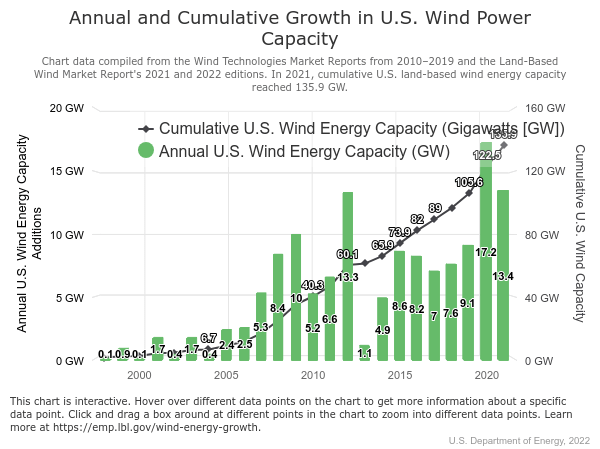
According to the Office of Energy Efficiency and Renewable Energy, USA installed 13.4 GWs of new windpower capacity in 2021. This brings the cumulative installed windpower capacity to 136 GWs in United States of America. 2020 was equally an excellent year for installed windpower capacity as USA installed a cumulative 17.2 GWs. Thus, the country installed a cumulative 30.6 GWs of windpower capacity in 2020 and 2021. However, not all the previous years experienced such an exponential growth for an installed windpower capacity in the country. In 1998, USA had a cumulative installed windpower capacity of 1.5 GWs and the country had barely added 0.1 GWs to its cumulative installed windpower capacity during the same year. In 1999, the country added another 0.9 GWs to its cumulative capacity bringing it to a total of 2.4 GWs. In 2000, again only 0.1 GWs of windpower capacity was installed bringing the new total to 2.5 GWs.
With the start of 21st century, windpower gained some momentum in USA as 1.7 GWs (in 2001), 0.4 GWs (in 2002), 1.7 GWs (in 2003), 0.4 GWs (in 2004) and 2.4 GWs (in 2005) were added to the cumulative installed windpower capacity. These healthy additions increased an installed windpower capacity to 9 GWs in USA. Thus, it took USA almost 8 years to install 9 GWs of windpower and to mature windpower as a sector. From 2006 onwards, windpower experienced an even healthy of a growth pattern where 2.5 GWs (in 2006), 5.3 GWs (in 2007), 8.4 GWs (in 2008), 10 GWs (in 2009) and 5.2 GWs (in 2010) were added to an already installed windpower capacity. As a result, cumulative installed windpower capacity exponentially grew to 40.3 GWs respectively. Thus, USA took 8 years to install 9 GWs of windpower, followed by an addition of 31.3 GWs of installed windpower capacity during the next 5 years. Next 11 years (from 2011 to 2021) can be referred to as the most glorious period for windpower in United States of America, as the cumulative installed windpower capacity sky-rocketed to 135.9 GWs (in 2021) from 40.3 GWs (in 2010). Thus, it took United States of America 24 years to increase an installed windpower capacity from 1.5 GWs (in 1998) to 136 GWs (in 2021). United States can do better than this and I believe United States must do better than this.
As per the World Resources Institute, United States of America is the second largest emitter of greenhouse gases in the world with an annual emission of 6001.2 MTCO2e. China surpasses United States of America and is the largest emitter of climate change causing gases in the world. For United States, electricity & heat production, transportation and buildings are the three biggest point sources of greenhouse gases emission. We can confidently say that by exponentially increasing an installed windpower capacity in USA, the country can put a serious dent in its emissions curve. Its not necessary for USA to take another 24 years to install an additional 136 GWs of windpower capacity to its already installed capacity. USA can choose to install 136 GWs of windpower capacity in 5 years this time. So by 2030, USA would have a cumulative installed windpower capacity of 272 GWs. It can certainly help the country in bending its emissions curve and beating climate change.
Summing up all, United States of America is the second largest emitter of greenhouse gases in the world. Thus, it needs to show climate leadership by doing what needs to be done to bend the emissions curve and to mitigate climate change. As per University of Chicago, climate change will cause an economic loss of 1 – 4% of GDP for USA by the end of this century. As per Swiss Re Group, United States loses 0.4% of its GDP due to climate change related events now. When turned into dollars, 0.4% of GDP loss represents a cumulative financial loss of USD 97 billion on annual basis. Thus it is in the best of interest of USA to exponentially increase its installed windpower capacity to reduce its reliance on fossil fuels and nuclear power. According to Office of Energy Efficiency and Renewable Energy, USA produces over 20% of its total electricity from clean sources. Windpower tops the list with 10.3% share, followed by hydropower with 6% share, solar energy with 3.4% share, biomass with 1.2% and finally geothermal with a share of 0.4%. Unfortunately, USA produces 80% of its electricity from fossil fuels and nuclear power. United States can do better to exponentially increase its installed windpower capacity, to bend emissions curve and to phase out fossil fuels and nuclear power.
© Copyright 2024 Ayoub Hameedi. All rights reserved.
SmartFlower: A perfect solution to lead USA into an agrivoltaics era
Ayoub Hameedi
SmartFlower is a cleantech company that was originally founded in Austria and was later on acquired by Energy Management Inc (EMI), a Boston based privately held energy company. SmartFlower has developed an innovative solution that has an ability to track the movement of sun during the day and thus harness as much of solar radiation as it is possible to produce clean electricity. The design and functioning of a SmartFlower is an exact replica of a flower in a natural environment. Just as a flower blossom with the right conditions in place, so do the SmartFlower as well with sunrise. The nature inspired innovative solution has solar panels instead of petals that absorbs solar radiation and uses this renewable resource to produce clean electricity. SmartFlower can really help homes and businesses in transitioning to clean sources of power production. When compared with a conventional roof-top solar PV system, SmartFlower can be delivered and installed within few hours. In my opinion, quick delivery and rapid assembling is a crucial factor that can facilitate households and businesses in putting a dent in their greenhouse gases emission curve. Once installed on the property, SmartFlower is quite easy to be removed and resell in the market. Traditional rooftop based solar PV panels requires a lot more time and finances to be removed, in case you either need to sell them or relocate them to your new home. On the contrary, SmartFlower can be quickly removed and relocated in case, you sell your home and now want to move the SmartFlower to your new home. Most importantly, since SmartFlower follows the movement of sun during its operation thus it harness more solar radiation and as a result produces roughly 40% more clean electricity than conventional rooftop based solar PV system.
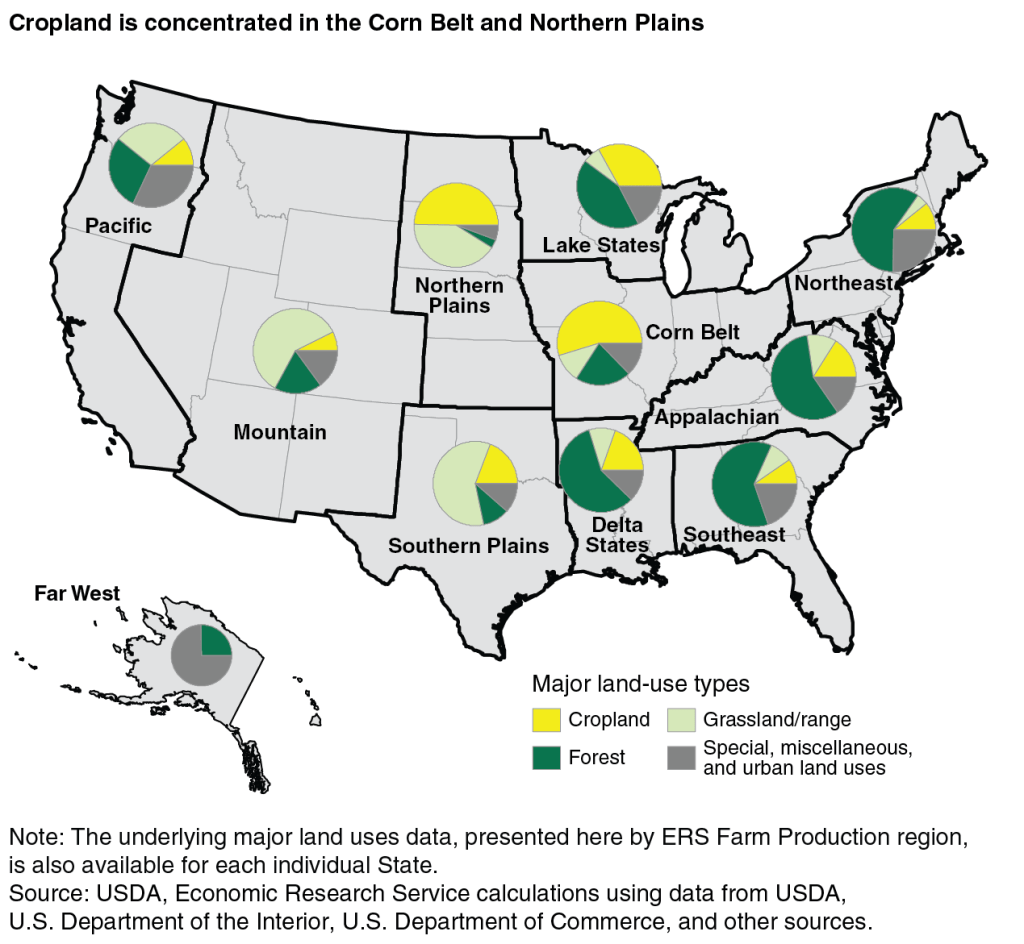
I personally believe that SmartFlower is a perfect solution when it comes to using agricultural plots for both food and electricity production in United States of America. We normally refer to such solution as agrivoltaics. As per the United States Department of Agriculture (USDA), a lions share of geographical area in Northern and Southern plains in USA is comprised of cropland and grassland. Similarly, mountain region in USA is mostly comprised of grassland and cropland as well. Lake states, Corn belt, Delta states and Pacific region also uses almost one-third of their geographical area as cropland and grassland. Altogether, the already spoken areas in USA represents more than half of the geographical area in the country. Fortunately, we can use these areas to install SmartFlower in order to produce both solar PV based clean electricity and food for households in the country. Thus, the farmers in USA can maximize their revenue through the sale of clean electricity as well as food in the market. The map given below is an intellectual property of US Department of Agriculture (USDA) and is shared here for awareness creation purpose only.
SmartFlower is an equally useful solution when it comes to using vacant land in U.S. cities for a better purpose. As per the Forest Service (U.S. Department of Agriculture), almost 9 million acres of land in U.S. cities is either vacant or abandoned. This represents almost 15% of the cumulative available land in U.S. cities and is roughly equal to Switzerland in terms of geographical area. Now imagine a scenario, where we would install a SmartFlower in each of the vacant plot in cities in United States of America. By doing so, we can use these vacant plots for a better purpose and can in-fact turn them into micro engines of clean electricity production, one vacant plot at a time.
Summing up all, we have the solutions needed to foster a clean energy transition in United States of America. An installation of SmartFlower in grassland and cropland will enable farmers to maximize revenue through the production of clean electricity and food from the same plot of land. Likewise, 9 million acres of abandoned land in U.S cities (i.e. roughly the size of Switzerland) can be used to install SmartFlower as well. This will enable the respective city administration to produce clean electricity, reduce their reliance on fossil fuels and nuclear power. Most importantly, the youth in United States of America can be trained to install SmartFlower and can thus be saved from prevailing violence in American society. As per the U.S. Government’s website, youth violence is responsible for a financial loss of over USD 18 billion in terms of medical and lost productivity costs each year. By delivering the much needed training in clean energy sector, we can save our youth from violence and can certainly empower them with training and knowledge that can alter their life for good. It is possible provided much needed policy attention and fiscal resources are diverted in this direction.
© Copyright 2024 Ayoub Hameedi. All rights reserved.
Solar PV Panels & Thermo Electric Generators (TEG): A match made in heaven
Ayoub Hameedi
2022 was a remarkable year for solar PV technology as the energy source crossed the milestone of a terawatt as global installed capacity. It is indeed remarkable as the rows and rows of solar PV panels helps us to decarbonize our economies and entering in a post fossil fuel era. However, these solar PV panels become idle as soon as the sun sets down. The same source of energy that counts as a blessing during day turns into a big challenge during night. But we need to overcome this basic obstacle as solar PV technology can help us moving beyond fossil fuels and into a 100% clean energy future. This is what this short report is all about.
Researchers at Stanford University in collaboration with US Department of Energy have developed a Photovoltaic Thermo Electric Generator (PV-TEG) that can produce electricity on the basis of difference in temperature between two surfaces. It is important to point out that solar PV panels absorb solar radiation during the day and uses this absorbed radiation to produce clean electricity. Due to solar radiation absorption, the PV panels becomes warmer and warmer with each passing hour. The temperature of solar PV panels becomes the highest around noon, when the panels are almost 15 degree Celsius warmer than their surrounding environment. Likewise, during night, solar PV panels starts cooling down and thus are almost few degree Celsius cooler than their surrounding environment. Sid, Zunaid and Shanhui are the researchers at Stanford University and the author of the research article. They claim that a thermo electric generator (TEG) when combined with solar PV panels can harness this existing temperature difference between solar PV panels and their surrounding environment and can utilize this to produce clean electricity during night.
To simplify, the functioning of solar PV-Thermo Electric Generator (PV-TEG) is really simple. As we all know, solar PV panels produces electricity during day through solar radiation. After sunset, solar PV panels starts cooling down and then thermo electric generator harnesses the temperature difference between PV panels surface and their surrounding environment to produce clean electricity. Thus, a PV-TEG device transform solar PV panels into a 24 hours clean electricity generation machine. PV-TEG device helps us overcoming the basic barrier of solar PV technology that is PV panels sits idle after sunset. Up till now, a PV-TEG device when attached with solar PV panels can produce 50 milliwatts of clean electricity per square meter of PV panels on a cloudless night sky. It is an excellent beginning and if more resources are invested to mature this solution, PV-TEG might produce even more clean electricity during night.
Summing up all, as per the Solar Energy Industries Association (SEIA), almost 48% of the new electricity generation capacity added in United States of America between Q1 – Q3 (2023) was solar PV technology. The same figure was just 4% in terms of new installed solar PV capacity back in 2010 (between Q1 – Q3). The graph given below is an intellectual property of SEIA & Wood MacKenzie and is shared here for educational purpose only:
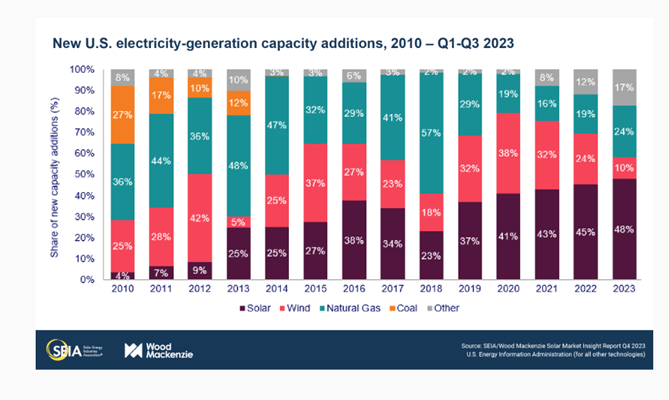
Just as USA has exponentially increased the share of solar PV capacity as new installed capacity from 2010 onwards, now is the time for USA to quickly add PV-TEG devices to these already installed solar PV capacity too. By maturing PV-TEG solution, USA would transform its already installed solar PV capacity into a 24 hours electricity generation machine. It will certainly help USA and countries across the globe in moving beyond fossil fuels and into a technological era where solar PV would produce clean electricity 24 hours a day.
© Copyright 2023 Ayoub Hameedi. All rights reserved.
Texas can be an undisputed champion of installed solar PV capacity in United States
Ayoub Hameedi
Texas is an extremely blessed state when it comes to conventional and non-conventional resources of energy production. According to the U.S. Energy Information Administration, Texas has the largest proven reserves of oil and natural gas in the country. Likewise, Texas is one of those states that receives the highest solar radiation and uses this sustainable resource to produce clean electricity through solar PV panels. According to Solar Energy Industry Association, Texas has an installed solar PV capacity of 6.75 GWs. Keeping in mind the available solar pv potential, Texas is capable to do even better and it is what this article is all about.
When it comes to an installed solar pv capacity at national level, California grabs the top spot. It has a cumulative installed solar PV capacity of 29.2 GWs. Texas shines bright at the second spot with an installed solar pv capacity of 6.75 GWs. Even though Texas stands at the second spot however, the difference between two is enormous. In my personal opinion, through right policies in place and their implementation US politicians can bridge this gap that exist between the former and latter. This would certainly help Texas to play an even bigger of a role when it comes clean electricity generation and to help United States of America to reduce emissions and to achieve the goals outlined in Paris Climate Agreement. North Carolina comes after Texas with a cumulative installed solar pv capacity of 6.5 GWs followed by Florida with a total installed solar pv capacity of 5.7 GWs respectively.
Research conducted by National Renewable Energy Laboratory (NREL) reflects that the roof-tops of all small buildings in Texas can host a gigantic amount of installed solar PV capacity. Energy policy makers can easily utilize a total surface area of 424.6 million square meters to deploy solar photovoltaic systems on the rooftops of all small buildings in Texas. The given figure is large enough to host a potential 62.7 GWs of solar PV installations that could then produce an estimated 83.2 Terawatt hours of clean electricity on yearly basis. From a realistic point of view, even if we would harness half of the available roof-top solar PV potential of small buildings, it can ignite a solar PV revolution across the state. Texas already has close to 7 GWs of installed solar PV capacity and thus we can easily say that solar PV technology is mature and the much needed momentum is already there. It would not be out of place to mention here that the price of solar PV technology has fallen 38% during the past 5 years in Texas. The sharply decreasing price, an abundant solar radiation potential alongwith the presence of 683 solar companies in Texas proves the fact that it can be the leader when it comes to the highest installed solar PV capacity in United States. It must be appreciated that Texas installed a cumulative solar PV capacity of 3.75 GWs during 2016 – 19. In contrast, California installed a whopping 14 GWs of solar PV capacity during the same time period. It is encouraging that Texas is increasing its installed solar PV capacity however as already discussed the existing pace is very slow. Like California, if Texas would also install roughly 4 GWs of solar PV each year, then by 2030 the state would have roughly 45 – 50 GWs to rely on for clean electricity production. It is possible for Texas especially, if one would observe the rapid growth that wind power technology experienced in the state during the previous decade. In 2011, Texas had a cumulative installed windpower capacity of 10 GWs. With right policies in place, the installed windpower capacity exponentially grew to roughly 29 GWs by the end of 2019.
Summing up all, Texas has excellent conditions to deploy solar PV panels for clean electricity production. By harnessing the available roof-top solar PV potential of small buildings in Texas, the state administration can no doubt make Texas an undisputed champion of solar PV technology in United States. An exponential growth in installed solar PV capacity would then reduce Texas reliance on coal, natural gas and nuclear power for electricity production. As the reliance on fossil fuels would be decreased, the corresponding emissions from electricity production sector would automatically decrease too. If Texas can make it happen for wind energy technology in the span of a decade, it can repeat the history for solar PV technology too. This would also serve as a wake-up call for New Mexico, Oklahoma, Louisiana, Mississippi, Alabama and Tennessee so that the cumulative percentage of electricity produced from solar PV technology in these states would exponentially grow too. It is absolutely possible for United States to implement Paris agreement and to create a sharp dent in the emissions curve.
© Copyright 2021 Ayoub Hameedi. All rights reserved.
Texas can produce half of its electricity through windpower
Ayoub Hameedi
Texas is the largest producer of crude oil in United States of America. It provides around 38% of the crude oil supply and is simultaneously the largest producer of lignite coal and natural gas in United States. A strong presence of fossil fuel sector has not affected the growth of windpower in Texas. Fortunately, Texas has installed around 2.3 GWs of windpower in 2017 that lead the already installed windpower capacity to over 22 GWs. Besides the largest producer of fossil fuels in USA, Texas is also the largest producer of windpower as it has 3 times more cumulative installed windpower capacity than Oklahoma which is the second largest producer of windpower in United States. According to US Department of Energy, Texas has an installed windpower capacity of 23.4 GWs that roughly produces 14.89% of electricity. The state produces 45.4% of its electricity from natural gas, another 30% from coal, 0.16% from oil & other fossils and 9% from nuclear power. Thus, Texas rely heavily on fossil fuels and nuclear power and collectively generates around 85% of its total electricity from these sources. From a critical point of view, reducing reliance on fossil fuels and nuclear power through an increased reliance on windpower is in the best of interest of Texas. It would certainly steer power generation sector in Texas towards sustainability.
According to the US Department of Energy, Texas has an estimated wind power potential of 1347 GWs. It represents a wide gulf that exists between the current installed capacity and the available potential that the political administration can harvest through massive investment in the sector of windpower. The state is equally rich in both off-shore and on-shore windpower and if given more policy attention, financial resources and technical expertise, windpower can easily satisfy half of the total electricity demand of Texas. Off-shore wind farms are expensive to manage however, they have the capacity to produce much more electricity than an on-shore wind farm. The turbines in an off-shore wind farm are normally higher in output capacity and wind also blows at higher speed in off-shore areas. Both of the already spoken factors than collectively help off-shore wind farms to produce more electricity than an on-shore wind farm. An excessive production then helps in reducing the price of electricity produced through wind farms thus, making it more competitive than conventional source of power production.
A vast availability of private land in West-Texas, a relatively low capital cost and no fuel cost on wind farms can help in the expansion of windpower in Texas. It must be appreciated that the political administration has upgraded the transmission system in Texas with more transmission lines. As a result, it is now easier to transfer the generated electricity from remote areas of Texas to cities, where the demand is the highest. A crucial thing to consider here is that wind mostly blows during night when the demand is the lowest. Therefore, financial investments to establish massive storage batteries to save windpower produced during night and then supplying it during the next day would be a much needed step in the right direction. An installed capacity of 23.4 GWs represents that wind energy technology is mature in Texas and if more resources are invested in this direction, wind power can play an even bigger role when it comes to power production. The cumulative installed windpower capacity in Texas is estimated to reach 28.5 GWs by the end of 2019.
According to US Energy Information Administration, Texas has an installed power generation capacity of 118.7 GWs. Thus if the installed windpower capacity is raised from 23.4 GWs to 60 GWs, windpower can easily produce half of the electricity demand in Texas. Adding first 23.4 GWs were the toughest one, an increase of 36.6 GWs to raise the installed windpower capacity to 60 GWs would not be that difficult. Germany has an installed windpower capacity of 58.6 GWs and if Germany can make it happen, Texas can do it too.
© Copyright 2018 Ayoub Hameedi. All rights reserved.
Solar pv technology can phase-out fossil fuels and nuclear power in Mexico by 2032
Ayoub Hameedi
In my opinion, the biggest issue of 21st century is climate change. An environmental problem that is costing us USD 1.2 trillions on annual basis in terms of damages and if left unmitigated will cause even more damage in decades to come. We do have solutions to mitigate climate change however, we need to increase the rate of implementation to minimize damage to us and our coming generations. The first and foremost step to mitigate climate change is to recognize it as a problem for example, we know that climate change has been caused by our reliance on fossil fuels to foster economic growth. As a result, we have released previously trapped greenhouse gases into atmosphere. This has increased the concentration of carbon dioxide and other greenhouse gases. As per NASA, the latest reading for the concentration of carbon dioxide gas stands at 410 parts-per-million. The second step to solution is to reduce our reliance on fossil fuels by replacing them with renewable sources of power production.
The time period (between 2006 – 16) has been tremendous for solar pv technology as the installed global solar pv capacity grew exponentially from a mere 6 GWs in 2006 to 303 GWs in 2016. Likewise in 2017, China alone installed over 53 GWs of solar pv and it now has a cumulative installed solar pv capacity of 130 GWs. Altogether, China invested USD 86.5 billions in 2017 (pg. 144) for the promotion of solar pv in the country. On the contrary, developed countries spent USD 45.4 billions on solar pv technology while the developing & emerging countries spent USD 28.9 billion on up-scaling installed solar pv capacity to produce clean power. Altogether, 2017 saw a collective investment of USD 161 billion in solar pv technology and the aforementioned figure was 18% more than what was invested in solar pv technology in 2016. A total of 98 GWs of solar pv was added in 2017 leading the total global installed capacity to 402 GWs (pg. 178). This short summary shows that solar pv technology is mature and it can help countries to phase-out conventional sources of power production. Mexico as one of the key producer of oil in Americas can create an example by replacing fossil fuel use with solar pv technology to generate clean electricity.
In 2016, Mexico had 35.3 GWs of installed natural gas capacity followed by oil and diesel with an installed capacity of 12.6 GWs and coal with an installed capacity of 5.4 GWs. Thus, conventional sources of power production represented a collective installed capacity of 53.3 GWs. On the contrary, the country had an installed hydropower capacity of 12.6 GWs, followed by windpower with an installed capacity of 3.7 GWs, geothermal with an installed capacity of 0.9 GWs, biomass & waste with an installed capacity of 0.9 GWs and solar with an installed capacity of 0.14 GWs. Thus, renewables altogether represented a cumulative installed capacity of 18.24 GWs respectively. Apart from fossil fuels and renewables, Mexico also had an installed nuclear power capacity of 1.6 GWs in 2016. The aforementioned figures represent a heavy reliance on fossil fuels and a dire need to upscale the use of solar pv technology to phase-out conventional sources of power production by 2032. This will reduce the greenhouse gases emission from Mexico and would also help the country in implementing Paris climate agreement. It is important to mention here that Mexico is extremely rich when it comes to producing electricity from solar pv technology. A solar resource map of Mexico with an estimated pv power potential is as follows:
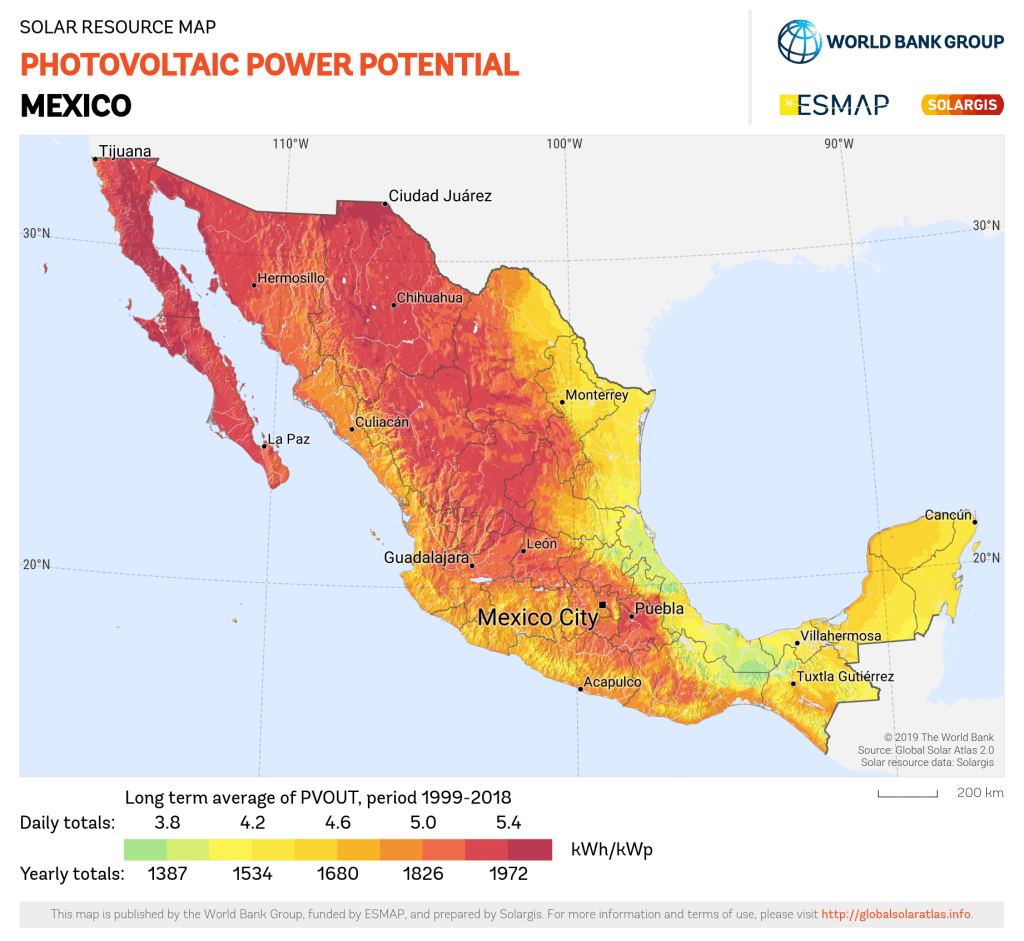
The map given above represents ideal conditions for solar pv as around 75% of Mexico receives 5 Kwh per square meter each day. The amount of solar radiation in Mexico is almost twice to Leipzig (Germany) that receives 2.7 Kwh of solar radiation per square meter on daily basis. The later has an installed solar pv capacity of 43 GWs whereas, the former had an installed solar pv capacity of 0.14 GWs in 2016. Thus it is clear that available conditions in Mexico are fantastic and if solar pv panels would be deployed on every available roof-top and as large solar pv farms, the government can easily phase-out conventional sources by 2032. An installation of a mere 5.5 GWs of solar pv on annual basis from 2019 to 2032 would add 77 GWs of renewable resource. The proposed collective install solar pv capacity of 77 GWs would practically replace the existing 55 GWs of coal, oil, gas and nuclear power in Mexico. The given recommendation is completely feasible to implement for Mexico provided proper administrative attention and financial resources are diverted in this direction. China is an excellent example for Mexico to consider in this regard.
All in all, solar pv technology is mature and it can phase-out conventional sources of power production in Mexico. It is important to mention here that in 2017, around 17 countries produced 90% of their total electricity through clean sources of power production (pg. 43). Mexico can also set an example for rest of the world by phasing-out conventional sources of power production in the next 14 years. An installation of 5.5 GWs of solar pv each year is realistic as pv technology is mature and Mexico has the required solar potential and needed physical space to implement the suggestion.
© Copyright 2018 Ayoub Hameedi. All rights reserved.
How Los Angeles is fighting urban heat island effect through an innovative solution
Ayoub Hameedi
The negative impacts of climate change are estimated to be around USD 1.2 trillion on yearly basis. Keeping the figure as constant, it would cause financial damages worth USD 12 trillion in span of a decade. The aforementioned amount is sufficient enough to practically eradicate extreme poverty from the face of planet earth. Due to rising temperature, sea level has already increased to about 3 inches since 1880 and is expected to reach 3 feet by the end of 21st century. We have made Paris Climate Agreement to limit the temperature increase to 1.5 degrees and if we would successfully achieve that, the increase in sea level would be 52 cm by the end of this century. In case of failure and a temperature increase of 2 degrees, the sea level would rise to 63 cm. Thus, our inability to limit sea rise to 52 cm would cost USD 1.4 trillion per year in terms of damages provided no mitigating action would be executed. Likewise, for United States, if status quo would be maintained the damages to real estates due to hurricanes together with water and energy costs would come with a price tag of USD 1.9 trillion on yearly basis by the end of this century. The already spoken amount is again too big for United States of America to lose and even if 25% of it would be minimized (i.e. around half a trillion dollar) it would help the administration in fighting poverty in the country. So, there is a dire need for United States of America to take every possible measure to mitigate the negative impacts of climate change. One such solution is adopted by the city of Los Angeles in California. The adopted solution is quite simple in nature and has the ability to produce significant results when it comes to lowering the temperature and thus reducing the cost of cooling in buildings. Thus, if it becomes successful in the pilot phase and is up-scaled, it can help the administration of the city of Los Angeles to save millions. The saved financial resource could then be utilized to reduce poverty and to create jobs for the unemployed masses.
The solution is referred to as CoolSeal and it is developed by a California based company GuardTop. It is basically an asphalt coating made of white color that is then applied on top of roads. According to colour psychology, black colour has an ability to retain heat. On the contrary, white colour has the natural ability to reflect heat. Thus, the application of white asphalt coating on roads would change them from heat retaining infrastructure to heat reflecting one. It will then lower the temperature in nearby areas and reduce the urban-heat island effect. As on pilot basis, the city of Los Angeles has applied CoolSeal and has recorded a slightly lower temperature in comparison to areas coated with black asphalt.
(*The shared video is an intellectual property of Mint)
The need of hour is once the project clears the pilot phase, it would then be gradually up-scaled to a mature level so that the benefits could be reaped massively. The offered solution should also be extensively applied in urban areas of Pakistan, India, Bangladesh, Indonesia, Brazil, China and in Middle East where the usage of air-conditioners for cooling purposes has sky-rocketed in last 20 – 30 years. If applied massively, it would certainly reduce reliance on air-conditioners in all of the already spoken geographical territories. It is important to mention here that air-conditioners in United States of America consumes around 6% of the total generated electricity and costs around USD 29 billion to households on annual basis. Thus, even if CoolSeal would help in saving a billion USD, the saved financial resource could then be channelized in combating poverty that was at 12.7 percent in 2016.
All in all, CoolSeal is a simple yet innovative solution to reduce urban heat island effect. In human history, the construction of highways was heavily criticized. Likewise, the use of crude oil in lamps instead of fish oil was equally criticized as well. Lastly, few decades earlier, the potential of clean sources of power production was also heavily criticized too. The need of hour is to keep on developing the solutions and making them better today than they were yesterday. Likewise, roads with white color would initially be criticized but eventually masses would like them. There is also a dire need to up-scale the solution to other cities in California, rest of USA and in countries other than USA. There is no planet B and we should take every possible measure to protect it for us and our coming generations.
© Copyright 2018 Ayoub Hameedi. All rights reserved.
 Project GE