
Geothermal Energy
Iceland: A Place Rich With Geothermal Resources
Ayoub Hameedi
Iceland is famous for it’s breathtaking scenic views, warm geysers and 100% clean production of electricity in the world. However, things weren’t always the same for Iceland and its inhabitants. In the start of 20th century, it was routinely categorized as one of the poorest countries in the world. It had a total population of 78,470 people out of which 33,875 were economically active. 70% of those were associated with agriculture and fisheries, 6% belonged to manufacturing, 4% were associated with public administration and finally 5% belonged to commerce and transport sector. On the contrary, in the first decade of 21st century, 7.6% of masses were employed in agriculture and fisheries, 19.4% in manufacturing & construction and 73% of the labor force were employed in both public and private sectors. It can be concluded that in the span of a century, Iceland transformed itself from a poor country into a technologically advanced one with a per capita Gross National Income (GNI) of USD 33,960. Iceland used to import coal for the sake of power generation however, now it produces 100% of electricity through indigenous renewable energy resources. Hydro power generates 75.5% of electricity whereas, geothermal resources produces remaining 24.5%. The country still relies on imported fossil fuel for the sake of fishing and transportation.
A question which comes to mind is how does a geothermal power plant works? The answer is quite simple. An energy firm drill boreholes between a range of 100 meters to 2200 meters to locate an underground water body. The located water reserve is then heated between 225 degree Celsius to 400 degree Celsius with the help of volcanic activity. As a result, the obtained steam or a combination of steam and hot water is then utilized to power turbines at both high and low pressure to produce electricity. The steam is then condensed afterwards to produce warm water to satisfy the domestic demand of local community or municipality. A map of Iceland reflecting geothermal areas with high and low temperature fields is available as under:
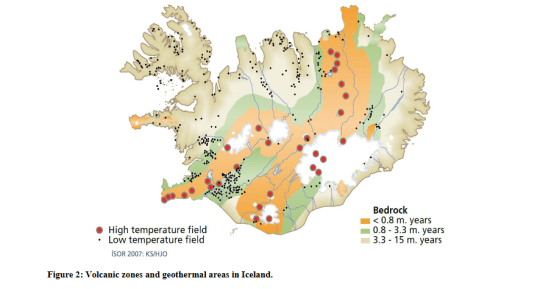
It is clear that the low temperature fields are more frequent in number than in comparison to high temperature fields. Most of the central part of Iceland is less then 0.8 million years old and all the high temperature fields are located in this particular geological area. Thus from a geological perspective, Iceland is a relatively young country. On the other hand, low temperature fields are concentrated into areas with a geologic time scale (GTS) greater than 0.8 million years. The available geothermal resources in Iceland are estimated to produce 20 Terra-watt hours of clean electricity on annual basis. Hellisheidi Power Station with an installed capacity of 303 MWs is the largest geothermal power plant in Iceland. Finally, Iceland has made significant sustainable progress particularly in the field of new energy technologies, when it comes to power generation. However, a real challenge for National Energy Authority of Iceland would be to sustain the clean production of electricity over years to come.
© Copyright 2017 Ayoub Hameedi. All rights reserved.
 Project GE