
Hydro Power & Eco-friendly Desalination
Hydropower Generating A Lion’s Share Of Electricity In Iceland
Ayoub Hameedi
Iceland is spread over a geographical area of 103,000 square kilometers and lakes, reservoirs and rivers represents as much as 6% of the total land area of the country. It has a total installed hydropower capacity of 1.99 gigawatt-hours (GWs) which facilitates Orkustofnun (i.e. National Energy Authority of Iceland) to generate over 70% of electricity through hydropower. Due to a small population ratio, an Icelandic citizen consumes four times more electricity than an average American. A picture representing installed hydropower capacity in Iceland since 1913 is as follows:
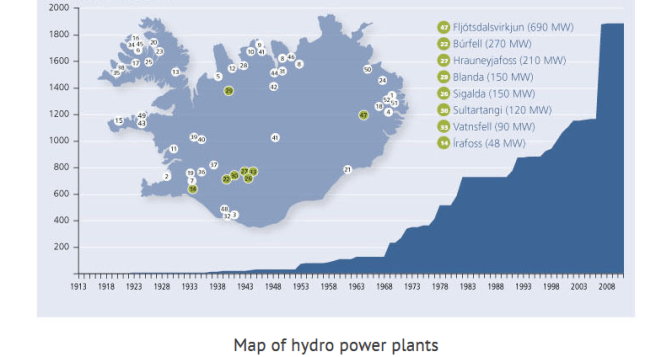
It is clear that Fljotsdalsvirkjun is the biggest hydropower facility in Iceland with a total installed capacity of 690 MWs. The next on the list is Burfell hydropower plant with an installed capacity of 270 MWs, respectively. The picture given above points out prominent places where a hydropower facility has been installed for the sake of power generation. The graph represents installed hydropower capacity in Iceland since 1913. During the initial period, the growth trend was not quite sharp however, things started to change for the sake of good from 1968. A real exponential growth took place from 1978 and particularly from 2005 when the installed hydropower capacity reached over 1800 MWs, respectively. The first hydropower plant started its operation in Iceland in a place called Hafnarfjörour in 1904 followed by two other hydropower facilities in 1921 & 1922.
Iceland Geo Survey (ISOR) made a master plan for geothermal and hydropower Development in Iceland. It points out areas where hydropower potential has been utilized to the fullest along with the areas where a potential plan is in progress. Lastly, it also points out areas where a hydropower facility can be installed in future. A map projecting the hydropower resources of Iceland is as follows:

It is quite clear that there are 31 regions where small and large scale hydropower facilities can be installed in future for the sake of power generation. Likewise, there are five different regions where a hydropower plant is in a planning phase. Lastly, there are 11 regions where a hydropower facility is already in operation and delivering clean electricity to households and business sector in Iceland. Finally, hydropower serves as a backbone when it comes to the production of electricity and to sustain socioeconomic growth in Iceland in a sustainable manner.
© Copyright 2017 Ayoub Hameedi. All rights reserved.
Norway: Fossil Fuel Exports and Renewable Sources of Electricity Production
Ayoub Hameedi
Norway is amongst the most technologically advanced countries in the world. It spreads over a geographical area of 323,802 square kilometers. With over 5.3 million inhabitants, it is one of the least densely populated country in the world. The total GDP for Norway stood at USD 386.6 billion during financial year 2015. Approximately, 98% of electricity in the country is produced through hydro resources and the remaining two percent is generated from a combination of wind and thermal power. During last year, it exported crude oil, natural gas and condensate of worth NOK 385 billion which represented 36% of total value of overall exports for Norway. A graph representing the exports of fossil fuels during 1971 – 2016 is as follows:
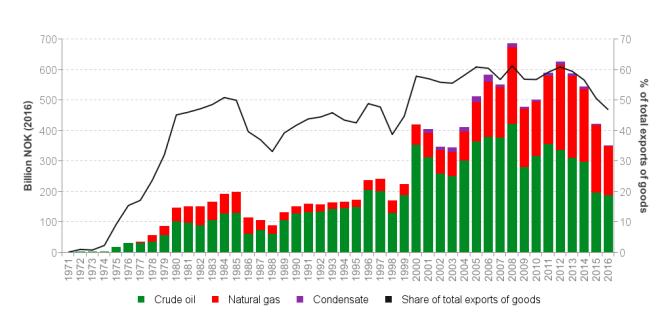
It is clear that crude oil formulated the largest share when it comes to the exports of fossil fuel, followed by natural gas and condensate. The exports of conventional sources peaked in 2008 with a net revenue earning of approximately NOK 700 billion. It represented around 70% of the total exports of goods in 2008.
Despite having massive fossil fuel reserves, Norway has preferred to developed hydropower potential over fossil fuel based source of electricity generation. The peak era for the construction of dams in Norway begin after the second world war and lasted till early 1980s. The average age of a large scale hydropower project is 46 years and an up-gradation process is carried out on a regular basis. As a result, the output capacity of a hydropower plant normally increases from 10% – 60%. According to the Norwegian Water Resource and Energy Administration (NVE), there are approximately 3,600 dams registered in Norway, out of which 343 are large dams with a height greater than 15 meters.
In addition to hydropower potential, it is equally important for Norway to develop other renewable energy resources as well. Wind Energy is one such example. The total installed wind power capacity in Norway was 873 MWs in year 2015 which produced 2.5 terrawatt hours of clean electricity. Wind power satisfied 1.9% of total electricity demand in Norway during 2015. The development of wind energy potential in Norway during last 19 years is represented in the form of a graph, which is available as under:
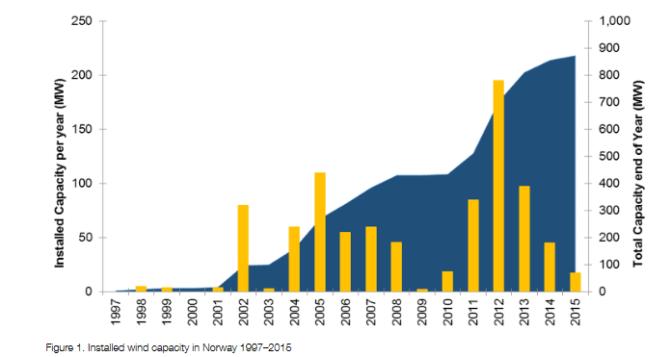
The highest wind power potential of 200 MWs was installed in 2012 whereas, the least potential was installed during 1997 – 2001, 2003 and 2009, respectively. In 2015, a total of 17 MWs of wind power was installed in Norway. In addition to wind power, waste-to-energy power plants and solar photovoltaics can also be utilized for the sake of electricity generation. Collectively, wind power, solar energy and waste can diversify the sources of green electricity generation in Norway.
All in all, energy authorities in Norway must be appreciated for their efforts to promote green energy resources, however, emphasizes should be placed on developing multiple sources of clean electricity generation. Despite having ample fossil fuel reserves, the strategy to produce approximately 100% of electricity through renewable resources provides Norway a competitive advantage over all other oil and gas producing countries.
© Copyright 2017 Ayoub Hameedi. All rights reserved.
Hydropower: The Largest Source of Electricity Production In Sweden
Ayoub Hameedi
Hydropower plays an important role in the production of electricity in Sweden. In fact, it is the largest source of renewable electricity generation with a total installed capacity of 16,155 MWs. Nearly, 90% of hydropower facilities in operation today were given a green signal before 1983. Some even received permission to operate as per the Water Law of 1918. The utilization of hydropower has enabled authorities in Sweden to reduce reliance on fossil fuel for the sake of electricity generation. A table reflecting installed hydropower capacity on rivers across Sweden is as follows:
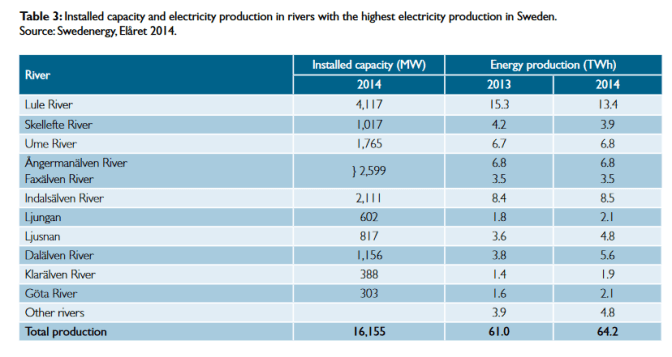
It is clear that the Lule river has the highest installed hydropower capacity of 4,117 MWs. The facility generated 15.3 Terra-watt hours (TWh) of green electricity in year 2013 and 13.4 TWh of clean electricity in year 2014. Second on the list is a combination of two rivers namely Ångermanälven & Faxälven rivers with a total installed hydropower capacity of 2,599 MWs, respectively. Indalsälven river has the third highest installed hydropower capacity of 2,111 MWs followed by Ume river with installed capacity of 1,765 MWs and Dalälven river with an installed capacity of 1,156 MWs. Skellefte river secures the last spot due to an installed capacity of 1,017 MWs. All these hydropower facilities have an installed capacity of over 1,000 MWs. Collectively, hydropower plants generated a total of 125.2 Terra-watt hours of green electricity during 2013 & 2014.
A question which arises at this point is: how does a hydropower plant works? The answer is shown in the diagram below:
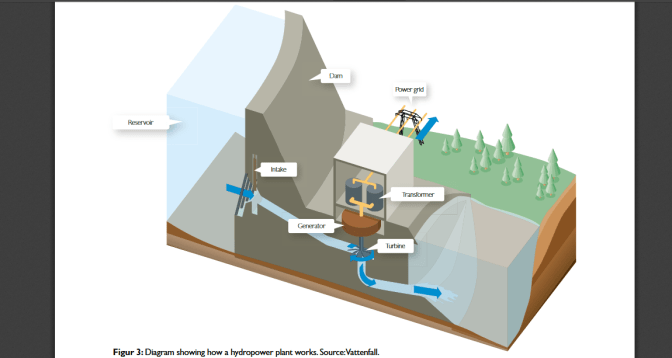
A hydropower facility is comprised of a reservoir which contains water in a large amount. It also includes turbines, generators, transformers and power grid to generate & transfer electricity. The reservoir has gates to control the flow of water. When the water is released, it powers turbine and generators to produce electricity. The electrical output is then transferred from source to distribution companies with the help of transformers and power grid.
According to World Energy Council (WEC), Sweden had an installed hydropower capacity of 16,197 MWs in year 2016. A total of 2,057 hydropower plants are in operation, out of which 1050 hydropower plants have an installed capacity of less than 10 MWs. Hydropower plants normally produce 66 Terra-watt hours (TWhs) of electricity on per annum basis. However, the total electrical output can be optimized up to 2 TWhs annually through the up-gradation of the existing infrastructure. The construction of new hydropower plants have been banned in Sweden due to environmental consideration. It is important to mention here that Sweden is amongst the top 10 hydropower producers in the world. A graph confirming the same is as follows:
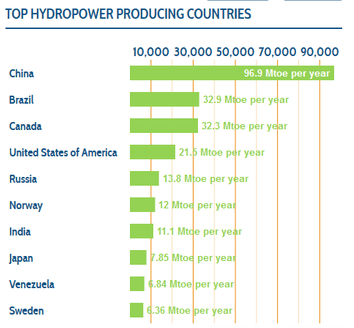
All in all, hydropower is the largest source of electricity production with an install capacity of over 16 Gigawatts. It generates over 40% of total electricity supply on annual basis in Sweden. It is important to highlight here that improvements in existing infrastructure can enhance the electrical output up to 2 TWhs on per annum basis. Lastly, it is financially feasible to develop the current infrastructure to maximize the electrical output.
© Copyright 2017 Ayoub Hameedi. All rights reserved.
 Project GE