
Alternatives To Nuclear Power
Decommissioning of Ringhals 1 & 2 with a more sustainable alternative to generate clean electricity in Sweden
Ayoub Hameedi
Hydropower, nuclear power, other thermal sources (including CHP industry, district heating, conventional power and gas turbine) and wind power are the four sources of power production in Sweden. Nuclear power is the second largest source of power generation in the country. It produced 41% of total electricity in 2014 and 43% of total electricity in 2013. It must be appreciated that the role of nuclear power diminished by 2% between 2013 – 14 however, more needs to be done in order to ensure a safe and sustainable Sweden for coming generations. As per the SKB, the financial cost of Swedish nuclear power program is around SEK 141 billion, out of which 30.5% (i.e. SEK 43 billion) has already been utilized for the installation, operation of nuclear power plants and on research and development (R&D) on nuclear waste and its safe disposal. The remaining SEK 98 billion will be utilized as future costs for nuclear program from 2018 on-wards.
According to World Nuclear Association there are a total of 8 nuclear reactors in operation all of which are intended to be decommissioned by 2045. The first ones on the list are Ringhals 1 & 2 with an installed capacity of 878 MWs and 807 MWs, respectively. Ringhals 2 is intended to be decommissioned in 2019 and Ringhals 1 will meet the same destiny in 2020. Again as per the figures of SKB, it takes 1 billion kronor to decommission a nuclear reactor plus an additional billions of kronor to dispose the nuclear waste in a safe manner. Thus altogether, the decommissioning of Ringhals 1 & 2 will cost around 2 billion kronor plus an additional billions to safely store the nuclear waste. It must be appreciated that the national Government has developed laws, which enables the nuclear power plant owners to pay for the decommissioning charges and management of nuclear waste. National Government has also imposed a surcharge of SEK 0.04 for every produced KWhs of nuclear power which is then invested / collected in a government fund “Nuclear Waste Fund“. The financial standing of the nuclear waste fund was SEK 60 billion at the end of 2016. However, the story does not end here as the nuclear waste needs to remain safely buried for the coming 100,000 years thus, remains a constant threat for society at large. It is understandable that the nuclear power has been the second major source of power supply in Sweden since decades however, the previous and current governments in Sweden have played their part in minimizing its role, for example, in 1996 the overall installed nuclear power capacity in Sweden was over 10 GWs. In 2014, the same figure for installed nuclear power capacity was 9.53 GWs. It can be concluded that 0.527 GWs of nuclear power has been decommissioned in Sweden since 1996. However, more could be achieved by prioritizing wind power over nuclear power. An important question which arises at his point is how can Ringhals 1 & 2 be replaced with a more sustainable source of power production. Both reactors are intended to be decommissioned in 2019 – 2020, so what can be an alternate source once both reactors would go offline. The answer lies in wind power and there are two ways to achieve this target.
First path would be to upgrade the already installed wind turbines in Sweden. Both Ringhals 1 & 2 collectively have an installed capacity of 1.69 GWs whereas, the total number of installed wind turbines in operation in Sweden was 3,387 at the end of June 2017. Thus, if each wind turbine is upgraded up to 1 MWs, the Government can easily add 3.39 GWs more to its already installed wind power capacity. From a critical perspective, the added capacity will easily replace over 35% (i.e. (3.39 GWs / 9.53 GWs)*100) of the installed nuclear power capacity. Even if half of the already installed wind turbines would be upgraded 1 MW each, still 18% (i.e. (1.7 GWs / 9.53 GWs)*100) of the installed nuclear power capacity will be sustainably replaced by wind power.
A second course is to seek a bilateral agreement with Norway to harvest its offshore wind potential which is estimated to be around 4.6 – 12.6 GWs and can produce 19 – 50 terrawatt hours of clean electricity on annual basis. It would still be a financially and environment friendly strategy than to invest billions of kronor to maintain the status quo with nuclear power. According to the European Wind Energy Association (EWEA), a wind turbine does not emit any greenhouse gas during its functioning. During its first six months of operation, each turbine generates the same electricity which is consumed to produce the turbine from point of origin to the point of its installation. Finally, during the whole life span of a wind turbine which is estimated to be around 20 – 25 years, each turbine produces 80 times more electricity than it has consumed during its whole life span. Wind turbines also consume less water to generate electricity than in comparison to nuclear power plants and produces no hazardous waste at the end of the cycle.
Summing up all, nuclear power has been a major source of power supply in Sweden however, now is the time that Government would take action to decommission it in different stages. Sweden has decommissioned nuclear reactor Barsebäck 1 in 1999 and another nuclear reactor Barsebäck 2 in 2005. The closure of Barsebäck nuclear power plant was due to political reasons however, it made a history in Sweden. It must be appreciated that the previous and current Governments have played their part in diminishing the role of nuclear power however more could be and should be done in this regard. Decommissioning of Ringhals 1 & 2 will be another step in this direction. Upgrading already installed wind turbines up to 1 MWs each will easily fill the vacuum which would otherwise exist due to the closure of Ringhals 1 & 2 reactors. A bilateral agreement to import clean electricity through offshore wind farms in Norway is another viable option. Lastly, a sustainable transition from nuclear power to a more clean source of power production will certainly take time, patience and financial resources however it will certainly provide Government an opportunity to increase the share of wind power in the overall energy mix of Sweden.
© Copyright 2017 Ayoub Hameedi. All rights reserved.
How Finland Can Neutralize its installed Nuclear Power Capacity Through The Use of Renewable Sources
Ayoub Hameedi
Finland is famous for its natural landscapes with lush green forests and lakes. It is a geographical location dominated by green and blue, both of which have an ability to produce a soothing and a calm impact on its viewer. Yale categorized Finland as the most sustainable country in 2016 with an overall score of 90.68. However, an unsustainable fact concerning Finland is its ability to generate over 33% of its electricity from nuclear energy technology. Even though nuclear power has facilitated Finnish government in minimizing its reliance on fossil fuels for power generation however, in terms of policy making it would be like replacing an inefficient strategy with another. The real issue with nuclear technology is the production of nuclear waste, which is an issue that needs to be dealt with for tens of thousands of years. From a critical approach, reliance on nuclear power is extremely unsustainable and this policy course needs to be reviewed and reversed.
The history of Finland reflects many achievements in the field of environment. As per a report published by Finnish Environment Institute, the greenhouse gas (GHGs) emissions in Finland reached its lowest point in 2012 when compared with the emission levels of 1992. It also achieved the Kyoto protocol’s target for 2008 – 2012 by stabilizing its GHGs emissions at an emission level of year 1990. Likewise, the forest cover has experienced a gradual increase too since 1990 and trees now serve as a major tool to sequest carbon. Moreover, European Union gave a target to Finland to generate 38% of its electricity demand from clean energy sources by 2020. Finland achieved the given environmental goal in 2015, which was 5 years ahead of the deadline. All of these aforementioned achievements show that Finland can repeat history when it comes to policy making and implementation on nuclear power.
According to Finnish Energy, nuclear power generated the largest share of electricity around 26.2%, followed by CHP district heating & industry which collectively produced 24.3% in 2016. Hydropower produced an overall 18.4% whereas, wind power supplied 3.6% in the total electricity mix. Finland satisfied the remaining demand of 22.3% through the import of electricity from Nordic countries, Russia and Estonia. A key challenge for the government of Finland is to reduce its reliance on nuclear power. However, it seems easier said than done as Finnish government generates only 78% of the required electricity while imports the rest from neighboring countries. Under the current scenario, it appears difficult to achieve sovereignty in terms of electricity generation however, an optimization of renewable resources and a monomaniac focus can liberate Finland from the need to import electricity. It is interesting to note here that Finland receives more or less the same amount of solar radiation as Germany but unfortunately, generates only 0.01% of its electricity through solar energy. On the other hand, Germany has an installed solar PV capacity of 41.55 GWs.
The development of wind energy in Finland started in 1997 with an installation of 12 MWs generational capacity. Over the years, the installed capacity was increased and reached to a total of 110 MWs in 2007. The installed capacity then reached it’s pinnacle in 2016 after a span of 20 years. The exact figures for the installed capacity was 1,539 MWs at the end of 2016. It can be concluded that the development of wind power in Finland was fairly slow in comparison to its Nordic neighbors Sweden & Denmark. Sweden installed its first 127 MWs of wind power in 1997, the same year as Finland. During an exact time frame as Finland (i.e. 1997 – 2016), the installed capacity in Sweden reached 6,493 MWs. Similarly, Denmark had an installed wind power capacity of 1,066 MWs in 1997 which exponentially grew to a figure of 5,227 MWs in 2016. Denmark developed its installed wind power capacity, 5 times during last two decades. Thus, the difference between Finland and its Nordic neighbors when it comes to wind power is quite strong. It points to the fact that Finland needs to pump more financial resources to develop wind power.
All in all, it can be concluded that solar and wind sources of power generation can be an excellent alternative for Finland to neutralize its installed nuclear power capacity. Likewise, the promotion of these renewable sources will also make Finland a sovereign country when it comes to relying on indigenous renewable sources of power generation. It will also reduced the Finnish government’s expenses likely to incur on the import of electricity. It is equally important to mention here that the given solution is both realistic and achievable, provided proper time, political attention and financial resources are channelized in this direction. Finally, Finland has taken remarkable steps when it comes to policy making and implementation on environmental issues in the past and it has the potential to repeat its history in future too.
© Copyright 2017 Ayoub Hameedi. All rights reserved.
Sweden’s Unsustainable Reliance on Nuclear Energy Technology
Ayoub Hameedi
Nuclear power is the second largest source of electricity production in Sweden. It generates 40% of the total electricity on annul basis. Certainly, Sweden is among the top 10 countries where nuclear power is heavily utilized for the sake of electricity production. A graph confirming the same is as follows (Source: Carbon Brief website, 2017):
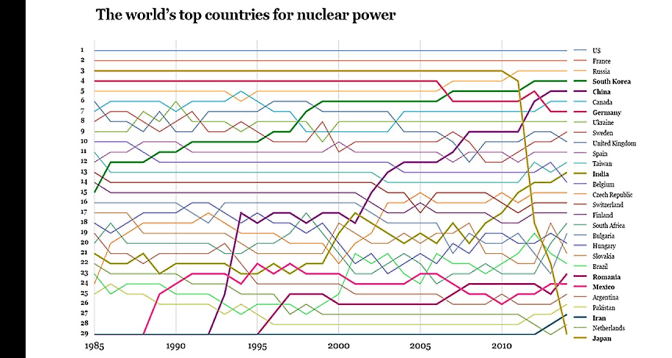
The above mentioned graph reflects the deployment of nuclear energy technology in Sweden from 1985 to 2014. It is certainly clear that Sweden’s reliance on nuclear technology is far greater than United kingdom, Spain, Taiwan, India, Belgium, Czech Republic, Switzerland, Finland and other countries on the list.
A total of 9 nuclear power plants are in operation in Sweden with a total installed capacity of 9,528 MWs, respectively. All the nuclear power companies in Sweden collectively formed Swedish Nuclear Fuel and Waste Management Company (SKB) in 1970’s to safely handle the nuclear waste, so the overall risks to society, economy and environment could be minimized. From a critical perspective, it is financially unsustainable as additional resources are needed to manage the storage facility. Moreover, no matter how safely nuclear waste is stored there is still a potential risk associated with it.
From a policy perspective, an excessive reliance on nuclear power is not good for the society and economy and therefore, this policy approach needs to be reversed. A sustainable change must be introduced through increase reliance on new energy technologies. What could be done in this regard is to enhance the installed capacities of both solar and wind to neutralize nuclear power and eventually decommission all of it. An important step which could be taken in this regard is to upgrade the already installed wind turbines, so their output capacities could be optimized further. There are approximately 3,100 wind turbines in operation in Sweden. If each turbine is upgraded up to 1 MW, the overall installed capacity could be raised up to 3,100 MWs. This enhanced wind power capacity could then replace an equivalent installed nuclear power capacity in Sweden. It would be a complete win-win situation in terms of resource efficiency and sustainability. To be honest, decommissioning approximately one-third of the installed nuclear power would be a serious sociopolitical achievement for Sweden and its masses at both national and international arenas.
© Copyright 2017 Ayoub Hameedi. All rights reserved.
 Project GE