
Sustainable Forest Management
___________________________________________________
A successful comeback of forests in Norway and what other countries can learn from it
Ayoub Hameedi
Forests play an important role in providing ecological products and services that allows the global average temperature to stay within a particular limit, so that life would survive and thrive on planet earth. One of the most important ecological service offered by forests is the removal of greenhouse gases from atmosphere. Forests serves as a tool to lower the concentration of GHGs and thus plays an important role when it comes to mitigating climate change and preserving biodiversity. It is vital to mention here that a lower concentration of greenhouse gases slows the melting of ice at poles and Himalayas and thus keeps the ice shelves intact. On the contrary, a higher concentration of GHGs in atmosphere expedites the melting of ice-caps at the poles and Himalayas and thus exacerbate the absorption of sunlight followed by an increase in global average temperature that then leads to climate change.
Today, we are experiencing one of the most complex environmental challenge of climate change. It is the result of around 170 years of greenhouse gases emission that we have produced since 1850. As a result of our reliance on fossil fuels, the concentration of greenhouses gases has increased rapidly in the atmosphere over the period of time. Even though, the installed clean energy capacity has exponentially grew since 2006, however quite unfortunately, the concentration of carbon dioxide gas has also skyrocketed to 411 parts-per-million during the same time period. It is the highest ever concentration we have experienced in our written history. Adding insult to injury, the increase in concentration of CO2 gas was more prominent from 2005 on-wards. During the last 14 years ago, the concentration of CO2 has increased 33 parts-per-million. This increase in concentration rings the alarm bell for everyone that despite a healthy growth in installed renewable energy capacity, the concentration of CO2 has increased exponentially too. As already spoken, trees are an important tool to mitigate climate change as they lowers the concentration of GHGs in atmosphere and thus keeps the global average temperature to a healthy level. Norway serves as an excellent case study for rest of the world when it comes to regenerating forests and to use the same resource to reduce overall environmental impact. Almost a century ago, Norway was on the brink of losing all of its forests due to unsustainable forest management. However, in 1919, the then Norwegian government realized the sharp decline in the forest cover and decided to take the action. Accordingly, it changed the law that allowed the forest department to plant more saplings than the wood industry took away on annual basis. As a result of the sustained implementation of the designed strategy, Norway now has 3 times more forests than it had almost a century ago. As of today, almost 37% of the Norwegian mainland is forested.
The strategy adopted and implemented by Norway offers an excellent example to follow for countries with least or no forest cover. The rule of thumb is simple to plant twice as much trees on annual basis as the wood industry takes down in a single year. Implementing the same strategy for over a decade will certainly increase the forest cover to a healthy level. Abiding by the same rule of thumb for the next 50 years will certainly reap positive rewards for the countries who would implement the recommended strategy. It will not only improve the quality of air people would breadth in but would also promote biodiversity too. Trees are the building blocks of life as they provide the right conditions for life to flourish on planet earth. Our survival is integrated with a healthy forest cover all across the globe. The sooner we would realize this basic fact, the easier it would be for us to create a world that would be financially viable, ecologically sustainable and socially functional for us and our coming generations.
© Copyright 2019 Ayoub Hameedi. All rights reserved.
How Afforestation Can Turn Things Around Positively For Greenland
Ayoub Hameedi
Greenland is certainly one of the most pristine places on earth. It holds 8% of the global fresh water in the form of glaciers that are spread over 81% of geographical area of Greenland. The economic sector of fisheries serves as a backbone and generate a lion’s share of revenue for the country. Unfortunately, there is an absence of forest cover in Greenland and reversing that trend will certainly promote ecological services and increase sustainability in Greenland. Forest regeneration might also diversify the economic portfolio of country in terms of revenue generation through the export of wood related products. It has a population of slightly over 56,000 and an ice-free area of the country is roughly the size of Sweden but a small proportion of it is arable land. So an important task for policy makers in Greenland might be to analyze how much of the arable land can be spared to grow forests that could then be harvested sustainably over a span of 50 – 60 years to earn revenues. Finland and Sweden are two case studies in this regard. Finland earns around €20 billion in terms of revenue through sustainable forest management on annual basis however still 78% of it is covered with forests. Likewise, Sweden earns around USD 15 billion on annual basis through forest industry yet still 70% of the country is covered with forests.
Forests regeneration will certainly open new window of opportunities for Greenland first and foremost of which would be the reduction in its greenhouse gases emission. It is a commonly known fact that the trees are the nature’s carbon capture and storage devices and can reduce the concentration of GHGs in atmosphere. The beautiful country of Greenland can also learn a lot from Norway that has made an impressive progress when it comes to forest regeneration. Norway was on the brink of losing all of its forests almost 100 years ago however, things changed for good when the then Norwegian Government started investing financial and human resources to protect and regenerate forests. Today, the standing forest cover is almost 3 times in size compared to what it was a century ago and a continuous increase in the forest cover now absorbs around 60% of Norway’s greenhouse gases on annual basis. A decade ago, Norway initiated “Amazon Fund” to protect the forest cover in Amazon and has so far invested over a billion USD in the fund to curb the deforestation rate in Amazon. At present, already spoken fund is facing an eclipse as the rate of deforestation in Amazon is not quite align with the spirit of Amazon fund. As a consequence, the Norwegian government has shrinked the transfer of financial resources to Amazon fund.
The Government of Greenland can also have bilateral talks with the Government of Norway to initiate a similar fund “Greenland Forestation Fund”. A preliminary plan could be that Norway decides to invest USD 500 million in Greenland to generate forests over a decade. It means a transfer of USD 50 million in Greenland Forestation Fund on yearly basis. As spoken earlier, the ice-free area of Greenland is equivalent to the size of Sweden. The Government of Greenland then uses that fiscal resource to generate forest on half of its ice-free area. It can choose to plant sapling on 10% of that chosen area on annual basis for the coming ten years. Thus, in a matter of decade (let’s say 2021 – 2030) Norwegian Government will transfer half a billion USD to Greenland Forestation Fund that would help the Government of Greenland to generate forests over half of its ice-free area. From a critical point of view, forest generation will promote socio-economic sustainability in Greenland and it will also help Norwegian Government to neutralize its greenhouse gases emission. Once successfully completed, the forests should be protected and monitored for next 30 years. After 2060, the Government of Greenland can then choose to sustainably harvest 1% of the planted area on annual basis however, with a primary binding to replant equal or more number of saplings in the deforested area. On the contrary, both governments can also mutually decide to protect the area on permanent basis as well.
The proposed plan might be bit ambitious in nature however, is feasible and realistic provided proper financial resource and administrative attention are channelized in this direction. The Government of Norway has the first hand knowledge & experience of forest regeneration and can certainly help Greenland to reduce the impact of climate change through another counter strategy.
© Copyright 2018 Ayoub Hameedi. All rights reserved.
An Acute shortage of Forests In Iceland & How can re-plantation Promote Economic Growth In The Country
Ayoub Hameedi
Iceland is the youngest country in the world in terms of geological time scale and it can be referred to as a place where mother nature is still at work. The country has lush green fields, glaciers and it briefly offers a breath taking view of Atlantic ocean from its shores. The country can certainly be categorized as one of the most sustainable countries in the world to live in. It produces 100% of its electricity through environment friendly resources however, a thing that is not so sustainable about Iceland is that only 1% of the land is covered with forests. The settlers started inhabiting Iceland around 9th century and at that time over a quarter of the country was covered with forests. A point of inquiry for readers would be that how did the country go from around 25% – 40% of land area covered with forests 1150 years ago to merely 1% covered with forests today. Another point of inquiry for readers might be how can this trend be reversed so that Iceland would also enjoy ecological benefits of a dense forest cover that can diversify its economic portfolio to shield itself better from the next financial crisis. An increase in existing forest cover will also give a boost to tourism that plays a vibrant role in Icelandic economy today.
As per the historical saying, it was basically the initial settlers that cleared the land for sheep grazing and agriculture. During medieval period, sheep were an important source to obtain wool however, sheep herding seriously prevented the forest regeneration in areas where land was deforested. Fast forward to 1950, things related to forestry started to change for good as the then government in Iceland briefly emphasized on forest regeneration in the country. Icelandic Forest Service (IFS) that was established in 1908 planted around 1.5 million seedlings on annual basis during 1960 – 62, a trend that was reversed to half a million to million from 1962 on-wards till 1989. From early 1990’s the trend exponentially grew to plantation of 4 million seedlings annually to even 6 million seedlings annually during 2007 – 09. However, the long term romance with re-plantation came to its lowest point due to the financial crisis that took place in 2008 and lasted till 2010. Iceland suffered badly as its gross domestic product (GDP) observed a sharp decline of 6.8% in 2009 and the rate of unemployment escalated to 9.4% in February 2009. The then Government of Iceland had to borrow USD 10 billion from stakeholders including IMF to sustain the seismic impact of the financial crisis. The aftershocks forced the then government to shrink the funding reserved for reforestation to half in 2013 in comparison to what it was in 2005. Consequently, rate of reforestation shrinked to 3 million seedlings in 2015.
An ample forest cover will certainly diversify the sources to generate revenue for the Government of Iceland. The country signed the Paris Climate Agreement on 22nd April 2016 and it came into force on 4 November 2016. The current government has an inspirational plan to go carbon-neutral by 2040 and an expansion of existing forest cover will certainly help Prime Minister Katrín Jakobsdóttir to achieve this goal for Iceland. The government of Iceland can also seek consultation from Sweden and Finland that are more briefly experienced in this field. Sweden plants around 400 million seedling per year and forests are spread over an area of 28 million hectares in the country. Sweden is the third largest exporter of paper, pulp and swan timber in the world. An overall 70% of geographical area in Sweden is forested and the forest industry alone enables the Swedish government to earn approximately USD 14.8 billion (i.e. SEK 125 billion) in revenues. As a result of sustainable management practices, the forest cover has doubled in Sweden during last 100 years. Similarly, a total of 78% of Finland is covered with forests and the political administration in Finland plants an area equivalent to 120,000 hectares on annual basis. The sector of forestry represents 27% of the total exports from Finland and earns a revenue of around €20 billion on annual basis.
What the political administration of Prime Minister Katrín Jakobsdóttir can do in this regard is to refocus its energies on the expansion of forests in Iceland through injecting more financial resources. The aim can be to increase the plantation of seedlings to 6 million & beyond as existed in 2007 – 09. Trees are the nature’s carbon capture and storage devices plus a sustainable management of forests can prove to be another important economic tool to diversify the economic portfolio of Iceland. The country can certainly choose to follow the footsteps of Sweden and Finland and can prepare itself more adequately for future financial crisis. The given suggestion will certainly help Iceland to bring down its greenhouse gases emission and would act as an important tool to implement the Paris Climate Accord. Ensuring an ample forest cover will certainly increase sustainability in Iceland. The introduction of wolves in the Yellowstone National Park in the United States changed the whole ecological system for the better. Similarly, the expansion of forests in Iceland to the levels existed in medieval period can generate positive environmental impact for Iceland and its people and can certainly put the country on the track to achieve carbon neutrality by 2040.
© Copyright 2018 Ayoub Hameedi. All rights reserved.
Sustainable Management of Forests In Sweden
Ayoub Hameedi
Sweden is one of the most densely forested country in Europe as 70% of its land mass is covered with trees. The country is the third largest exporter of paper, pulp and swan timber in the world. Last year, the Government of Sweden earned a revenue of 125 billion Swedish Kronor (i.e. USD 14.8 billion) through the export of paper, pulp and swan timber. Sustainable management of forest is a key to support socio-economic growth in Sweden. In 2016, Sweden produced 11.6 million tonnes of pulp, 10.1 million tonnes of paper and 17.8 million cubic meters of swan timber. Altogether, 20% of the produced paper, pulp and swan timber was consumed in domestic market while the rest was exported to countries across the globe. During the last century, the total forest area in Sweden has observed a positive growth of two-fold increase and the forest industry now provides bread and butter to almost 100,000 masses in Sweden.
Forest industry in the country produces 1% of the overall greenhouse gases and consumes 20 terrawatt hours (TWh) of electricity on annual basis. The figure is equivalent to 15% of the total electricity produced in Sweden on annual basis. Forest industry spends 2 billion SEK on annual basis for the sake of transportation of raw materials and final products and an additional 2.3 billion SEK to promote research and development within the field of sustainable forest management. The Government of Sweden also provides an additional funding of 2 billion SEK to promote research on forest industries in Universities, Institutes and Colleges. Altogether, there are 50 paper & pulp mills, 120 sawmills and 40 companies in operation in Sweden to produce paper, pulp and timbre goods to satisfy domestic demand and to export products to sustain economic growth. A total of 80% of forest in Sweden is comprised of coniferous trees, majority of which are pine and spruce.
The advantages of an ample forest cover are enormous. It is also a key strategy to mitigate climate change. Forests have an immense ability to remove carbon dioxide and other harmful greenhouse gases from atmosphere and store it in the form of biomass. A dense forest cover lowers the concentration of greenhouse gases in atmosphere which is good for the economic productivity as the reduced GHG emissions will create more room for a sustainable economic growth. A prominent change that has taken place across the globe when it comes to forest management is normally referred to as government to governance phenomena. Under the former part which existed before 1980, forests were regulated by government with hard rules whereas, in the later part the role of government is slightly diminished and the deregulation is based more on soft laws. A geographical map of Sweden reflecting the distribution of forests is as follows:
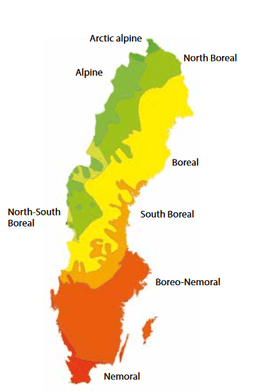
It is quite clear from the above map that the Boreal forests are the most common in Sweden followed by the Nemoral and a combination of Boreo-Nemoral forests which lies in the Southern region of Sweden. During 18th and 19th century, forest reserves were extensively utilized to satisfy numerous socio-economic needs. This excessive reliance created an acute shortage and as a counter measure, the then administration introduced the First Forestry Act of Sweden in 1903 which made it compulsory to replant saplings in the areas where harvestation has taken place. The forestry act of Sweden has been updated several times since then. It is important to mention here that the forest reserves in Sweden has observed a positive growth during last 50 – 60 years. Over 80 million metric cube of bark has been harvested in Sweden since 1956 – 2010. On the contrary, the volume of bark has increased from 80 million metric cube in 1956 to over 120 million metric cube in 2010.
According to the Swedish National Forest Inventory (NFI), an overall standing volume of bark in Sweden has increased from over 2000 million metric cube in 1955 to over 3000 million metric cube in 2010, respectively. Sweden was the first country in the world to introduce Forest Stewardship Council (FSC) in 1998 and all the major forestry stakeholders took an immediate step to implement it on priority basis. A total of 400 million seedlings are planted each year in Sweden to promote reforestation. Forest is spread over an area of 28 million hectares in Sweden out of which 2 million hectares is dedicated to promote biodiversity and conservation efforts.
Forests offer numerous ecological services to masses including hunting, outdoor activities, reindeer herding and employment in general. In addition, forests are an effective tool to mitigate climate change as a research from Mid Sweden University highlights that a building with timber frame absorbed more than 150 tonnes of carbon dioxide over a span of 100 years. On the contrary, a building with a concrete frame emitted 96 tonnes of carbon dioxide during the same time period. From a critical perspective, it would be appropriate to prioritize the construction of buildings with wood frames or otherwise optimize the use of wood in the buildings with concrete frame to reduce its carbon footprints. It will be a major step in reducing carbon footprint in the construction sector. It is equally important to mention here that the Swedish economy is more carbon efficient than most of the highly developed economies in the world today.
Summing it all, Sweden is the third largest producer of forest related products in the world. Sustainable Management of forest has not only enabled Sweden to earn a fat revenue on annual basis but has also doubled the area covered with forest during the last 100 years. This reflects successful strategy measures taken by the numerous Governments over the course of decades to ensure a sustainable management of forests in Sweden.
© Copyright 2017 - 2018 Ayoub Hameedi. All rights reserved.
Sustainable Forest Management In Finland
Ayoub Hameedi
The primary aim of this report is to examine the sustainable forest management practices in Finland. The goal of Finnish strategy is to obtain high quality timber without damaging the biodiversity and natural growth cycle of native trees. An area equivalent to 120,000 hectares is reforested on annual basis in Finland. Trees are harvested through a strategy refer to as Nordic cut to length system (CTL) where logs are cut to an appropriate predetermined length according to their future use and the remaining in the form of branches and crowns are left in forest. Finland is the most densely forested country in Europe as almost 78% of its total land area is cover with trees. Moreover, forest related industry generates an annual turnover of €20 billion and almost 65,000 masses are employed in this sector.
A total of 60% of forests in Finland is owned by ordinary citizens whereas, the remaining 40% is owned by government, industries and municipalities. Personal ownership of forests has an important role to play when it comes to timber harvestation in Finland as almost 80% of the wood is obtained from privately owned entities. From an individual household perspective, ownership of a forest is quite often perceived as an asset to earn revenue. Forest sector represents 4% of the overall Gross Domestic Product (GDP) and produces almost 20% of the overall exports for Finland. A dense forest cover acts as a carbon reserve for Finland and facilitate the administration in neutralizing 40% of the total industrial emission of carbon dioxide on annual basis.
Sustainable management of forest sector in Finland is certainly a case study to examine, when it comes to earning revenue in terms of production of wood and seeking benefit from ecosystem services in the form of reducing carbon dioxide emissions. An ample forest cover in any geographical area is the best strategy to mitigate climate change. For sustainable production of wood, it is important to replant the harvested area with an equal number of saplings to sustain a healthy forest cover. An effective strategy could be to plant native species as they are most adaptive to local conditions and thus grow better in comparison to other species of trees. Another approach could be to select a particular area to harvest timber in a sustainable manner. The basic idea is to harvest 5% of that particular area each year and to replant it with an equal number of saplings. If the same procedure is repeated for 20 years in a row, 100% of the selected area would be harvested and reforested in a sustainable manner. Once the sustainable harvestation cycle is completed, the area that was reforested during the first year would be ready for reharvestation and so on. However, an important point to consider is to have an effective monitoring system in place to ensure that 90% of planted saplings would transform into mature trees. There is also a dire need to have an effective check and balance system to prevent illegal logging. Finally, the given recommendation is a suggestion and it can completely or partially vary during the implementation phase.
© Copyright 2017 - 2018 Ayoub Hameedi. All rights reserved.
 Project GE