
Solar Energy
_____________________________________________________
Svea Solar: A cleantech start-up that is paving the way forward for solar pv in Sweden
Ayoub Hameedi
Sweden can be considered as a champion when it comes to renewable electricity production in European Union. According to Swedish Energy Agency, Sweden generated almost 59% of its total electricity from clean sources of power production namely hydropower, wind power, biopower and solar pv in year 2019. However, if we would look beyond the obvious, hydropower had the lion’s share of power generation among all the clean sources, followed by wind power and biopower. On the contrary, solar pv played the least role among all the clean sources. We need to reverse this trend in Sweden and we need to create an environment where solar pv would play its much needed role when it comes to phasing out nuclear power from the energy landscape in Sweden. Yes, it is absolutely possible for us. A solar photovoltaic power potential map of Sweden is given below:

© 2020 The World Bank, Source: Global Solar Atlas 2.0, Solar resource data: Solargis.
We can clearly see from the map above that from Uppsala down to Malmo, Sweden receives an average of 1022 kWh of solar radiation per meter square. The given PV power potential gets even better in Malmo, Karlskrona, Öland and Gotland that receives roughly between 1095 to 1168 kWh of solar radiation potential. Cleantech Start-ups like Svea Solar has recognized this basic fact and are thus taking the much needed steps in the right direction to increase the share of solar pv in overall electricity generation ability of Sweden. There is a dire need for energy policy makers to prioritize solar pv as a source of electricity generation when it comes to establishing new power plants in Sweden. Unfortunately, solar pv plays a very limited role and we must reverse this trend to achieve our goals outlined in Paris Climate Agreement. It is excellent that the use of windpower as a sustainable sources of electricity production has grown rapidly during last decade and we must replicate the same for solar pv technology in coming decade in Sweden. The below graph from Swedish Energy Agency reflects each source of power production in terms of installed capacity:
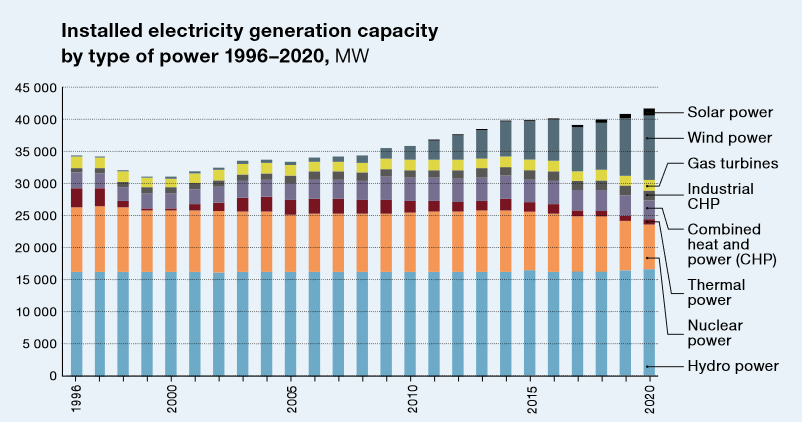
From a policy perspective, if we can install a GW of solar pv in Sweden, we can also install 5 GWs of solar pv as well. As per a research conducted by Sigrid Kamp, almost 319 square kilometers of roof top surface area can be used to install solar pv panels in Sweden. If all of this area is utilized Sweden can easily have almost 48 GWs of installed solar pv capacity. Even if 10% of this available roof top surface area is utilized for solar pv installation, Sweden can easily have 5 GWs of solar pv as an installed capacity and with right choices in the right direction, we can actually get it done in the coming five years. Yes it is absolutely true.
Svea Solar has recognized this basic fact and are thus taking the much needed steps to increase the share of solar pv in overall electricity mix in Sweden. Svea Solar was founded by Erik Martinson and Björn Lind in 2013/2014 to expedite the use of solar pv technology in Sweden. Sustainability is a key element of Svea Solar’s business ideology and they believe in working together when it comes to fixing the planet and mitigating climate change. In 2016, Svea Solar was already amongst the leading solar pv installer in Sweden and by 2019, it received the award of fastest growing start-up in the country. In 2020, Svea Solar already had its physical presence beyond the borders of Sweden and in Germany, Spain, Netherlands and Belgium. When it comes to solar pv panels as a product, Svea solar offers solutions for residential areas, agriculture sector, housing cooperatives and Businesses in general. Svea solar also offers climate smart solution in the form of solar parks too. Komatsu solar park, Solinavium solar park and Sparbanken Skåne are 3 examples in this regard.
Svea solar offers solar pv panels in four different types beginning with “Essential” that is the most cost effective type of solar pv panels. These panels are monocrystalline panels with dark cells and can help a household in saving roughly 11,500 sek each year. Next is “Design” where a high priority is given to efficiency and design of the solar pv panels. These are all black in appearance and thus can perfectly blend into your roof. Solar panels under the category of design can help a household to save roughly 11,200 sek on yearly basis. “Pro” is another type of solar pv panels. As per the Svea Solar, these are the most efficient solar pv panels available in the market today. These have extra robust cell technology, are sustainably certified and can help a household to save up to 11,000 sek on annual basis. The final type is “Power Roof” where solar panels are the part of the roof. These are quite solid and durable and can facilitate a household in saving 7800 sek in savings on annual basis. It is important to mention here that Svea Solar takes full responsibility of installation of solar pv panels and their maintenance once they are up and running. Other than the solar pv panels, it also offers a solution that can help you in charging your electric vehicles with ease.
All in all, cleantech companies like Svea Solar are playing an extremely important role when it comes to enabling sustainable transition to clean sources of electricity production. Solar pv technology has the potential to act as an Achilles in our fight against climate change. Sunlight is one of the most abundant natural resource we have and with an installation of solar pv panels on roof tops with suitable potential, we can actually turn our roofs into engines of power production. Keeping solar pv power potential map in mind, we can say that Sweden has the much needed solar pv potential in place and its about time that we would use that potential to produce clean electricity and to phase nuclear power out from the energy landscape in Sweden. It is our responsibility to give our coming generations a future free from nuclear power plants and its waste.
© Copyright 2022 Ayoub Hameedi. All rights reserved.
An installation of floating solar power plants in hydropower dams is an extremely realistic idea for Sweden
Ayoub Hameedi
Sweden has constructed a large number surface water storage infrastructure to sustainably manage its available water on year round basis. It is important to mention here that Sweden has 10,000 dams to store available surface water to reduce the threat of flooding, foster agriculture productivity and economic growth regardless of the time and season of the year. Apart from the constructed dams, Sweden has 100,000 lakes and the total length of rivers in the country is roughly 60,000 km. All of the already spoken figures about dams, lakes and length of the Swedish rivers represent an untapped opportunity, which if managed sustainably can reduce the water lost through evaporation, foster the clean electricity generation through solar pv panels and save precious land that could then be used to construct homes and to grow food. The idea is pretty simple and is in implementation form in countries across the globe. The national government in Sweden can install floating solar pv plants in reservoirs of dams and in lakes. Solar pv panels can also be installed on rivers across the length and breadth of the country. It is vital to point out that the available water beneath a floating solar pv platform keeps the panels cool and thus allow them to produce more electricity than an average land based solar pv power plant.
Japan serves as an excellent example for Sweden when it comes to floating solar pv plants and how can we manage them sustainably with the dams. Yamakura Dam in Chiba prefecture can become a case study to explore the possibility of turning hydropower plants into hybrid power stations with the ability to produce electricity both from the available water and solar radiation. The floating solar pv plant installed in Yamakura dam is the biggest floating installation in Japan and it spans over an area of 18 hectares. It provides electricity to 5000 homes in Japan and offset around 8,000 tonnes of carbon dioxide on yearly basis. Yamakura solar power plant has a cumulative installed solar pv capacity of 13.7 MWs or 13700 KWs. Japan is not the only country in the world that is aiming for floating solar pv infrastructure. United Kingdom has similar ambitious plans for Queen Elizabeth II reservoir and for another reservoir close to Manchester. China and South Korea are also planning similar projects to turn hydro power plants into hybrid ones with the ability to harness the potential of both water and sun. Imagine, if each of the constructed dam in Sweden would host a floating solar photovoltaic power plant of 1 MW in capacity, it can raise the cumulative installed solar pv capacity to another 10 GWs. If we would be ambitious enough to install 2 MWs of floating solar pv power plant in each of the 10,000 constructed dams, we can easily add another 20 GWs of installed solar pv capacity in Sweden.
Summing up all, an installation of 1 MW of floating solar photovoltaic power plant in each of the 10,000 constructed dams in Sweden is a very realistic idea. This rapid expansion of solar pv will certainly help the Swedish Government to reduce its reliance on nuclear power for the sake of electricity production. Moreover, a rapid growth in solar pv sector will also be a giant leap towards a future where the transport sector would be completely powered by 100% clean electricity. If Japan, United Kingdom, China and South Korea can make it happen, Sweden can get it done as well provided enough resources are invested in this direction.
© Copyright 2020 Ayoub Hameedi. All rights reserved.
How Sweden Can Achieve A Realistic Goal Of 1 GW Of Installed Solar Photovoltaic (PV) Capacity By 2020
Ayoub Hameedi
Solar photovoltaics (pv) is the least utilized source of power production in Sweden. The total installed capacity of solar pv was 205.5 MWs in 2016 out of which 192.9 MWs was grid connected while the rest was off-grid. In comparison, the neighboring country of Denmark had an installed solar pv capacity of 851 MWs in 2016, respectively. So, there is a dire need that Sweden should increase its install solar pv capacity to enhance its share in the overall energy mix. Sweden can plan to upscale installed solar pv capacity to 1 GW by 2020. It will facilitate Swedish Energy Agency to diversify its clean sources of power production and to reduce its unsustainable reliance on nuclear power. The realization of 1 GW of solar pv by 2020 would require dedicated investment of time, physical energy and financial resources however, is completely realistic and achievable. With an increase in the installed solar pv capacity in Sweden, the Government will certainly take another step in the right direction to create a safe society that would be socially equitable, financially viable and ecologically sustainable for everyone. It is understandable that up-scaling installed solar pv capacity won’t happen over night and would require patience from every stakeholder involved.
A question that might arise now is What can be done to achieve this goal within stipulated period of time. The first and foremost point to consider is the price competitiveness (i.e. highest efficiency with a reasonable price tag) of solar photovoltaic panels to be installed in areas across Sweden. It would allow the government to produce more clean power from the installed physical infrastructure. From a critical point of view, it would be convenient to contact companies that have supplied the most of Solar PV to countries across the globe. A list of companies with the lion’s share of solar pv supply in FY 2016 to countries across the globe is available on this link. Jinko Solar, a Chinese company has topped the list when it comes to the supply of solar panels is one such example in this regard. From the point of view of Sustainability, it would be a win-win situation for Government to invest money in solar photovoltaic panels for clean power production. According to the figures of National Renewable Energy Laboratory (NREL), solar PV consumes least amount of water for power generation when compared with conventional and other clean sources of power production. It is only wind power that practically requires no water to produce electricity. Solar pv technology also helps in reducing greenhouse gases emission and nuclear waste by shrinking reliance on fossil fuels & nuclear power. It produces bare minimum waste to deal with at the end of its life cycle as 98% of the materials from solar pv panels can be recycled through the application of thermal and mechanical approaches. In terms of numbers, 19.6 kilograms of materials can be extracted from a module of 20 kilograms that could than be re-utilized for reproduction of solar panels. From a financial perspective, the price of solar pv modules has decreased 80% when compared with the prices of 2009. The price of solar pv modules is expected to shrink another 59% by 2025 when compared to what prices were in 2015.
According to a report from Swedish Energy Agency, the muncipalities of Linköping, Stockholm and Varberg installed the most solar pv capacity in 2016. So, these municipalities can certainly act as a case study for the rest of municipalities to upscale solar pv technology in Sweden. It is interesting to mention here that over 80% of the solar pv panels installed in Sweden in 2010 were imported from China. However in 2013, European Union (EU) introduced a measure “minimum import price” which ensured that no silicon solar cell should be imported in EU at a price lower than 0.56 € per watt produced (i.e. SEK 5.2 per watt produced). This measure sharply reduced the share of solar pv panels from China from 73.9% in 2013 to 36.4% in 2016, respectively. Besides China, Sweden also imports solar panels from Singapore, Taiwan, Vietnam, Thailand, South Korea, Japan, Germany, Poland and other countries. From a policy implementation point of view, the government can also seek guidance from Germany that installed 1.75 GWs of solar pv capacity in year 2017 and had a collective installed solar pv capacity of around 43 GWs by the end of 2017.
Finally, if one would start counting from April 2018 till December 2020, there are 33 months left in which Government can sustainably plan to install 809 MWs of solar pv to push the total install solar pv capacity beyond the milestone of 1 GW. An installation of 25 MWs each month will certainly help the Government to reach the aforementioned goal by December 2020. The presented suggestion can easily be implemented under the umbrella of “New Climate Act” and thus provide the government a window to increase sustainability in the sector of power production in Sweden. It is important to mention here that 1 GW of solar pv by 2020 is both realistic and achievable provided proper financial resources and technical expertise are channelized in this direction. Lastly, even if half of the proposed target would be achieved by December 2020, it will still open numerous window of opportunities including creation of jobs within solar energy technology in Sweden.
© Copyright 2018 Ayoub Hameedi. All rights reserved.
Denmark On Its Pursuit To Increase The Share of Solar Energy
Ayoub Hameedi
Denmark is a Scandinavian country that lies in the Northern Europe. It is famous for wind power especially when it comes to harvesting the available off-shore wind power potential. Denmark was the first country in the world to install a wind farm at an offshore location for the sake of clean power production. There is a saying that scarcity of a particular resource pushes policy makers to the limit of their thinking and thus forces them to think out of the box. So was the case with Danish policy makers during the oil crisis of 1970 – 1973 that forced the policy makers to explore alternate source of power production. Since, the availability of land was bit limited so the only option was to develop technology to harvest the offshore wind power potential for Denmark. With appropriate channelization of human and financial resources and time, Danes developed and installed world’s first offshore wind farm “Vindeby” with an installed capacity of 5 MWs in 1991. So once a dream was now a new reality for Denmark. The country then gradually increased the share of wind power from 2% in 1991 to 43.4% in 2017 and now has an ambitious plan to generate 100% of its electricity through renewable resources by 2050. For the coming 8 years, the aim is to produce 26 terrawatt hours of clean power through onshore, nearshore and offshore types of wind power. The aforementioned figure will correspond to 63% of the total consumption in Denmark. The need of hour is to diversify the sources of clean power production by deploying all of the available source of clean power production. To diversify sources besides wind power, the Government of Denmark is gradually increasing the share of solar power in its overall energy mix. Thus, the policy makers in Denmark are moving in the right direction one step at a time.
The installed solar photovoltaic capacity in Denmark was 779 MWs in 2015. Another 72 MWs was added that raised the total installed solar power figure to 851 MWs by the end of 2016. It must be appreciated that Denmark is optimizing the use of solar energy besides wind power to achieve its target to produce 100% of its electricity demand through clean sources by 2050. A map of Denmark reflecting average solar potential from 1994 to 2016 is as follows:

The total installed electricity generation capacity in Denmark was slightly over 12.5 GWs at the end of 2016 and the share of solar pv was around 6.8% with an installed capacity of 851 MWs, respectively. With strategic thinking and proper planning, solar energy can help Denmark to reduce its reliance on natural gas, coal and oil. The country had an installed natural gas capacity of 2,148 MWs in 2016 followed by 685 MWs of installed capacity of oil and 1,604 MWs of installed capacity of coal at the end of 2016. It must be appreciated that the use of fossil fuels have decreased in Denmark in the last few years. The sharpest decline of 615 MWs took place in the use of coal as its installed capacity decreased from 2,219 MWs in 2015 to 1,604 MWs in 2016. The use of natural gas decreased from 2,153 MWs in 2015 to 2,148 MWs in 2016, respectively. The observed decrease in coal and natural gas installed capacity points out that the Danish energy administration is taking right steps to achieve the goals underlined via Paris Climate Agreement. Denmark signed that Paris Climate Accord on 22nd April 2016 and it came into force on 1st December 2016. As per the accord, the country is required to take actions to limit the temperature rise to 1.5 degree Celsius. A key way to achieve this goal is to reduce the greenhouse gas emissions. As an implementation of Paris Climate Accord, the Danish Government plans to reduce its greenhouse gases emission by 20% till 2020 and to produce 100% clean electricity by 2050. Decommissioning of 0.62 GWs of installed coal power in Denmark in the past year certainly testify that the country is moving in the right direction. As spoken earlier, the policy makers plan to optimize the wind power to produce 26 terrawatt hours by 2026 that would account for 63% of total electricity consumption in Denmark. Likewise, policy makers can also plan to optimize the share of solar energy to a corresponding level where solar pv will generate 7% of the electricity demand by 2026. So collectively, both solar and wind would satisfy 70% (63% from wind power & 7% for solar pv) of electricity demand for Denmark by 2026.
Besides being the dirtiest of all, coal is also the most water intensive source of power production. By optimizing the share of solar energy, the greenhouse gas emissions will be minimized and water consumption will be reduced too. So from the lens of sustainability, it will be a complete resource efficient bargain for Denmark. From a business point of view, investing money to expand solar photovoltaic might be the right thing to do due to several reasons. First and foremost is the sharp decrease in the price that makes it more competitive in comparison to other clean sources of power production. It is important to mention here that the price of solar photovoltaic modules has decreased 80% since 2009. Secondly, scarcity of land forced the Danes to explore offshore wind power potential in early 1990s and so would be the case again for solar pv. However, the problem can be resolved if every available rooftop in Denmark is considered as a valuable resource to install solar photovoltaic modules to generate electricity through solar energy. By doing so, Denmark might be able to reduce its reliance on fossil fuels to a point where coal, natural gas and oil will either be completely eliminated from the landscape of power production or might play an insignificant role. The proposed solution might seems to be bit ambitious in nature but is realistic and achievable. Solar radiation map of Denmark shows that the right side of the geographical territory has an appropriate potential to deploy solar pv to reduce reliance on fossil fuels. The installed solar pv in Denmark satisfied around 2.5% of the total electricity demand in 2015. The country plans to install another 20 – 35 MWs of solar pv in 2018 and to further expand installed solar pv beyond 1 Gigawatt (GW) in the coming years.
Decreasing cost of solar photovoltaic panels and a dire need to reduce reliance on fossil fuels particularly on coal that is the dirtiest source among all points out the fact that the country needs to optimize the use of solar pv modules. A bullish approach to solar pv will certainly reduce Denmark’s reliance on fossil fuels. As the reliance will be reduced it will directly minimize the greenhouse gas emissions too. Finally, the installation of solar pv modules on every available roof top in Denmark might give Danes a level of achievement / happiness that they are contributing positively to protect the environment. Denmark has made history in past with Vindeby offshore wind farm and can do the same again with the installation of solar pv modules on every available rooftop in the country. For convenience, Denmark can consider the case study of China that has installed 20 GWs of solar pv in 2017 and invested an overall sum of USD 132.5 billion to upscale the use of clean energy technologies to reduce its reliance on coal and other fossil fuel based sources of power production.
© Copyright 2018 Ayoub Hameedi. All rights reserved.
A Gradual Expansion of Solar Energy Technology in Sweden
Ayoub Hameedi
Solar photovoltaics is one of the least deployed sources of green electricity generation in Sweden. The installed capacities of other sources of clean electricity generation are comparatively high. According to World Energy Council (WEC), the installed capacity of solar photovoltaics was 85 MWs in year 2016. In comparison, hydropower had an installed capacity of 16.2 GWs, followed by wind power with an installed capacity of 6.03 GWs and finally geothermal with an installed capacity of 5.6 GWs respectively. These figures represent a strong gap when it comes to prioritization of different renewable energy technologies in Sweden.
A graph reflecting an overall installed solar photovoltaic capacity in Sweden is as follows:
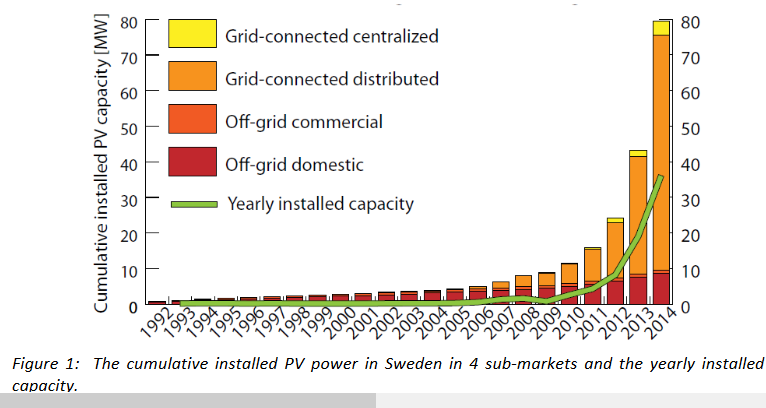
The above-mentioned graph with a gradual upward trend reflects the development of SPV from 1992 to 2014. In 2013, a total of 19.1 MWs of solar photovoltaic (PV) were installed in Sweden. Likewise, a total of 36.2 MWs of solar pv were installed in the next year. So, a total of 55.3 MWs of solar photovoltaic capacity was installed in Sweden during 2013 & 2014. The domestic production of solar photovoltaic modules in Sweden is 34 MWs whereas, the domestic consumption is only 2 MWs. As a result, the remaining domestic production of 32 MWs is normally exported to other countries. On the other hand, the domestic requirement for solar PV modules is satisfied through imports from Germany and China. The price of solar photovoltaic module has declined sharply in Sweden during last 12 years. A table reflecting the same is as follows:

It can be seen that the module price has decreased sharply from 70 SEK per watt in year 2003 to 8.15 SEK per watt in year 2014. As a result, it can be concluded that the price of a typical module has dropped 61.85 SEK per watt during last 12 years. This sharp decrease in the price of photovoltaic modules in Swedish domestic market is directly related to the decline in the price in international market. A solar radiation map of Sweden is as follows:
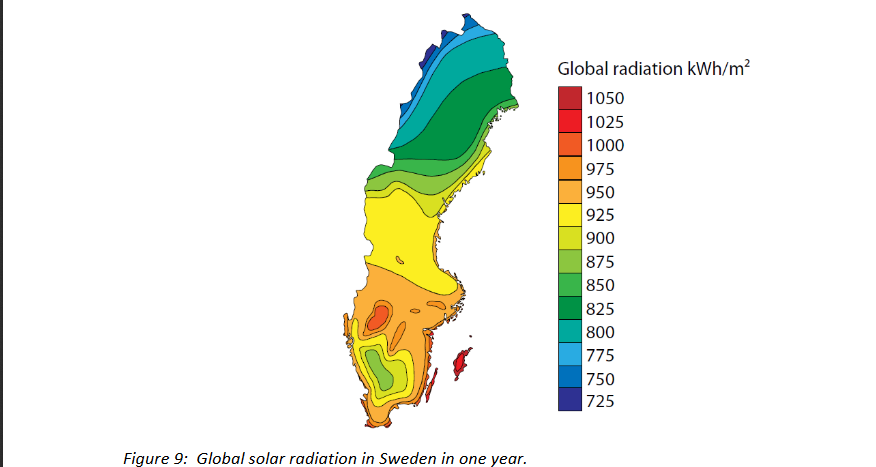
From the solar radiation map above, it is clear that the southern region of Sweden is most suitable for the installation of solar photovoltaic modules as it receives around 950 KWh of solar radiation per meter square of geographical area. Central region of Sweden is also appropriate as it receives around 925 KWh of solar radiation per meter square. Islands of Gotland and Öland are the most suitable ones as they receive around 1025 to 1050 KWh of solar radiation per meter square. As per a report published by Sustainable Energy Authority of Ireland “19th century was the age of coal, 20th century was the age of oil and 21st century is certainly the age of solar technology“. Therefore, a solar-friendly energy policy in place will reduce reliance on nuclear technology, which makes up 41% of total electricity production in Sweden. A question which arises at this point is: What could be done to achieve this target? An answer based on policy recommendation is as follows:
Local governing body of each municipality can encourage residents to install grid-independent / grid dependent solar photovoltaic systems on roof-tops to satisfy individual household requirements. Municipalities can give residents an option to opt for a long-term lease of 25 years in this regard. Roof-tops of all municipal buildings in Southern region provides an ample area, which could be utilized for the sake of clean electricity production through solar photovoltaics. Municipalities can also chose to install solar trees which are not only attractive in appearance but are also a stable source of electricity supply on a micro level. All in all, these steps might appear small in magnitude but if implemented on a large scale, can encourage masses and business sectors to opt for solar energy technology (SET) in Sweden.
© Copyright 2017 - 2022 Ayoub Hameedi. All rights reserved.
 Project GE