
Wind Power
————————————————————————————————–
Sea Twirl: A cleantech company breaking the barriers in offshore areas
Ayoub Hameedi
An exponential growth in population and climate change are no doubt two most serious problems of this century. An estimated global population figure is already over 7 billion and we are expected to be 9 billion by the mid of this century. A rapid increase in human population is directly proportional to space needed for housing and agricultural activities so that everyone would have a decent place to live and an ample food on the plate to survive. We need to do all this with the limited land resource we have at our disposal. On one side our population and its subsequent needs will rise sharply in the coming decades. On the other hand, land as an available resource would remain constant. On top of more space needed for housing and food production, we will have to produce even more electricity so that more and more people would be able to use their time productively once the sun goes down. All of these challenges require us to think out of the box and to make unconventional choices that would free up more and more land that could then be used more effectively. One such option is to use the offshore areas for electricity generation with the help of windpower. This is what this short report is all about.
SEATWIRL is Swedish cleantech company that is adopting an unconventional approach to harness the windpower potential of our offshore areas. In 2015, Sea Twirl designed and deployed a vertical axis wind turbine “S1” with 30 kw capacity in the coastal area of Lysekil to test if it could sustain the harsh conditions of marine environment. It turned out that S1 could easily withstand the storms. Most importantly, S1 had stayed connected to grid since its deployment. As per the Sea Twirl, S1 has a very simple design with least moving parts that enables the turbine to be more productive than the conventional wind turbines. Due to less number of moving parts, the installed turbine is less prone to parts breaking down that would otherwise halt the functioning of a wind turbine. An important feature when it comes to S1 is that its maintenance is quite simple since all the major components lies very close to the sea level. Moreover, several S1’s can be installed close to each other to maximize the production of electricity from vertical axis wind turbines in the offshore areas.
The above video is an intellectual property of Sea Twirl.
As we all know, price plays a critical role when it comes to acceptance of a new technology or otherwise. Keeping that in mind, Sea Twirl has made sure that the manufacturing cost of floating vertical axis wind turbines would remain low. On top of lower manufacturing cost, the operational cost of Sea Twirl wind turbine is also low since it requires less maintenance. When compared with conventional horizontal axis wind turbines in offshore areas, Sea Twirl’s wind turbines can be installed at depths greater than 50 – 60 meters. Thus, Sea Twirls vertical axis wind turbines are able to harness winds in offshore areas with high potential and more certainty. A combination of factors like lower production cost, lower operational cost and an installation at greater depths makes Sea Twirl’s vertical axis wind turbines a possible game changer when it comes to clean electricity generation from offshore areas. Sea Twirl is currently working on the production of S2x vertical axis wind turbine with a capacity of 1MW respectively. The S2X will be ready for the sake of installation in 2023 and could be installed at a depth of 100 meters and above.
Summing up all, in the coming decades our seas and oceans will play an even greater of a role when it comes to clean electricity generation to reduce our reliance on fossil fuels and nuclear power. Thus there is dire need to develop technological solutions that could be installed at greater depths in offshore areas. Most importantly the production and operational cost of such solutions should be competitive to the conventional solutions available in market today. Sea Twirl is developing floating vertical axis wind turbines that are satisfying all of the already spoken 3 criteria’s and can thus prove to an innovative solution to fight climate change.
© Copyright 2022 Ayoub Hameedi. All rights reserved.
A Brief Overview of Offshore Wind Power Potential in Denmark
Ayoub Hameedi
Denmark generated 43.4% of its consumed electricity through wind turbines and thus made a new record by surpassing its previous highest figure of 42% by 1.4%. It is interesting to mention here that the number of installed wind turbines peaked in 2001 in Denmark and today the country has 20% less installed wind turbines. It points out that Denmark has certainly made remarkable progress in the sector of wind power. The administration in Denmark has replaced former turbines with smaller output capacity with larger turbines that are capable to produce more power. As a result, the number of wind turbines in Denmark has decreased considerably whereas, the percentage of generated electricity has increased exponentially. Denmark is certainly a country which has turned the 1973 oil crisis into a series of opportunities for its economy. It was basically the 1973 oil crisis which forced the administration to explore clean sources of power production. The country installed its first wind turbine in 1979 and kept on developing and improving wind energy technology. In 2015, the sector of wind power earned an overall turnover of DKK 88 billion where the share from exports related to wind energy technology was DKK 48 billion.
There exist a gulf between the installed onshore and offshore wind power capacities in Denmark for example in 2016, the installed onshore capacity was 3954 MWs whereas, the installed offshore capacity was 1271 MWs, respectively. The country which is quite often referred to as cradle of wind power needs to close this gap, if it plans to achieve its goal of 50% of power production through wind turbines by 2020. Danish Energy Agency plans to upscale installed offshore wind power to 1,450 MWs before 2020. To transform this designed strategy into reality, the Danish Energy Agency asked for a preliminary tender of 400 MWs for Horns Rev 3 in North Sea in 2014, followed by another preliminary tender of a 600 MWs for Kriegers Flak in Baltic Sea. During the same time period, the government asked for another preliminary tender of 450 MWs for nearshore areas along the coast of Denmark.
As per a report published by Danish Energy Agency, majority of the wind turbines installed in the country since 1995 are collectively owned by individuals, power companies and commercial wind power companies. This factor has resulted in the quick acceptance of wind turbines by citizens of Denmark. The shortage of land forced Denmark to seek opportunities in offshore areas. The country installed its first offshore wind farm “Vindeby” in 1991 with an installed capacity of 5 MWs and a total of 11 wind turbines. However, after providing its services for 25 years, Vindeby offshore wind farm was decommissioned in 2017. It is important to mention here that Vindeby was the world’s first off-shore wind farm and it transformed Danish dream to utilize off-shore areas for power production into reality. Today, 90% of the installed wind turbines in off-shore areas across the globe are either produced by Denmark or their components have been made in Denmark.
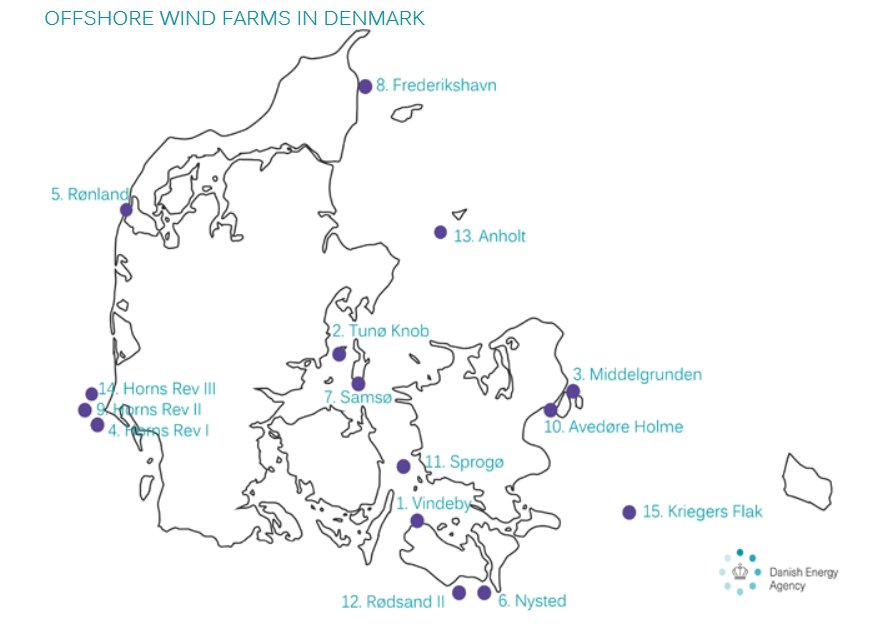
The country has a total of 12 offshore wind farms in operation with a range of a minimum installed capacity of 5 MWs in Tuno Knob which was commissioned in 1995 and has 10 wind turbines to a maximum of 400 MWs in Anholt offshore wind farm which was commissioned in 2012 and has 111 wind turbines, respectively. There are an additional 3 offshore wind farms in-construction phase namely nearshore projects which are expected to be commissioned in 2019, followed by the expected commissioning of Horns Rev 3 in 2020. Kriegers Flak will go online in 2021. Once online, Horns Rev 3 will receive a feed-in-tarrif of 0.77 DKK / Kwhs for the first 50,000 full load hours. Likewise, Kriegers Flak will also receive a feed-in-tarrif of 0.372 DKK / kwhs for the first 50,000 full load hours, followed by nearshore projects with a feed-in-tariff of 0.475 DKK / kwhs. The aforementioned 50,000 full load hours resembles approximately 10 – 12 years of operational span for each project.
Once in operational phase, Kriegers Flak offshore farm will have the highest installed capacity followed by the Horns Rev 3 with the second highest installed capacity. It is quite clear that Danish expertise in offshore wind power from an individual project will increase significantly from 5 MWs in 1991 (Vindeby farm) to 600 MWs in 2021 (Kriegers Flak). A Danish map reflecting all of the offshore wind farms in-operational & in construction phase is as follow (Source: Danish Energy Agency):
Another map reflecting the available offshore wind power potential in both North & Baltic seas around Denmark is as follows (Source: Danish Energy Agency):
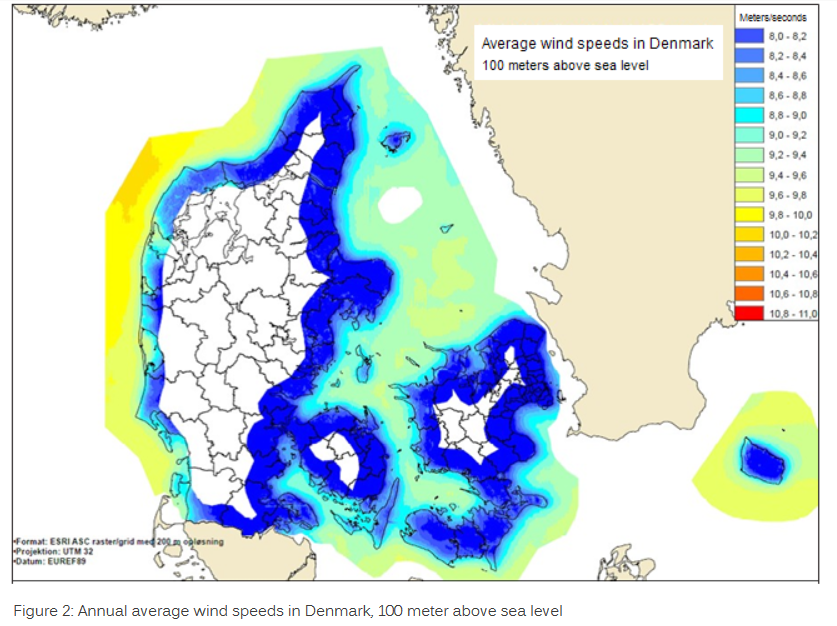
It is clear from the above map that Denmark is extremely blessed when it comes to offshore wind energy potential in both North & Baltic Seas. It must be appreciated that the previous and current Governments in Denmark have utilized the offshore wind potential in Baltic sea to its fullest. On the contrary, there are only 4 off-shore wind farms in North sea (including Horns Rev 3 that will go online in 2020). The Government of Denmark can further utilize the available offshore wind potential in North sea where the average wind speed is between 9 – 10 meters per second at 100 meters above the sea level. Larger turbines, energy efficiency in industry and energy efficient appliances in households might possibly help Denmark to achieve it’s target of 100% clean energy production.
As spoken earlier, the 1973 oil crises forced Denmark to explore clean sources of power production and thus it started conducting research on the development of wind power to reduce its reliance on fossil fuel. Later on, the scarcity of land forced the then Government of Denmark to explore offshore wind potential for the sake of turbines installation and power production. Denmark achieved both milestones and created a history. It reflects a perfect story where an adversity was transformed into a brief window of opportunity. The sector of wind power now generates 5% of total exports for Denmark and earns an annual revenue of over DKK 80 billion. The country serves as a case study and provides a beacon of hope when it comes to promoting clean sources of power production and subsequently increasing the share of clean energy in the overall energy mix.
© Copyright 2018 Ayoub Hameedi. All rights reserved.
The Development of Wind Energy Technology In Denmark
Ayoub Hameedi
Kingdom of Denmark is a Nordic country with over 400 named islands. The largest island among all is Zealand where Copenhagen is located. Only 72 islands among all are inhabited by masses. Denmark has a total geographical area of 43,094 square kilometers and shares a border with Germany in South. Both Sweden and Norway lies in north across the Baltic sea whereas, United Kingdom is located on the west side across North sea. In the direction of east, lies Bornholm which is an island controlled and administered by Denmark. The Kingdom of Denmark is further comprised of the territories of Faroe Islands and Greenland however, it is only responsible for defense and foreign policy when it comes to these two geographical territories. It played a significant role in shaping the history of Nordic region from 1397 with the formation of Kalmar Union to 1521 with an uprising in Sweden which also brought an end to the treaty (Source: Governing and Governance in Sweden, 2011).
The oil crises of 1973 forced Denmark to explore renewable resources to reduce its reliance on fossil fuels which were normally imported from Middle East. After years of research and development, Vestas installed its first wind turbine with an output capacity of 30KW in 1979. It is important to mention here that Vestas initially started as a blacksmith shop in 1898 in Western Denmark. The installation of a wind turbine marked the beginning of a new industrial sector which later transformed into a multi-billion kroner industry in Denmark. Wind power industry earned an overall turnover of DKK 84.4 billion in FY 2014. Exports related to wind industry represents 5% of the overall exports from Denmark. Today, Vestas has developed a wind turbine with an output capacity of 8MWs. The same wind turbine was later upgraded to an output capacity of 9 MWs, respectively. Thus in a span of 38 years, Vestas went from designing and installing a 30 KW wind turbine to a 9 MWs wind turbine. It is important to mention here that a wind turbine with higher output capacity will produce more electricity and thus will reduce the need to install more wind turbines. As a result, less resources would be utilized to generate more electricity.
Denmark is certainly amongst the pioneers when it comes to generation of clean electricity through wind energy technology. A gradual increase of 234 MWs took place in 2015 and another 234 MWs was added in 2016, which took the total installed wind power capacity to 5.227 GWs at the end of 2016. Today, wind turbines satisfy 40% of the Danish electricity requirement and the concerned authorities are planing to generate half of total energy demand from wind turbines by 2020. As per 2012 Energy Act, Denmark will produce 100% of its electricity through clean energy resources by 2050 and a large percentage of that will be generated from wind energy technology. The case study of Denmark clearly reflects that a political crises can prove to be a blessing in disguise provided proper time, financial resources and research are directed to address the issue in a systematic manner. With proper policy making and implementation, Denmark has not only allowed itself to generate clean electricity but has also opened a new window of opportunity to conduct sustainable business and to earn green revenue.
© Copyright 2017 - 2018 Ayoub Hameedi. All rights reserved.
Wind Power As A Sustainable Alternative To Nuclear Energy Technology in Sweden
Ayoub Hameedi
Energy Authority in Sweden relies on diverse resources namely hydro power, nuclear energy technology, other thermal energy and wind power to generate 100% of electricity. The largest share of electricity about 42% is produced from hydro power. Next to hydropower is nuclear energy technology which generates approximately 41% of total electricity. The third largest share of approximately 9% is produced from other thermal energy resources and finally wind power provides the remaining 8% of electricity. So, technically speaking, Sweden has a very low carbon footprint when it comes to the production of electricity however, it is only possible due to an extreme reliance on nuclear power. Through the lens of Sustainability, this trend needs to be reversed and wind power should be given prioritization on nuclear energy technology.
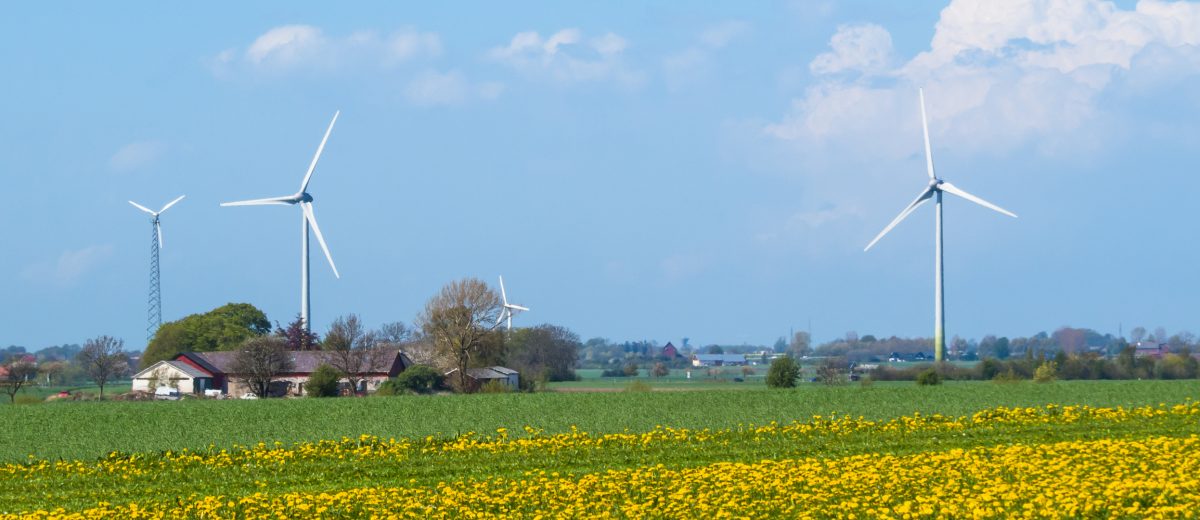
Nuclear power is unsustainable to rely on when it comes to the production of electricity. It’s waste is both expensive and extremely dangerous to deal with. In comparison, wind power is environment friendly, easy to install and operate and finally has an extremely low carbon footprint. In my personal opinion, the installation of wind turbines enhances the attractiveness of nearby natural landscape too. A pictorial evidence of the same can be found below (Source: Google Images)
In 2014, the total installed nuclear power capacity in Sweden was 9,528 MWs whereas, the installed wind power capacity was 5,420 MWs respectively. The installed wind power capacity became 6,000 MWs in 2015. In order to completely decommission all of the nuclear power plants, the energy authority needs to install approximately 10,000 MWs of wind power in Sweden. To achieve this goal, Government can encourage business sector to participate in crowd-funding projects to promote wind energy in Sweden. The energy policy makers can also choose to install wind turbines with larger output capacities or to up-grade existing ones.
The decommissioning of all nuclear power plants will truly set Sweden on the path to Sustainable Development. The expansion of wind energy technology is inversely proportional to financial resources. The higher the installation rate, the lower would be the cost and vice versa. Another important strategy is to decrease the cost of wind turbine through research & development. The most efficient way to execute this, is to consider each part separately and minimize its cost. As a result, the overall cost of a wind turbine would be minimized. By taking all these steps, energy policy makers would be able to replace nuclear power with wind energy technology. Finally, even if 2000 MWs of wind power is installed on annual basis, even then wind power would completely replace nuclear power in five years.
© Copyright 2017 - 2018 Ayoub Hameedi. All rights reserved.
 Project GE